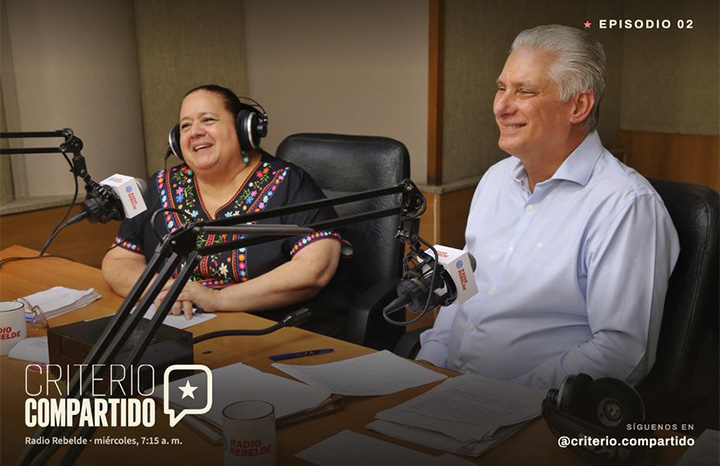
In one of the dimensions addressed today by Miguel Díaz-Canel, First Secretary of the Communist Party of Cuba Central Committee and President of the Republic, during his participation in the second broadcast of the programme «Criterio Compartido», the Cuban president referred to the capacity of neighbourhoods and municipalities to find their own solutions and mobilise the resources existing in each territory.
During the address, which takes place on alternate Wednesdays on Radio Rebelde, Díaz-Canel defended the community as one of the strategic spaces for economic and social transformations, because that is where neighbours, professionals, workers, young people, economic actors and organisations with the capacity to articulate concrete solutions and overcome difficulties come together.
«If we solve problems in the community with everyone’s participation, the municipality is strengthened; if the municipality is strengthened, the province is strengthened; and if the province is strengthened, the country is strengthened,» assessed the head of state.
As part of the exchange, and with a view to highlighting an encouraging example, Pedro Lizardo Garcés, president of the Rampa popular council in the capital municipality of Plaza de la Revolución, also took part. He explained some key points and experiences of the community work carried out in the district, linked mainly to the care of older adults, the collection of rubbish and waste using electric tricycles, and solidarity mobilisation among neighbours.
The Cuban President noted that these experiences do not yet solve all the problems, but they show the capacity of community organisation and popular participation to generate results, even in adverse economic circumstances.
«In the midst of this crisis we can do better things than we did in times of plenty, because crisis also generates citizen creativity,» he added.
During the programme, in addition to collecting new proposals from the public, some of the responses given to citizens who had called from different provinces of the country were explained.
In Holguín, a proposal from an older adult related to community problems and her social situation was attended to by a commission driven by the main provincial authorities.
Similarly, in Ciego de Ávila, Party and provincial Government authorities also took part in following up on the problems raised by Pablo León Aguilar, president of the National Association of the Blind in his municipality, related to the functioning of the structures responsible for attending to people with visual disabilities.
Finally, in Marianao, Guillermo Rodríguez’s complaint about drainage problems was attended to by territorial authorities from Water Resources.
As a result of this public complaint, work orders were issued to clean manholes, carry out unblocking work and repair the affected infrastructure.