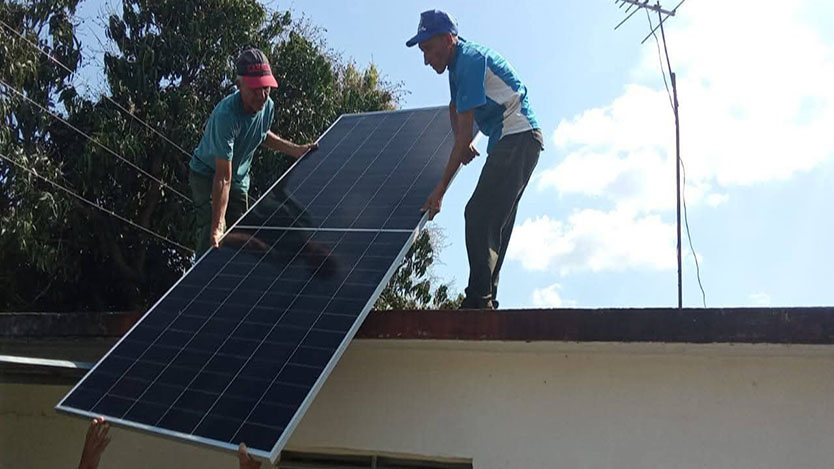
The Health sector in Ciego de Ávila is advancing in the implementation of photovoltaic systems in healthcare units and for frontline workers, within the framework of the national energy sovereignty policy.
When the blackouts arrive, Dr Rosa Victoria Venegas Pérez turns on her EcoFlow, and her neighbours in La Guajira come to charge their mobile phones, their lamps, or whatever they need. Her mother, over 75, watches her soap opera. The doctor even manages to finish the medical report she hadn’t been able to complete at work. A solar panel has suddenly transformed the routine of her closest neighbours — whether we call them the neighbourhood or our fellow human beings. This story has multiple protagonists across all 10 municipalities of Ciego de Ávila.
The Ministry of Public Health granted the province 200 photovoltaic panels as part of the national energy sovereignty programme, a modest figure in relation to the sector’s workforce, but significant as the start of a broader process that has already begun to bear its first fruits.
The arrival of the resources was not improvised. Dr Kesnel Lima Rey, General Director of Health for the province, explains that given the limited quantity available, the sector’s authorities decided to create an integrated provincial commission. «Different spheres participated, including colleagues from the trade union and the Party, to assess and evaluate how the distribution would be carried out,» the director states.
The central criterion was direct connection to patient care. Priority was given to those who, day in, day out, are systematically alongside the sick: personnel from the maternal and child health programme, primary healthcare workers, and staff from both provincial hospitals, as well as officials whose work extends beyond the clinic and reaches into people’s homes.
Account was also taken of professionals who carry out part of their tasks from home, such as the preparation of reports and statistical data that underpin the functioning of the healthcare network.
Individual distribution was only the first chapter. In parallel, the installation of photovoltaic systems in healthcare units across the entire provincial network is advancing: polyclinics, grandparents’ homes, maternity homes and old people’s homes are the main beneficiaries.
Lima Rey confirms that institutional distribution has been completed in all 10 municipalities and that installation work is in full process. In the provincial capital, teams are currently working at the Berky Sotomayor polyclinic.
The projected impact on these centres is twofold: improving the quality of care when the National Energy System fails, and enhancing the quality of life for those who reside in them.
«Generally, when the power went out, residents had no means to continue with their tasks or leisure activities in their spaces,» the director notes, highlighting the human dimension of the measure beyond technical figures.
What the Ministry started, the territory is expanding. Local actors — MSMEs and local development projects — have assumed a complementary role that enriches the policy’s outcomes. In the municipality of Florencia, the old people’s home already has a photovoltaic system donated free of charge through a local initiative.
In the provincial capital, various actors plan to donate and install systems in the five polyclinics of Ciego de Ávila municipality, as well as in the old people’s home and the three maternity homes.
This coordination is particularly valuable because it allows for the lighting of additional facilities that the technical characteristics of the ministerial systems did not fully cover. The synergy between the national plan and the territorial contribution, together, draws a more resilient energy network for Avilanian health.
Dr Rosa Victoria Venegas Pérez, a Family Medicine specialist residing in Ciego de Ávila, needs no statistics to explain what the photovoltaic panel and the EcoFlow have meant in her life. She speaks of her elderly mother, of the soap opera she can now watch without interruptions, of the difference between working with full lighting or by emergency lamp.
But there is something the professional highlights with particular pride: the collective dimension of an individually allocated resource. On the day the National Energy System situation was especially critical in the province, she recounts, her neighbours came to charge their mobile phones and lamps.
«It belongs to me, it was allocated to me, but we are never really functioning for the house as such,» she says, and in that sentence beats the vocation of service that defines those who chose medicine.
The doctor views the programme’s expansion with optimism. She considers that the positive impact will not be limited to the health and education sectors — which have so far been the privileged recipients — but that, as it progresses, it will reach the general population.
Two hundred photovoltaic panels are, in the arithmetic of the national energy deficit, a small number. But in Ciego de Ávila, those two hundred panels have lit up clinics, illuminated old people’s homes, allowed a family doctor to finish her report after the blackout, and enabled her neighbour to charge the phone he uses to speak with his children.
Energy sovereignty, in the Health sector, is built exactly like this: panel by panel, centre by centre, person by person.