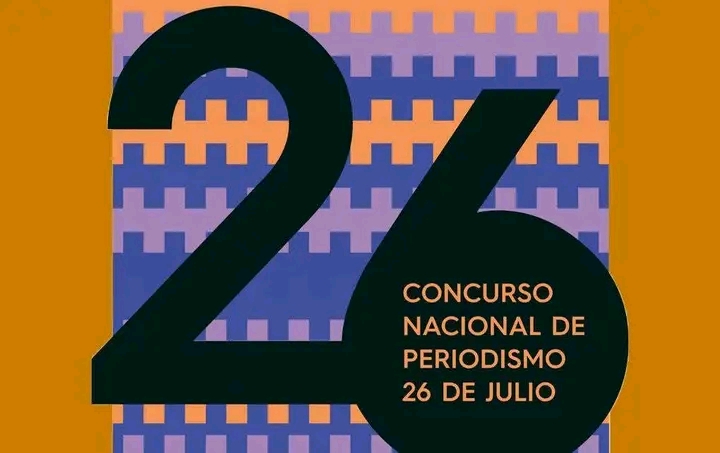
Invasor journalists Claribel Basulto Valdés and Filiberto Pérez Carvajal, together with Yoanne Mursulí Rodríguez, were honoured with awards in this year’s edition of the 26 July National Journalism Contest, according to the results of the competition published yesterday.
Claribel and Filiberto received the award in the Print Press category for their commentary «Tribute with Brushstrokes», while Yoanne was awarded in the Print Press Design category for the infographic entitled «Memorable Moments of Twelve Adverse Months».
The Union of Journalists of Cuba (UPEC) announced the results of the Contest on Thursday during a press conference led by the organisation’s president, Ricardo Ronquillo Bello.
Dedicated to the 73rd anniversary of the Assault on the Moncada Barracks and the 63rd anniversary of UPEC’s founding, the contest served to highlight the value of journalistic work addressing the country’s social and human issues.
The vice-president of UPEC, Juan Carlos Ramírez Heras, specified that nearly 800 works were received from the provinces and national entities. Of the 93 total awards — 44 prizes and 49 mentions — 50 went to national media outlets and 43 to provincial and municipal ones.
At the territorial level, Sancti Spíritus led the winners’ list with nine awards, while Villa Clara, Cienfuegos and Matanzas were also recognised for their results.
At the national press level, Ideas Multimedios stood as the most awarded, with 16 recognitions. Likewise, Casa Editora Abril, Cubavisión Internacional and the Trabajadores newspaper were distinguished as vanguard media in this edition.
Beyond the traditional awards, the jury granted two special prizes. The Special Award for the Centenary of Commander-in-Chief Fidel Castro Ruz went to the series «Here Fidel Passed», by journalist Aroldo García Fombellida, Radio Rebelde correspondent in Holguín. The work is a collection of interviews and testimonies from ordinary people recounting the historical leader’s passage through various points of the national geography.
On the other hand, «The Ghosts of the Sauto», from the Girón newspaper (Matanzas), obtained the Best Podcast Award. Its authors, Gissell Brito García and Beatriz Mendoza Triana, were praised for developing a topic that awakens the listener’s curiosity, the sound resources used — effects and transitions — the naturalness in the presentation and the value of the selected sources.
Bárbara Betancourt, jury president and journalist from Radio Havana Cuba, opened her speech by acknowledging all participants. She described the willingness to compete amidst the difficulties that have forced many press outlets to vary their production routines and turn to social media as being «of enormous value».
The president stressed that, as this is the country’s most important journalism contest, there should be greater support from Grassroots Delegations and media directors to stimulate participation.
«We value the high quality of the entries presented in the Hypermedia category, with a superior command of multimedia language compared to other editions of the contest. The submitted works showed better adherence to public and media agendas and had high human value. In many of these works, the use of transmediality is demonstrated, which was not common in previous editions,» expressed Edda Diz Garcés, José Martí National Journalism Prize winner, member of the Hypermedia Journalism jury.
In the photography section, fellow José Martí National Journalism Prize winner Juvenal Balán Neyra, a jury member, pointed out a fundamental technical aspect: «It is important to emphasise that in the case of our speciality, contestants must send, in addition to the established documentation, the original photos to be judged to have the opportunity to analyse their technical quality.»
Balán Neyra also added that «the most deficient category was photojournalism,» and called for participants to truly master the concepts and objectives of the contest to achieve a more precise focus in future editions.
«What the people demand in the current context is that journalism be closer to the country’s problems, and the greatest strength that could be evidenced in our journalism through the contest was the fact of addressing those social and human issues. Despite all the existing complications, journalists have continued to carry out their work,» explained Bárbara Betancourt.
Finally, UPEC president Ricardo Ronquillo Bello recognised that the outstanding media outlets happily coincide with those that have advanced most in the experiment for changing the management models of the Cuban press promoted by the organisation since its 20th Congress.