
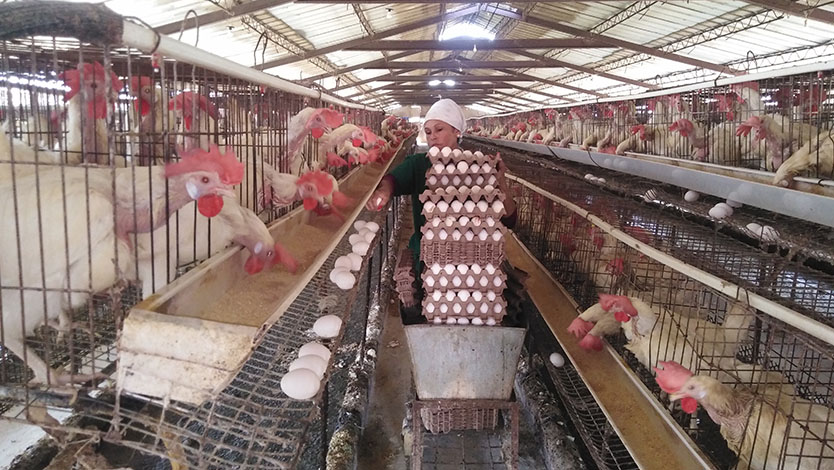
Far from records and feats as in years past, but alternatives and solutions are reviving the Poultry Company of Ciego de Ávila
The golden hens, as they were called in Ciego de Ávila – national leaders in the egg-per-bird indicator, most efficient in converting feed into finished production and with impeccable health – began to lose their glamour in 2021.
That same year, the Monetary Reordering (MR) arrived at the Avilanian Poultry Company facilities, an unfortunate experience due to its poor design for not a few Cuban work collectives; indeed, even the most efficient went backwards.
So intent was that task on organising the country’s finances that the usual subsidy equivalent to 500 pesos per thousand eggs produced was withdrawn, when tariffs on all inputs also rose, leaving the nutritious product at a disadvantage due to its high production cost.
The subsidy was later reinstated, but to reduce economic losses with the help of the State budget and thus avoid the disappearance of such essential branches as poultry farming.
With absolute reason, sector workers call it a sad reality due to its negative impact, which left the Avilanian entity with 35 million pesos in economic losses after the first 365 days of the MR.
As the country could not guarantee feed imports, expenses from animal deaths exceeded 42.4 million pesos in the Avilanian territory.
The white-feathered birds, specialised in breeding and egg production, suffered most because they endured fasting due to delays in feed transported from the industry in Cienfuegos, a nutrient that sometimes was a cereal or a premix due to a lack of raw materials.
On the other hand, while the Ciego poultry company was feeding on bank loans to pay for feed, inputs and suppliers, it had defaulting clients who were slow to settle debts. Thus, it inherited a cascade economy like a broken egg.
The Saving Solutions
When the most capable company could no longer withstand how raw materials, feed and the cost of eggs were being sold to it, the first saving alternative appeared for several of its UEBs.
A better climate began to be noticed from the end of 2024 with the implementation of co-production: the usual poultry farmers continued to manage that type of livestock mass, while private agricultural producers financed feed imports. The latter were entitled to 70 per cent of the production, and 30 per cent went to the Poultry Company to ensure the distribution of food only to priority organisations included in the social consumption programme.
Recently, another solution emerged: the recovery and start-up of the incubation plant and the breeding centre, belonging to the Pina 2 UEB, which had been inactive in recent years.
After 21 days of heat in the incubator machines for approximately 11,900 eggs, deliveries of day-old chicks began to different economic actors for the fattening programme, thanks to the dedication of the staff, the technical equipment that guarantees 90 per cent hatching of eggs, and the installation of solar panels with batteries that ensure the vitality of the production process.
If in the past this collective was a national leader in the productive political movement «On the Route to the Million», accustomed to setting production records and performing feats such as raising seven units of layers whose sheds were knocked to the ground by Hurricane Irma in 2017, today the great challenge is to continue reviving with its own capital so that the reappearance of eggs on Cubans’ tables, with the action derived from the productive management of state economic actors, does not remain as distant as today, to the crow of aviculture.