
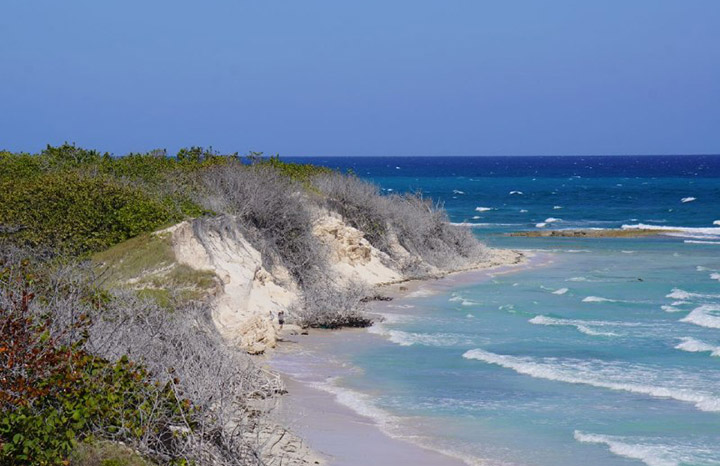
The updating of the management plans for three protected areas under the jurisdiction of the province of Ciego de Ávila enables the adjustment of procedures to conserve and sustainably use valuable flora and fauna resources in terrestrial and marine ecosystems.
Daylon Fundora Caballero, head of the Department of Natural Resources, Priority Ecosystems and Climate Change, at the Environment Sub-Delegation of the Territorial Delegation of the Ministry of Science, Technology and Environment in Ciego de Ávila (Citma), stressed the responsibility and rigour with which this process is being carried out.
He specified that the management plans of the Centro-Oeste de Cayo Coco Ecological Reserve, the Playa Pilar Dunes Outstanding Natural Feature and the El Venero Wildlife Refuge are being modified, in addition to updating, jointly with the province of Camagüey, that of the Jardines de la Reina National Park, whose management is shared.
Fundora Caballero pointed out that the updating process is governed by the methodology of the National Centre for Protected Areas and the schedule set by the Citma General Directorate of Environment.
In each protected area, technical teams have undertaken the necessary adjustments during the first quarter of the year to present a first version to the Citma territorial delegation, where the document is assessed, with the aim of correcting potential errors until it meets scientific quality standards.
Decree-Law number 83 of 2024 on the National System of Protected Areas states that «the management plan is the guiding document that establishes and regulates the development of activities required for the effective conservation of the natural heritage values in a protected area.»
This regulation defines what, where, how and with which resources activities in each area should be carried out, over a working period of up to 10 years, and is inserted within the framework of territorial planning.
There are different management categories and, consequently, specific objectives, forms and methods of administration, protection regimes, conservation actions and use of managed resources are defined.
The province of Ciego de Ávila currently has six protected areas, all administered by the Provincial Flora and Fauna Company and largely linked to nature tourism, which generates foreign currency income for the national economy and finances conservation work.
With the updating of the management plans, the importance of protected areas for preserving key ecosystems against the effects of climate change, biodiversity loss and sea level rise is reaffirmed.
These spaces, which include wetlands, dunes, keys and seabeds, not only harbour species of high ecological and cultural value, but also support essential environmental services for coastal communities and the development of nature tourism in the country.
Proper management, based on science and territorial planning, guarantees the balance between the conservation of natural resources and their sustainable use, for the benefit of present and future generations, as part of Cuban environmental policy. (Author Román Romero López)