
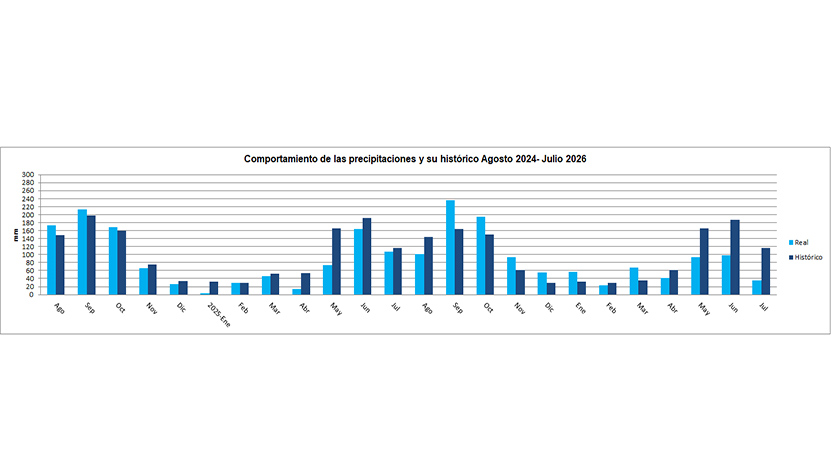
Throughout August, we have had very warm days and very little rainfall in our province, and everything indicates that, with only hours remaining before the month ends and given the prevailing atmospheric stability, August will conclude with a marked rainfall deficit. The absence of rain in the province has not only been present in August; it has been occurring for several months, leading to conditions of meteorological, agricultural and hydrological drought.
In August 2026, Ciego de Ávila faces an extreme and prolonged drought, where more than 75 per cent of its territory accumulates between three and 11 consecutive months of rainfall deficit, with some areas presenting more than 12 months of severe meteorological drought. This phenomenon has caused a marked deficit of soil moisture, leading to agricultural drought conditions, which seriously affect crop status and livestock performance. Furthermore, this drought is affecting the state of aquifers because groundwater recovery depends on rainfall occurring in the territory and surrounding areas, causing a hydrological drought event since November 2020, a date from which, according to specialists of the Hydraulic Utilisation Company, the territory has not managed to fully recover groundwater levels.
As noted above, the continuous rainfall deficit causes meteorological drought. But what is meteorological drought?
Meteorological drought occurs when there is a continuous shortage of rainfall over a long period, and its duration can vary depending on the region and atmospheric conditions. In fact, it sets in gradually and can last for years in the most extreme cases. The rainfall shortage is related to the behaviour of the ocean-atmosphere system, where both natural and anthropogenic factors influence it. Moreover, it is the drought that gives rise to the other types of drought (agricultural, hydrological and socio-economic) and usually affects large areas.
Drought is a climate phenomenon that affects more and more regions of the planet. Its frequency has increased by 29 per cent since 2000, driven by climate change, with direct effects on the environment, health and the global economy. It has been estimated that droughts are the costliest natural disaster in the world, representing six to eight billion dollars annually, and impact more people than any other form of natural disaster. Since 1900, more than 11 million people have died as a result of droughts, and two billion have been affected.
Drought events are caused by several factors. Among them are prolonged periods with below-normal rainfall due to the position and persistence of high-pressure systems, the absence of cold fronts and the reduction of convection that provides necessary moisture, as well as higher temperatures that increase evaporation from soils, reservoirs and vegetation.
Relationship of ENSO with the Current Drought
During the El Niño phase, a modification occurs in the position and intensity of the North Atlantic Anticyclone. This change alters the routes of humid air masses and the convergence conditions that normally generate rainfall in the Cuban archipelago. The phenomenon also contributes to an increase in temperatures, which intensifies evapotranspiration and accelerates soil moisture loss. Another of its effects is the reduction in the formation and intensification of tropical cyclones, which, although it might seem beneficial, has a negative side effect: fewer tropical cyclones mean less rainfall contribution, which in normal years significantly contributes to the water balance.
According to the latest reports published on ENSO evolution, El Niño will continue to strengthen until the end of the year. During the October to December 2026 season, there is a 69 per cent probability of a historic event that would surpass the intensity of previous El Niño events in the record dating back to 1950.
With an event of this magnitude, the probabilities of experiencing impacts consistent with El Niño are greater. Faced with this scenario, INSMET specialists are forecasting below-average rainfall for the August-October quarter, so drought conditions will continue during the next quarter.
In summary, the rainfall outlook is unfavourable, so it is urgent to intensify water-saving measures and stay informed through communications from the competent bodies. Although generally deficit rainfall is forecast, localised rain may occur that temporarily alleviates the drought in specific areas.