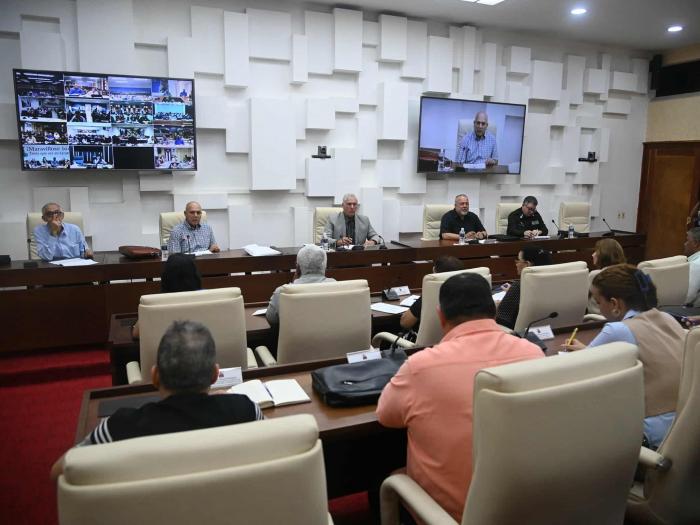
The meeting that marked the beginning of the Exercise was led by the First Secretary of the Central Committee of the Communist Party and President of the Republic, Miguel Díaz-Canel Bermúdez, who insisted on the need to take into account the experiences that have already been acquired in the exercises that precede this one.
The First Secretary of the Central Committee of the Communist Party and President of the Republic, Miguel Díaz-Canel Bermúdez, described the Fourth National Exercise for the prevention and confrontation of crime, corruption, drugs, illegalities, and social indiscipline, which began this Monday in Cuba, as an opportunity to strengthen ourselves and guarantee, amidst the complex situation we are experiencing, citizen tranquillity, respect for internal order, stability in the country, social discipline, and above all, participation in the main tasks we are undertaking.
The Head of Government insisted on the necessity of continuing to increase the levels of cohesion, based on the integration and participation of all forces and the population in this confrontation, so that it allows us to consolidate and systematise results.
All of this, he said, must be done taking into account the experiences that have already been acquired in the exercises that precede this one, and the determination we have to continue in a frontal battle against crime, corruption, drugs, social indiscipline, as well as negative manifestations and tendencies in our society, which is one of the four priorities we have defined for the work of the Party.
Referring to the multiple scenarios in which action is required, President Díaz-Canel emphasised that strong work must be done in confronting crimes that threaten the integrity of people’s lives and social functioning.
We must address and counter the acts of violence occurring in the country at this time, which are worrying situations due to the level of aggressiveness with which they are carried out and the manner in which they develop, he specified.
Likewise, he listed other matters that must be confronted as a priority, among them crimes of violence against women, drugs, as well as robberies, thefts, and others that affect above all the stability of individuals, life in homes, and the agrarian and peasant sector.
With special emphasis, he referred to other actions that threaten social discipline and the internal order of the country, including acts of vandalism, stoning of shops and buses. We cannot allow these acts, we must act with energy against them, and severely sanction the people who commit them, he indicated.
Particularly regarding crimes against the economy, he highlighted the occurrence of several in the electrical sector that urgently need to be confronted with greater effectiveness. He gave examples such as the theft of cables from electrical systems, primarily from secondary distribution; of oil from transformers; of transformers themselves, and of batteries.
In this regard, he drew attention to how the directors of the implicated institutions should confront these events: it is not only about reporting the theft when it is detected, but about working with greater emphasis on internal prevention measures and on combating the crimes, because the administrative leaders are the first who have to investigate and seek solutions when these occur.
He also underlined the importance of constantly updating and specifying the confrontation plans in state institutions, which are not to be kept filed away, but to be used as working tools that allow for not improvising when events happen. He equally highlighted the priority with which corruption cases should be analysed at all levels. Among other priority topics, he commented on those associated with the proper relations between the state and non-state sectors; tax evasion, which is still high regardless of the progress made in this regard, and the execution of the State Budget throughout the country, since even though it has improved, it is a fact that it requires continued attention.
Opening the meeting, Julio César García Rodríguez, head of the Office for the Attention to the Organs of the Popular Power System, the State, and the Legal Sector of the Central Committee of the Communist Party, assured that the actions supporting this Exercise, as happened in the three previous ones, are consistent with what was agreed at the 8th Party Congress regarding strengthening the role of the organisation, its participation, support, and control in the prevention and confrontation of all phenomena and manifestations that constitute a threat to national security.
What is planned —he said— fulfils several of the Guidelines of the Economic and Social Policy of the Party and the Revolution, as well as the Government Programme to correct distortions and re-boost the economy, specifically its General Objective 8, aimed at reducing crime, corruption, illegalities, and social indiscipline, through prevention and confrontation, influencing the causes and conditions that generate them.
As on previous occasions, García Rodríguez ratified that the main objective of the Fourth National Exercise is to increase the actions of political, social, and mass organisations, the organs of the State, the Government, the Ministry of the Interior, communications, and popular control, in the prevention and confrontation of criminal activities, antisocial behaviour, corruption, drugs, illegalities, social indiscipline, and other harmful phenomena that affect security and internal order.
Among other actions, a rigorous evaluation will be carried out on the fulfilment of the objectives, actions, and goals proposed on previous occasions.
«In this battle for order, discipline, and control, faced with a complex international and national scenario, the unity of the revolutionary forces and the ideological conviction that yes we can overcome are essential premises,» he assessed.
Also present at the meeting were the Prime Minister, Manuel Marrero Cruz; the Secretary of Organisation, Roberto Morales Ojeda; the Minister of the Interior, Army Corps General Lázaro Álvarez Casas; and the Secretary of the Executive Committee of the Council of Ministers, Amado Ricardo Guerra, all members of the Political Bureau; as well as representatives of State organs and the country’s mass organisations. Via videoconference, the main authorities of the Party and the Government from all provinces and the special municipality of Isla de la Juventud participated.