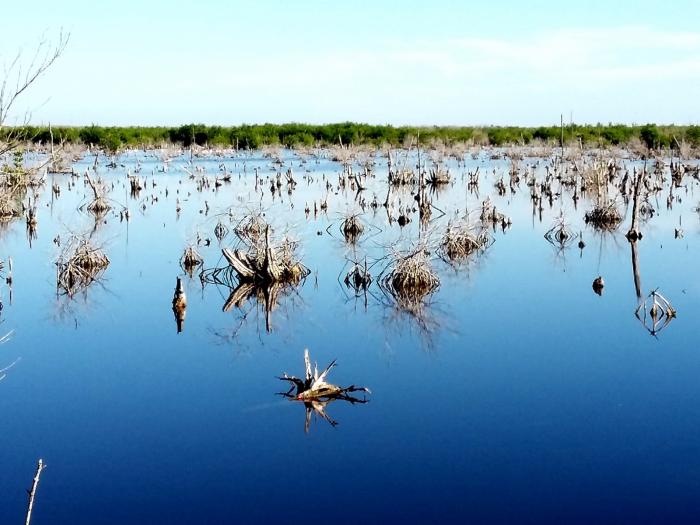
More than five years of drought have lowered the levels of Avilanian reservoirs and water supply sources for the population.
A phenomenon categorised as extreme drought has been afflicting the central province of Ciego de Ávila for more than five years, without the territory having managed to fully recover the levels of groundwater upon which its economic and social development depends.
According to Master in Water Resources Management Oscar Osvaldo Monteagudo Brito, technical director of the Ciego de Ávila Hydraulic Utilisation Company (EAHCA), the situation is particularly serious at the Ruspoli source, where of its four wells, only one is pumping, and not at maximum capacity, a limitation that has forced the transfer of water from the southern basin to the provincial capital to guarantee supply to the population.
Monteagudo Brito detailed that the most unfavourable hydrogeological sectors are the Peonía area, number five — which covers the municipalities of Morón, Ciro Redondo and part of the city of Ciego de Ávila — and the Pedro Ballester settlement. In unfavourable, though less critical, conditions are the Jagüeyal and Vicente sectors. Conversely, Falla, Ranchuelo, Bolivia, Majagua, Venezuela and Baraguá are favourable.
As for reservoirs, the outlook is also discouraging: the Liberación de Florencia hydraulic system — which includes the Cañada Blanca and Chambas Dos dams — was the only one to show favourable behaviour, above 90 per cent capacity, thanks to rains recorded in October and November last year. However, the rest of the province’s reservoirs barely reach 46 per cent of their capacity.
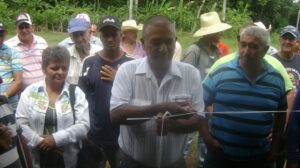
Faced with this critical scenario, the EAHCA collective, recognised as National Vanguard, is implementing a series of actions within the framework of the Euroclima Plus and Mi Costa projects, with the purpose of mitigating the effects of drought.
Among the measures adopted, 13 devices have been installed at rainfall stations that provide real-time information on rainfall in the northern basin, primarily in areas of agricultural development and in the sector that supplies water to 60 per cent of the provincial population.
These instruments were also placed in areas of the La Cuba and Arnaldo Ramírez Agricultural Companies and the Agroindustrial Bolivia.
In the southern basin, the Mi Costa project has allowed the installation of rainfall and well-level recorders, as well as automatic stations on the Majagua river and the Zaza-Ciego de Ávila main canal.
In addition, evaporimeters have been placed at the reservoirs with the highest consumption, in strategic locations, to calculate evaporation and develop a water balance control graph with more reliable data.
The director explained that the dams were built between 1988 and 1989 and the climate has changed substantially, so knowledge management, the application of science, technique and innovation, as well as the continuity of the objectives of these projects, are essential.
«The province is in a critical situation with water,» Monteagudo Brito declared, making an urgent call that what Ciego de Ávila needs most is not a cyclone — due to its devastating effects — but an event that generates a strong runoff towards the aquifer. While that miraculous rain does not come, the director insists that the immediate priority is the rigorous control of all available water: groundwater, reservoir water and river and stream water, a mission that falls on the shoulders of the EAHCA.
More than five years of extreme drought and the outlook remains discouraging. Nevertheless, the Avilanian response has not been slow to come: scientific knowledge, alliances with international programmes and the dedication of water workers stand as the only possible trenches against a crisis that compromises the very life of the province in the short and long term.