
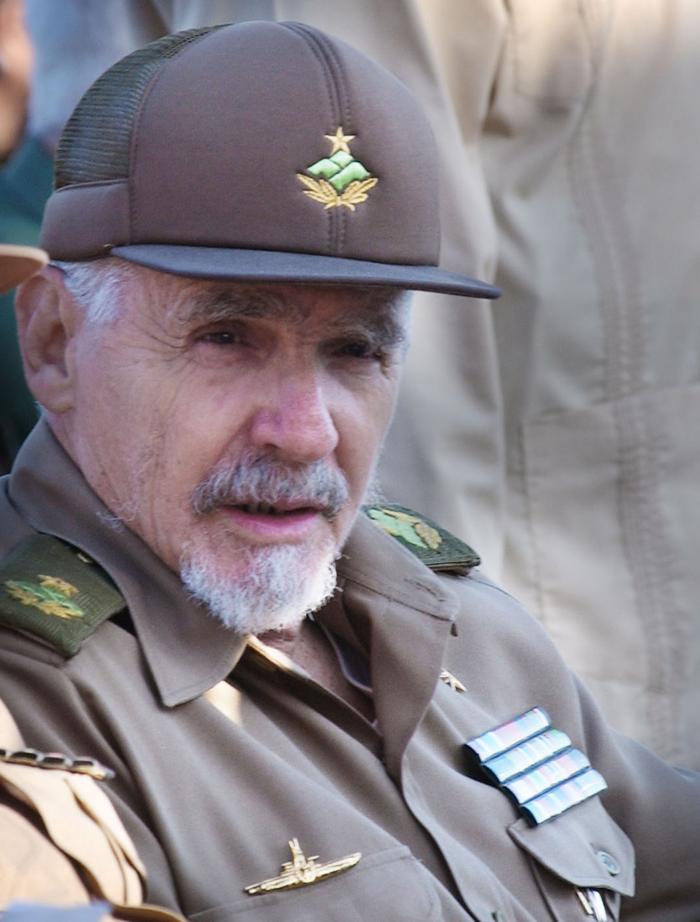
Because not just anyone carries the dignity with which the stories of men of Ramiro Valdés Menéndez’s stature are written.
It hurts to say it, but Ramiro is no longer with us. It hurts because his name was synonymous with resistance, with that fibre that does not bend, not with age nor with blows. It hurts because his silence has become eternal, and his absence weighs more than any speech.
We knew him as Commander, as minister, as vice-president. But those who knew how to look beyond, those who stayed by his side in the hard times, know that before all that, he was the boy from Artemisa, who preferred to dismantle a radio rather than run after a ball. His childhood was one of poverty and curiosity; his favourite toy was a screwdriver and a pile of wires. From then on, he knew that energy is not invented, it is transformed. And he himself was pure energy, transforming himself in every battle.
In the Sierra, when the jungle pressed and hunger was a campaign companion, Ramiro did not raise his voice; he raised the example. He was Che’s second-in-command, but he never sought the limelight. He preferred the trench, the map, the strategy. There, he learned that freedom is not won with harangues, but with method and cool-headedness. And when he came down from the mountains, he was no longer the same; he was a man who had measured the light of the revolution and had decided it was worth burning for it.
But not everything was combat and rifle. There is a Ramiro that few know: the one of his free time, the one who would sit in front of a ham radio with the same passion with which others gaze at the sea. It was his hobby, his secret vice: linking voices through the waves, connecting distant points, as if he wanted to build invisible bridges between the island and the world. He also liked photography: capturing instants, fixing memory on paper. They say that when he travelled to electrical works, he took his camera and photographed the workers, not the buildings. Because he was a humanist through and through.
His passage through Ciego de Ávila, through the solar parks, was not that of a visiting bureaucrat. It was that of the engineer who rolled up his sleeves, who asked about panel performance and the exact tilt of the modules. He did not seek blame; he sought solutions. He would sit with the technicians, share their coffee, and listen. And when he left, he left a lesson: energy sovereignty is as sacred as politics. Because without light, there is no hospital, no school, no future.
His relationship with Fidel was one of those that transcended positions. While one dreamed of the horizons, the other traced them on plans. Ramiro was the man of numbers, of feasibility, of rigour. But he was also the man of the most absolute loyalty, one who does not negotiate, not with power nor with time. And when Fidel left, he continued in the breach, his gaze fixed on Raúl, his brother in causes, his commander on earth.
The years bent his pace, but never his gaze. That gaze of his, clear and deep, continued to see beyond the present. Every inaugurated photovoltaic park was his victory; every young engineer trained was his legacy. He did not want statues; he wanted results. And he had them.
Today, as the news passes from mouth to mouth, there is a knot in Cuba’s throat. It is not the official mourning; it is the true pain, the one felt when a father, a grandfather, a teacher leaves. The electrical workers, whom he so respected, mourn him in silence. Because they sense that a piece of living history has gone.
But energy does not disappear; it is transformed. And Ramiro Valdés Menéndez, that Moncada assailant, Granma expeditionary, Sierra combatant, Hero of the Republic of Cuba and Commander of the Revolution, is now light. Light in the memory of those who accompanied him, in the will of those who continue his work.
Not just anyone carries the dignity with which he wrote his story. Because history is not written with ink, but with deeds. And Ramiro Valdés’s deeds are of those that cannot be erased, that weigh, that hurt and that, at the same time, sustain us.
Today, we must bid farewell to a giant. But giants do not die; they only change form. And Ramiro, from somewhere, will continue to measure light and freedom.