A worrying and recurring problem seeks a clear path to the final sessions of a new Congress of the Cuban Workers’ Federation
There is no constant movement of trains in the Ferroazuc yard, the best base business unit (UEB) of its kind in the country, belonging to the Cuban Railways Union, with its main location in the centre of Ciego de Ávila province.
Lathes, milling machines, drills and other equipment are also there, almost in complete silence, in the reference workshops for the manufacture and recovery of spare parts that for several years earned this UEB the status of National Vanguard of the Association of Innovators and Rationalisers and the same superior category in the emulation awarded by the Cuban Workers’ Federation (CTC).
Not so long ago, these machine tools generated millions in production. Today, it could be a considerable contribution to the remuneration of workers relocated to other tasks within the same entity, but the criminal oil blockade and other enemies of the Revolution have put a stop to that equipment and to the locomotives with towing means intended for transporting products from the sugar industry, which did not make the 2025-2026 harvest.
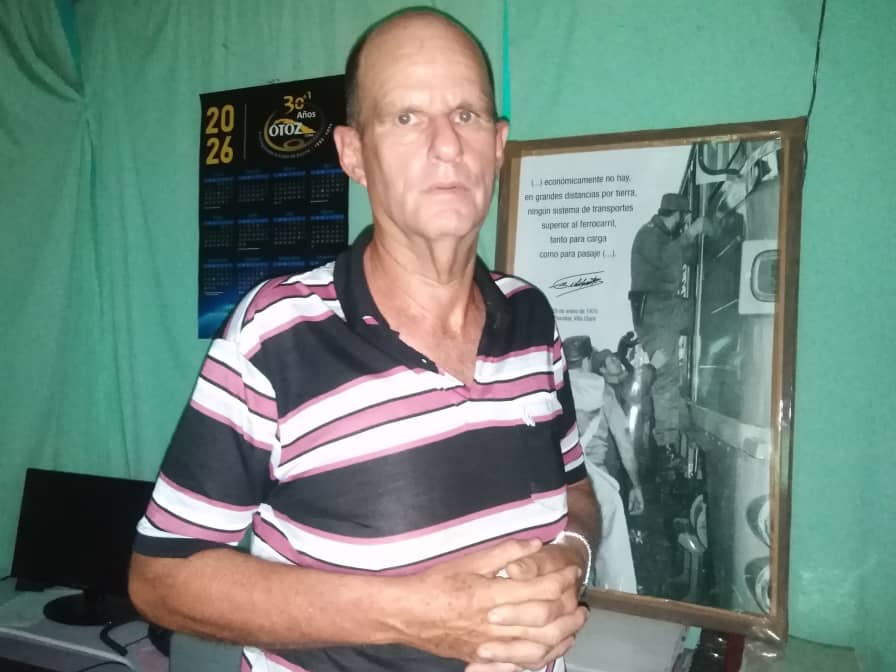
Now, managers and specialists are calculating costs clearly in search of alternatives. «Transporting other loads by rail does not generate enough to pay our collective; we have to find other options,» states Edilberto Acosta Ramos, who has 40 years of fruitful experience in railway activity.
The trade unionist was interviewed by Trabajadores, considering that wages, with their excess of problems, are once again the main dissatisfaction of the working class, in the process of the 22nd CTC Congress, whose final sessions will take place on 26 and 27 of this month.
The issue is a permanent guest at major trade union gatherings. Delegates at the congress held in April 2019 assessed that, with the application of new forms and payment systems, the objective of making them correspond with the socialist distribution principle – from each according to his ability, to each according to his work – was not fully met.
Seven years after that conclave, Acosta Ramos believes that not always, nor in every place, is payment made according to quantity, quality and the complexity of the work.
«The wage problem has serious consequences such as demotivation, labour indiscipline and the exodus of trained and experienced people to entities or other management forms where they receive higher incomes; a locomotive driver, for example, is not trained in a few days of work, and skilled labour is being lost not only in the railways.
«I agree that the solution depends on increasing labour productivity and the capacity to create more wealth, although these issues had never been obstacles for our collective; we are accustomed to travelling on the track of efficiency.»
Wages face frequent derailments. This is evidenced by the four statements about pay among the seven considered worrying and recurrent in the Avilanian territory, at the trade union organisation’s conferences.
On board persist workers’ concerns about the deterioration of purchasing power due to rising prices, the situation with bank cards that delays payment in entities due to lack of liquidity in bank agencies, and the absence of ATMs to withdraw cash in most municipalities, where the production of goods and services is declining.
«We need to put wages and other mistakes back on track that the workers’ congress can steer,» emphasises Edilberto.
Beside him, in the photograph, thought and exemplariness indicate one of the paths: «(…) economically there is no, over long distances by land, any transport system superior to the railway, both for freight and for passengers (…),» underlined Commander-in-Chief Fidel Castro Ruz in Placetas, Villa Clara, on 29 January 1975, Railway Workers’ Day.