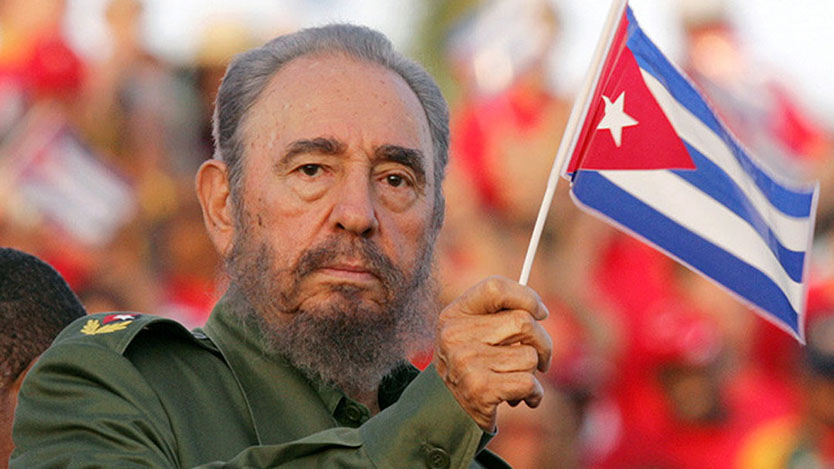
Some men never become absent. They leave the world, but remain in the memory of people; their voice fades, but their ideas endure; their body disappears, but their work survives. Fidel Castro belongs to that lineage that needs no monuments to endure, because they left their mark in a much more lasting place: the life of their people.
One hundred Augusts after his birth, Fidel remains, for millions of Cubans, a pillar of the Revolution he helped to build. His life, his efforts, his successes and also the enormous battles fought are inseparably linked to that work which he made his reason for existence.
He himself had announced it, when his struggle had barely begun, before a court that sought to judge his dreams: «History will absolve me.»
And history, which is never a simple court, continues to write its pages.
Today it is the people who keep his legacy alive.
He did not want honours. He did not ask for statues to eternalise him in marble. He did not need avenues with his name to feel present. His greatest monument was something else: the school opened for those who could not study before, the doctor who reached where no one had ever reached, the child who could learn to read, the young person who found an opportunity, the people who learned to defend their sovereignty as a possession not to be surrendered.
His work sought to look towards the humble, towards those «poor of the earth» to whom Martí dedicated his existence.
And perhaps that is why one of the most beautiful images of his legacy can be found far from any square: in the classrooms where young people from Latin America found a possibility that their own circumstances denied them.
The Latin American School of Medicine was also that: an open door. Thousands of young people came to Cuba with dreams that seemed too big for their lands and returned as professionals, carrying with them something more than knowledge. They returned with the memory of an island that, even amidst its own difficulties, decided to share what it had.
Because internationalism, for Fidel, was never an empty word. It was extending a hand. Understanding that solidarity does not first ask how much it can receive, but how much it can give. It was making his own Martí’s mandate of walking «in a tight formation, like silver in the roots of the Andes,» convinced that peoples, when they recognise each other as brothers, can turn unity into strength and dignity into a banner.
There was also his way of understanding sovereignty: as Cuba’s right to decide its own destiny; as defence of independence; as affirmation that no people should be too small to dream, nor too poor to aspire to justice.
Patriotism and internationalism were not opposing paths for him. They met in a single conviction: loving the homeland deeply without hating other peoples.
Fidel looked beyond the sea that surrounds Cuba. And from that small strip of land, so often challenged by history, he tried to illuminate with his particular beacon of convictions other paths of solidarity, independence and justice.
The years have passed. His voice became a memory. The images became photographs. The squares kept their silence. But some presences do not depend on calendars.
Because a man can die and yet remain when his ideas find where to take root. He can physically disappear and continue walking in the hands of those who continue his work, in the memory of those who knew him, in the books that recount his time, and even in the discussions of those who question his legacy.
Because that also means to transcend: to provoke that generations keep asking who he was, what he wanted to do and what remains of that dream.
One hundred Augusts later, Fidel remains a loved, defended, questioned presence and, above all, impossible to ignore in the contemporary history of Cuba.
But perhaps the best way to understand his permanence is not in grand words. It is in the face of an old man who remembers. In the doctor who heals. In the teacher who teaches. In the young person who dreams of a better country. In the memory of those who believe that a nation can rise, even when besieged.
And as long as a people preserve the legacy of their struggles, their dreams and their contradictions; as long as men and women are willing to defend dignity, sovereignty, solidarity and justice, that presence will continue to inhabit history. Not in marble, not in bronze, but in the living memory of Cuba.