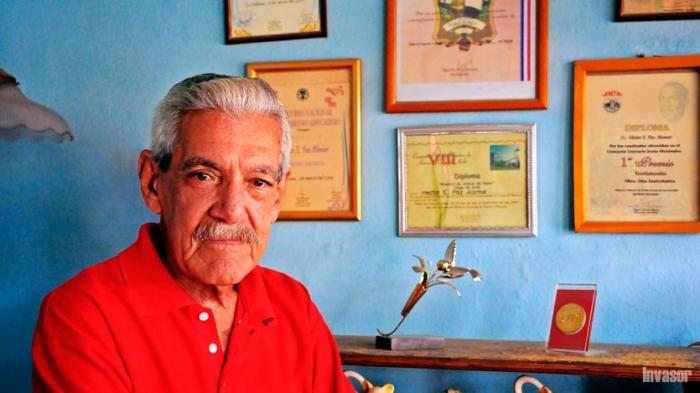
The echo of ink and the imprint of truth fell silent with the passing of Héctor E. Paz Alomar, a founding journalist of Invasor and one of the ethical and professional pillars of the profession in the province and the country.
His death leaves an irreplaceable void in newsrooms and in the hearts of those who learned to look at reality through his critical eyes and his photographic lens.
Born in 1943 in this very city, Paz Alomar forged a vocation that was not limited to the classroom. Although he held a degree in Journalism, his true school was the street, the dusty archive, the patient interview and the darkroom of development.
His career, spanning more than four decades, was distinguished by an uncommon rigour, an ethics proof against headlines, and a thorough command of journalistic genres. No note, report or chronicle escaped his precise pen, nor any fleeting instant that he did not capture with his camera, because in him the reporter and the photographer coexisted in perfect symbiosis.
Paz Alomar was a teacher in the broadest sense of the word. Generations of Avilanian journalists, from the most veteran to the youngest, recognised him as an obligatory reference, as the consultant who always had a fair phrase, an exact piece of data or a timely piece of advice.
His membership in the Union of Journalists of Cuba, where he held various positions of responsibility, reflected his commitment to the collective and to the defence of a journalism of service.
A meticulous researcher of local history, he dedicated his last years to unravelling the secrets of Avilanian identity. His thorough and well-documented works have become an unavoidable source of reference for theses, research and anyone seeking to understand the soul of this land.
The recognitions of his work are as numerous as they are deserved. Among the most significant distinctions his legacy treasures are the title of Distinguished Son of the Province of Ciego de Ávila and the status of National Vanguard, awards that speak of his total dedication to the community and to professional excellence. Added to these are multiple awards granted by the UPEC throughout his fruitful career and his meticulous attention to the sugar sector, for which he obtained the title of Master of Sugar, the only one with that honour in the Avilanian territory.
Following his wishes, his remains were cremated and his ashes laid to rest in the city cemetery, in an intimate family ceremony. His memory, his teachings, his written word and his photographic gaze will remain forever printed on the pages of Invasor and in the history of Cuban journalism.