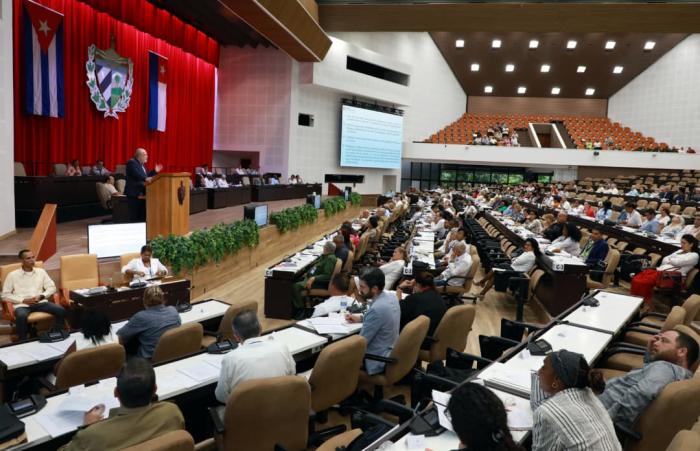
To evaluate the proposals for economic and social transformations, a matter of vital importance for the country’s future, the Third Extraordinary Session of the National Assembly of People’s Power (ANPP) is being held today, in its X Legislature.
The meeting, which takes place in its usual setting at the Convention Palace with deputies from Havana and those living in the capital due to their responsibilities, as well as with all deputies from across the country connected digitally, includes the remote participation of Army General Raúl Castro Ruz.
Also present in the chamber is the First Secretary of the Party Central Committee and President of the Republic, Miguel Díaz-Canel Bermúdez.
The President of the ANPP and the Council of State, Esteban Lazo Hernández, paid tribute to Vilma Espín Guillois, Heroine of the Cuban Revolution, who passed away on this date 19 years ago.
PRIME MINISTER REPORTS ON STRATEGIC TRANSFORMATIONS TO THE CUBAN ECONOMIC AND SOCIAL MODEL
In the most complex context facing the country since the special period, Politburo member and Prime Minister Manuel Marrero Cruz appeared before the ANPP to present strategic transformations to the Cuban economic and social model, conceived as a sovereign exercise to preserve the achievements of the Revolution without renouncing socialism.
During his speech, the Head of Government contextualised the current situation: an unprecedented combination of coercive measures by the US government, which has even interrupted fuel supplies and sources of foreign currency income, significantly affecting the stability of energy infrastructure and the quality of life of the population.
He also acknowledged that internal errors and shortcomings have never been denied, but stressed that this combination of factors has consistently affected the implementation of the transformations approved since the 6th Party Congress in 2011, whose positive results were maintained until mid-2019, when the sanctions policy intensified, reinforced at the beginning of January 2025.
In this scenario, the Party and the Government, in the legitimate exercise of their sovereignty, have promoted measures to reactivate the economy and correct distortions, a process strengthened by the approval of the Government’s Economic and Social Programme, validated by the people through popular consultation.
Taking popular sentiment as a direct reference, the Prime Minister announced transformations that find their first foundation in the thought of Commander-in-Chief Fidel Castro Ruz, who, in 1993, in the midst of the special period, warned: «Life, reality, the dramatic situation the world is experiencing, this unipolar world, forces us to do what we would never have done otherwise if we had had capital and if we had had the technology to do it.»
Under the guiding principle of doing what is necessary to preserve what is essential, the proposed measures include the expansion of the participation of all economic actors on equal terms, the promotion of foreign investment, and the admission of market mechanisms as an instrument for resource allocation. These actions – he emphasised – do not constitute a capitulation, but rather the sovereign adaptation of development instruments to the country’s specific circumstances.
The Prime Minister recalled the premises of Army General Raúl Castro Ruz in guiding the updating of the economic and social model: not to be dogmatic or immobilist, to banish the mechanical association between socialism and egalitarianism, and to recognise that socialist planning does not exclude, but must incorporate and regulate the rules of the market.
The transformations presented, which will be debated, are part of the collective effort to reactivate the economy and correct distortions, without ever renouncing socialist construction, but rather as a condition for its preservation.
For the preparation of the transformation proposals – Marrero Cruz explained – the following were considered: the instructions of the Army General and the First Secretary of the Central Committee, the 2026 Government Programme, the proposal for updating the Conceptualisation of the Economic and Social Model, as well as the Agreements of the ANEC Congress and leaders of the State and the Government of the country.
He noted that 390 proposals were received, with 66.7% accepted, and the remainder corresponding to the implementation process, other positive assessments, as well as aspects that do not constitute transformations.
As a result of the analysis of the transformation proposals carried out in the Politburo, 69 recommendations were incorporated into the document.
The Head of Government pointed out that the document presented contains 176 transformation proposals, grouped into 23 fundamental axes of the country’s economic and social life.