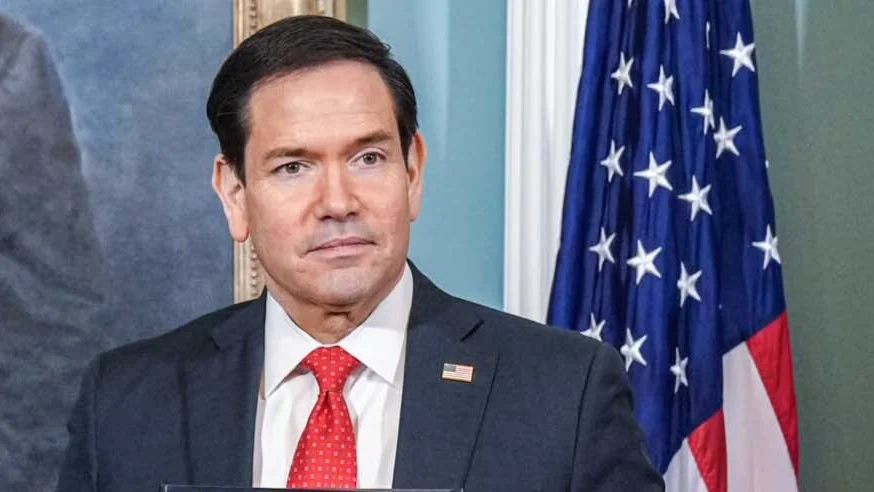
For Secretary of State Marco Rubio, Cuba is not suffering an oil blockade today, even though for more than three months, not a drop of fuel has reached the Caribbean country, harassed by Washington’s unilateral measures.
During a press conference on Tuesday at the White House, in which the head of US diplomacy and national security advisor to President Donald Trump assumed a new role as spokesperson, he answered questions on various topics, including Cuba.
«On Cuba (and the) oil blockade on Cuba: there is no oil blockade on Cuba ‘per se’,» Rubio stressed, stating without providing evidence that the island used to receive free oil from Venezuela — which was endorsed in bilateral agreements — and that it resold much of it on the international market to obtain cash. The official insisted on the rhetoric that «Cuba is a failed state» that is «just 145 kilometres from our shores» and that «furthermore, it happens to be friendly territory with some of our adversaries. Therefore, it is an unacceptable ‘status quo’. I will talk about it, but not today,» he concluded.
On 29 January, President Trump signed an executive order declaring a «national emergency» regarding Cuba due to the supposed «unusual and extraordinary threat» that, for the United States, the island represents in terms of national security.
The Republican president justified this new twist in his policy towards Cuba by arguing that the Havana government is aligned with «numerous hostile countries» and that it has welcomed «transnational terrorist groups» and even allowed the deployment of «sophisticated military and intelligence capabilities» from Russia and China on the island.
Based on such reasoning, he threatened to impose heavy tariffs on any sovereign nation that attempted to supply oil to Cuba.
In his return to Hugh Hewitt’s programme on Salem News Channel, Trump commented yesterday that he did not want to talk too much about Cuba, except to say «that perhaps I will do it on the way back from Iran, when we are finished there,» and repeated the idea of stopping an aircraft carrier very close to the Cuban coast to intimidate.
Last Friday, Trump stated — on the same day he announced new coercive measures against the Caribbean nation — that he intended to take control of the island «almost immediately.»
At a private dinner of the Forum Club in West Palm Beach, he confessed, to the laughter of attendees, that he would take care of Cuba, but first he would finish his war in Iran, because he likes «to finish the job.»
He also spoke of the aircraft carrier USS Abraham Lincoln, which he would stop «about 100 yards (91.44 metres) from the coast.»
UNPRECEDENTED HOSTILITY
Since assuming his second term in the White House on 20 January 2025, Trump has redoubled his efforts against Cuba. On his first day in office, he signed an executive order that reversed, but in the right direction, measures of his Democratic predecessor, Joe Biden.
Biden, who during his four years in the Oval Office remained in line with Trump’s policy towards Cuba, decided a week before the end of his presidency to remove the country from the US unilateral and arbitrary list of alleged state sponsors of terrorism.
Thus, in a cascade, with Trump, one provision after another arrived, all aimed at strangling the Caribbean nation with an unprecedented reinforcement of the longest economic, financial and commercial blockade in history, to overthrow the Cuban Revolution, that is, regime change.
He attacked remittances (from 31 January 2025, they were suspended); increased the persecution of Cuba’s international cooperation in the health area through pressure campaigns that made some countries yield, abandoning that humanitarian programme.
Also, the Office of Foreign Assets Control (OFAC) has intensified its persecution of the island’s financial operations; ended the humanitarian parole programme; suspended visas for cultural, sporting and scientific exchanges; and, in an unprecedented twist after 23 years on hold, Trump activated Title III of the Helms-Burton Act.
On 1 May, Trump published a decree expanding his government’s unilateral coercive actions against Cuba, which are an extension of those announced in January, although it does not mention any specific entity or person.
In response to this new step by the Trump administration, Cuba’s Minister of Foreign Affairs, Bruno Rodríguez, described the increase in White House economic pressure on the Caribbean country as reprehensible.
In a 51-47 vote on Tuesday, the US Senate rejected a Democratic war powers initiative to limit the possible military operations that Trump might order against Cuba without Congressional authorisation.
Democratic Congresswoman Pramila Jayapal, one of the most visible voices in Washington against US policy towards Cuba, expressed after an April visit to Havana with her colleague Jonathan Jackson, that the illegal blockade on fuel supplies constitutes a «cruel collective punishment» and an «economic bombardment» that has caused irreparable damage to national infrastructure and the Cuban people.