- #Hashtag is a necessary short film for society, especially Avilanian society.
I know Jorge Luis Neyra’s audiovisual work well enough to be able to write a critical review of #Hashtag, his latest creation, in one sitting and after a single viewing.
In my opinion, it is a minor piece within his creative machinery, especially since 13 years of creative inactivity, at least in fiction, had kept him immersed in the world of television and the pedagogical preparation of other media professionals.
Given that #Hashtag fulfils its didactic purpose of conveying a message of common good, contemporary and grounded in our own everyday reality, its artistic values are not negligible.
It stands out for its production, its harmonious editing and musicalisation that conveys that «something else» that needs to be reinforced in a dramatic scene: the secret voice. But it does not escape being part of a therapy, a pedagogical tool.
Let us remember that didactic cinema asks, «What do I want the spectator to learn?», while auteur cinema usually asks itself, «What experience do I want the spectator to live?»
That difference in purpose is usually reflected in the construction of characters, the dramatic structure and the use of audiovisual language.
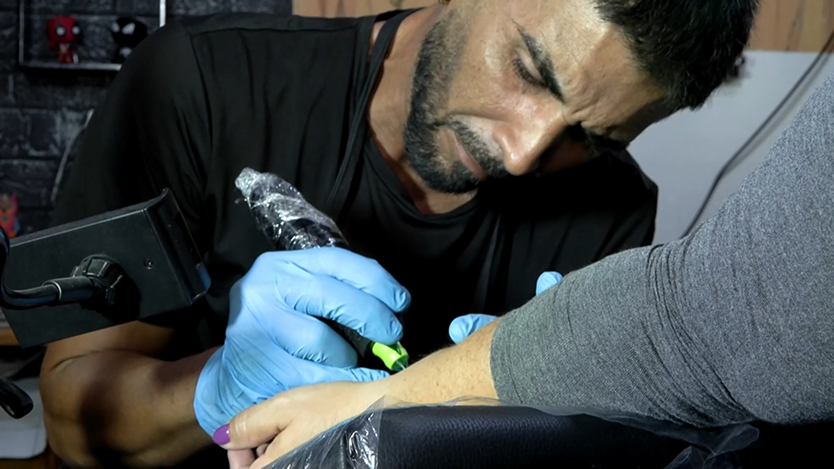
The story begins when a mother (Yanelys Valenzuela) goes to a tattoo artist to have the number 392 tattooed on herself, which is the number of days her daughter had been without consuming drugs until she died of an overdose.
The skin artist accepts the job and, after finishing, also agrees to do others for free for everyone who comes for it. And so, before his eyes, the different characters that build the plot excitingly and movingly parade by.
The original idea arose as a therapeutic material from psychologist Dany Rodríguez Ceballos. Of course, it changed. But I believe that haste or the lack of more specialised readings did not allow its perfectible side to be seen in time to correct it.
Although some adjustments can still be made. An audiovisual product does not have to stop at its premiere. Especially when it has not yet come of age.
As for its photography, the experienced Eric Yanes achieves a fresh image, as crystalline and loquacious as the director set out. The close-ups and wide shots manage to give all the drama or the diary-like quality of a society transformed into a kind of kaleidoscope and continues its path at rocket speed.
And although in editing the colours, framing, environments and even the shot itself always undergo some type of variation according to the demands of the process, the truth is that Eric achieves stability in each take, places himself in the right position and offers reverse shots, overhead shots, in an appreciable way as he has already accustomed us to in works such as Estorbo, La noche más larga del mundo, Plátano quemado, etc.
After seeing the point-of-view shots, the detail shots or close-ups, when returning the atmosphere of an Avilanian city that is striving to update itself and reveals its social seams, Eric demonstrates that his craft as a chronicler and translator of others’ ideas still yields appetising fruits.
It is enough to see the scene of Laritza López’s soliloquy. Every detail in her physiognomy counts. The framing is perfect. She is heard, and what she says is internalised naturally, because the camera, in addition to being the eyes, is the spectator’s ear. We see, in some way, what she feels, what she translates from objective reality, like the human psyche.
In the acting department, I dare to say that there is a coherent balance among all of them and they manage to uphold the director’s and screenwriter’s message. Although here they are the same person.
It is enough to point out the organicism of the mother-son duo, between Yuleidys Zurita and Jorge Ysel. Natural, organic, credible and authentic. Ysel demonstrates that he should never have left the stage; Zurita manages, in a few minutes, to convey all the pride of a mother who, although devastated, has faith in human improvement and trusts in her son’s salvation.
Special mention for Luis Ricardo Faura’s characterisation. His grieving father, who does not resign himself to the loss of his daughter, leads us to think of the uncertain future of our children who are still young. His gestures, his ways and excesses fit perfectly with the portrait of that ordinary man who still does not conceive of human weakness, nor the destruction of his own family.
Let us remember that it is a short film of just 25 minutes. The levels of histrionics are more restrained than usual because the characters are not conceived for a «normal» or long-drawn dramatic development.
It is evident that the most pressing thing is the message to be conveyed; the ideas and the feeling, the memory activated to the point of suffering, are put in by the spectators.
But if we talk about acting performance and character conception, I think Rafael Solenzar plays his role quite well. He is believable, not grandiloquent as a theatre actor should be, even though he has already had experiences on the small screen and is even a Caricato acting award winner.
Rafael Solenzar builds a contained, credible and notably organic tattoo artist. However, the performance ends up limited by an insufficient dramatic conception of the character. The script reserves an important revelation for the denouement, but never allows that experience to filter into his actions, silences or contradictions.
The result is a character who functions effectively as a mediator between the different stories, but not as a dramatic subject of them. When the narrative tries to turn him into the emotional centre of the denouement, the shift is more informative than organic.
As Ricardo Piglia pointed out, the surprising ending does not consist of hiding information but of managing it. Surprise is born when the outcome seems unexpected and, at the same time, inevitable.
As a messenger of good, it is commendable. And that is where the lesson ends.
Many will agree that it is a good staging with real scenery borrowed from a true tattoo artist such as art instructor Omar Gazmuri, who also had a decisive role as Rafael’s technical advisor regarding the practices of the trade.
I even know that it reaches the collective memory, evoking ghosts and nefarious episodes, but that is not everything for the monster of art that needs much more to survive and not be left stranded on the shore.
#Hashtag is a necessary short film for society, especially Avilanian society. The audience that has already seen it has clapped attentively, happily, respectfully, moved, and has known how to value it.
But art also has its hollows, and one must be able to appreciate everything. This is not the work with which Jorge Luis Neyra happily returns to the world of cinematic fiction that he is so passionate about.
This could be, however, the key piece, the necessary one that well deserves to be reviewed and adjusted after further hours of editing, to achieve a better product. Perhaps moving some final scenes to the beginning and making them parallel.
I do not know the definitive solution, but I do believe that audiovisual work is perfectible. The history of cinema has several examples to follow of director’s cut and industry cut versions. Let due justice be done.