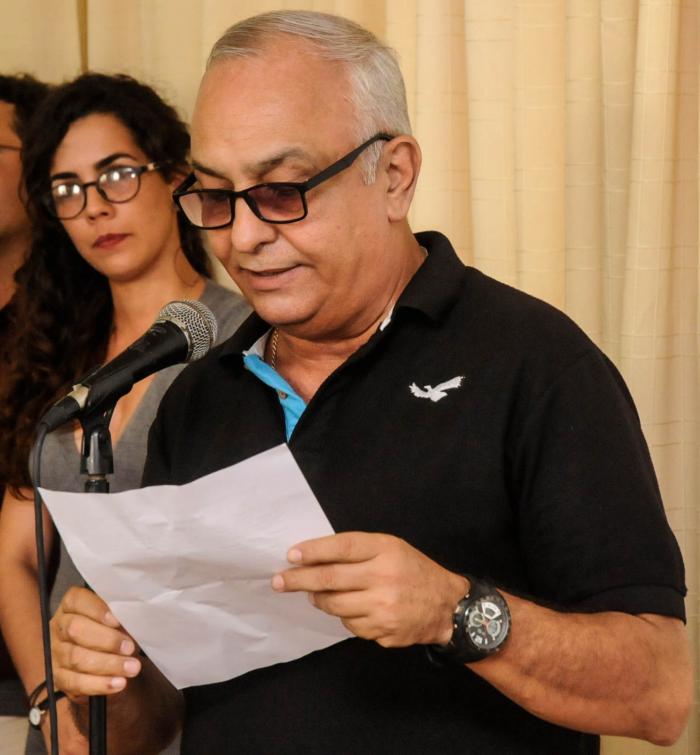
Today we are witnessing a rebirth of fascism, and writers cannot be oblivious to this danger, affirms Alberto Marrero, winner of the 2025 Carpentier Prize for Short Story.
«I have never written based on presuppositions, or a predetermined plan. Nor do I champion theses. I do not intend to demonstrate any, whether aesthetic, philosophical or political. I am in that sense an intuitive writer. However, that does not mean that ideas, images, certain objectives, in line with the worldview I have, do not seethe in my mind.»
So says Alberto Marrero (Havana, 1956), in his conversation with Granma, regarding the 2025 Carpentier Prize for Short Story, which he obtained with Cerámica de invierno: «I believe that if something could be considered a presupposition, it is my fidelity to Man (with a capital M), to my country, to the things I love and defend. I am interested in the dilemmas of human conduct, even its vanities, in different eras and circumstances, not infrequently extreme.»
Precisely for this reason, he explains, he is so attracted to history, into which his narrative frequently ventures: real characters interact with fictional characters.
«The human being is not homogeneous, with only one facet. They have virtues and defects, and can be strong and weak at the same time, emotional and rational, tender and ruthless, humble and selfish, coherent and contradictory.
«However, I believe that in the end, the immense capacity for love that we have prevails, our will to overcome the vicissitudes of life and triumph, although many are lost in the attempt. Some artists and writers perhaps do not share this outburst of optimism, betting on the incorrigible, on how useless any attempt at human improvement is. As a follower of Martí, I reaffirm his faith in that human improvement, at whatever cost necessary.»
The stories he gathered in this book – he affirms – speak of these complex matters, «or rather, they suggest them, without falling into insubstantial didacticism,» and cover a long historical period up to the present day. «They came out like that and, when I grouped them, I realised that they formed a fairly accepted picture of my unplanned ‘presuppositions’. The theme of war and man’s conduct in it is also present.»
– As a writer, what is your relationship with the short story?
– It is the genre that allowed me to write novels. I come from poetry, from which I have not left nor will I leave as long as I live, or as long as lucidity lasts. Poetry is essence and lucidity. Without it, nothing worthwhile can be written. And I am not speaking of poetry as a genre, but as a singular state of that lucidity. That is why I study and read it constantly. To enlighten myself. To discover new associations. So that language allows me to express significant matters.
«The short story is a terrain of challenges, a testing ground where everything the writer intuits and has learned is condensed. In the short story, nothing can fail.
«I always bet on telling a story. I am not interested in those stories that narrate nothing, that at the end one wonders what on earth they have told me. That does not mean I advocate for easiness, for a story without complexity. I think that the reader must be involved in the story being told, and that is difficult when everything is spoon-fed.»
Marrero had previously won the 2019 Carpentier Prize for Novel, with Agua de paraíso. Prizes are always appreciated, he assures, «it is a sign that the effort was not in vain, that other eyes saw literary value in what I have done, working with discipline, always at dawn, when noises and life are on pause.»
Currently director of the Foundation for New Latin American Cinema, he comments that he is accustomed to writing and, in parallel, working on other responsibilities unrelated to literature. «I make time. Raymond Carver, the great American short story writer, pointed out that a writer who complains about not having time to write should dedicate themselves to something else.»
– What importance do you think literature has right now in a world headed towards fascisms and the empire of the instantaneous?
– The revolutions of mankind have always had much good literature beneath them, sustaining them as a spiritual pillar. Likewise, countless novels, essays and plays prepared minds for change, promoted clarity, unmasked falsehoods, dismantled taboos.
«Today we are witnessing a rebirth of fascism, the destruction of a relatively stable order achieved in recent decades. The US government has broken all international norms and threatens to ignite a war of unimaginable consequences. It must be stopped. The US empire’s desire for global domination must be halted. Writers cannot be oblivious to these dangers. The quality and humanism of their works must once again prepare minds for this battle, which may be the last. There are a thousand ways to do it without desecrating the beauty of literature.»