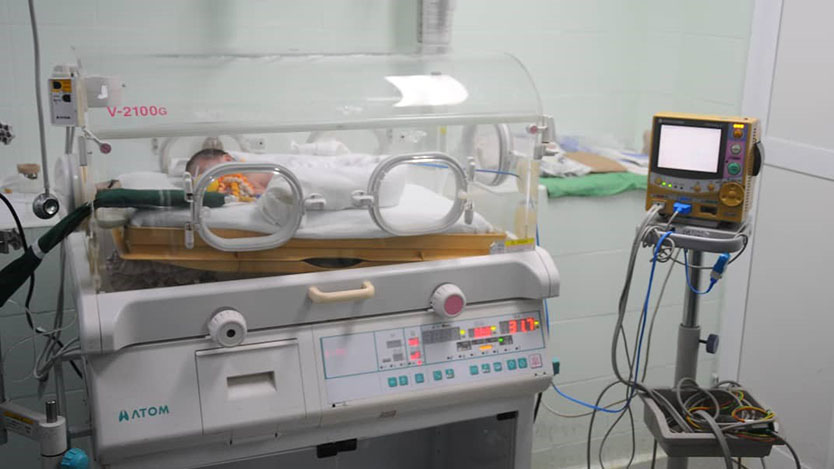
In the Neonatology ward of the Dr Antonio Luaces Iraola General Teaching Provincial Hospital, the incubators are ageing, and ventilators are scarce, a deficit aggravated by the United States blockade on Cuba, which limits access to medical supplies. Despite this, there is one certainty that does not yield: 98 out of every 100 babies admitted survive.
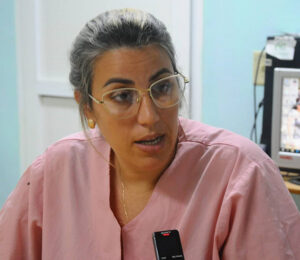
Before speaking, Dr Ladisbel Rodríguez Placeres jokes about the camera. Then she adjusts her gown and begins to talk about the only thing that never seems to tire her: her babies.
She is a first-degree specialist in Neonatology and works in the provincial referral service of the aforementioned Hospital, which receives infants under 1500 grams, those arriving with surgical pathologies, and those whose hearts fail before they learn to beat properly.
«The service is provincial, although the one in Morón also operates for most of the sick babies from the northern area,» she explains, setting out from the start the magnitude of what they attend to.
But the conversation soon turns to what is lacking.
«There is a real deficit of specialists, of nurses qualified in Neonatology. That will always have an impact on newborn care,» she says, without mincing words. «We do everything possible so that it does not show in the families and the babies.»
The incubator stock, she recounts, is worn and old — no new equipment has entered the service for a long time. The ventilators, those that help a newborn breathe when their lungs do not yet know how to do it alone, are insufficient.
And then there is the Pharmacy, which does not always have what it should.
«Sometimes we have to think a little further in the use of the medicines we are going to give to the baby, because often we do not have the first line of antibiotics; we have to move to a second one,» she relates. «That makes our work a little more difficult, but so far we have managed.»
There is also a shortage of supplies that sound small but are not: tubes, syringes, everything made to the measure of a body that fits in one hand. Faced with this scarcity, the service has chosen to add rather than subtract.
For some years now, they have been incorporating the family into the baby’s care, even those under 1500 grams: the kangaroo mother and father method, which brings the warmth of an adult body to a newborn too small to regulate its own.
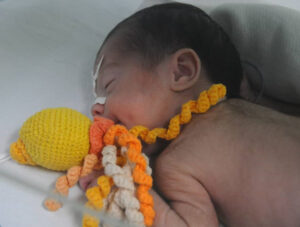
And there is a detail the doctor mentions with explicit gratitude: the «attachment octopuses,» knitted by craftswomen from the province, which today accompany babies in their incubators. A fabric object replacing, in part, what technology cannot always give: containment, calm, something to cling to with tiny fingers.
«When we are changing incubators, the mother or father can hold their baby for an hour and help with comfort and warmth,» she adds.
Despite everything, there is a number the doctor repeats with the certainty of one who has earned it through shifts and difficult decisions: the service maintains a survival indicator above 98 per cent.
«Even though the birth rate has decreased significantly in recent years, we are receiving almost the same number of babies, because they are born with more pathologies than before,» she explains. The number of births goes down; the number of admissions does not.
On institutional priority, she is categorical: «The neonatology service is prioritised within the Maternal and Child Health Programme (PAMI). If there is any specific medication we need for a baby, a request is even made at the national level, and if it exists, it is located and brought to us.»
She assures that the provincial director visits the service frequently, and that, in that regard, they have never faced problems.
In the end, amid ageing incubators and hand-knitted octopuses, an image remains that sums up the ward: a service that sustains lives with what it has, and that turns every lack into one more reason to invent.