
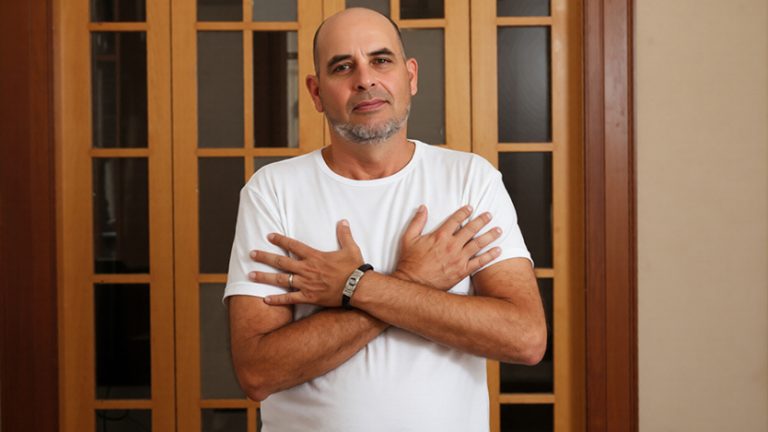
Jorge Luis Neyra repeats a scene with the precision of someone who has lived it a thousand times. It is not on a television set, nor in a studio. It is in Havana, about to close a call for grants from the Hermanos Saíz Association (AHS), together with his wife at a friend’s house, hastily putting together the project that would become the documentary Trovándote sin parar.
«We turned into magicians,» he recalls. «In twenty-four hours we put the project together.» That urgency, that making a whole out of nothing, is the same one that led him, together with three friends, to found one of the most important trova festivals in Cuba.
It is the same irreverence that accompanied him from the moment when, in 1987, as an Economics student in Cienfuegos, he came across an organisation that had just been born and that promised an art outside the commonplace.
That organisation was the AHS, and that young man was named Neyra, because few know him as Jorge Luis. Today, on the threshold of the AHS’s 40th anniversary, Neyra is an Honorary Member. But his story, like that of the association itself, is marked by a beginning where everything was still to be done.
«We didn’t have the remotest idea of what that was,» he confesses. He came from theatre, from national festivals, and was looking for a space he did not find in the university group. Together with two other students, he founded a comedy group. «At that time, in Cuba, a movement of young comedians was blossoming (…) who made a more critical and irreverent art.» That restlessness was the first magnet that drew him to the AHS, which was only just beginning to consolidate.
The organisation’s first great backing for his career as a filmmaker was Estorbo, a short film based on a story by Vasily Mendoza, another AHS member. «Television didn’t have the money to film it,» states Neyra. It was the AHS, with its then president Natacha Cabrera and producer Yoanys Soriano, that bet on the project. «I presented that project to the association, and the association approved it for us.»
That short film was not only made, but exceeded all expectations. «The result got out of our hands.» It was shown at the Havana Film Festival, won awards and earned a place in the encyclopedia of Cuban audiovisual work. «It was my film,» he says, with pride, recalling the shoot in Violeta, where a team of young people recently arrived in television, and the AHS put in hours and dawns, without asking about payment.
But one of Neyra’s most emblematic works is, without doubt, Trovándote. The origin of the event is also the story of a lack. In the mid-2000s, there was no regular space in Ciego de Ávila to enjoy live trova. «That made me angry,» he admits.
The spark was lit when a musician friend, Javier Jorge, showed him his collection of trova recordings. The idea of creating a space to exhibit them and, above all, to bring the music live, took hold of them. «What we need, in any case, is someone live,» they thought. The opportunity came with the return of two troubadours to their home town, and the four of them sat down to «cook up» the idea.
Once again, the AHS was the unifying body. «We went to the AHS seeking support,» he recounts. The organisation gave them institutional backing, but resources were scarce. The Museum of Decorative Arts lent them its courtyard and became the «first almost sponsor.» Every week, it was set up with the help of other AHS members, with «postmodern stage designs» made from newspapers and the talent of visual arts students. «Without paying anyone anything,» he stresses. The gathering was called Trovándote, and the first guest was Ariel Barreiros, whom Neyra called with the frankness of those who know that art comes first: «We don’t have money to pay you, brother.»
The evolution of the project reflects what Neyra calls the «splendour stage» of the AHS in Ciego de Ávila, between 2010 and 2019. «Two things converge: a whole infrastructure, support… and at the same time a critical and solid thinking among young creators.» Trovándote went from being a gathering to a national meeting.
The AHS, by then with a budget, backed it as an official event, and the organisation consolidated itself as a platform for young troubadours such as Dúo Iris, Amaury del Río or Nelson Valdez to have their first concert.
Neyra’s relationship with the AHS transcends that of a simple member. It is that of a constructive critic, a role he assumed naturally because, he says, «that is how great artists and teachers educated me.» In 2018, as an Honorary Member, he was already warning of the need to adapt to changing tastes.
Today, his analysis is more nuanced. He recognises that rigour and aesthetic quality are what will save the association, but he does not ignore the context. «COVID-19, the blockade and the migratory factor,» he lists, have led to «a large part of those young people who made up the artistic vanguard of Ciego de Ávila leaving.»
For Neyra, this drain has reduced the motivation and quality of the new generations joining. His commitment to the organisation has led him to raise his voice in forums such as the 10th Congress of the Union of Writers and Artists of Cuba.
He does so, however, with the conviction that «criticism will always contribute.» He does not fear the consequences of his observations, which, he says, are always for the benefit of his territory’s culture and not personal.
His army of arguments is his own experience: «What do I owe the AHS? It taught me to speak without fear, and to think.»
Looking to the future, his wish for the AHS is a single word: rigour. «It may lose resources, it may lose membership…, but I believe what it should never lose is rigour, the aesthetic, artistic and human quality of the people who join its ranks.» For him, the association is a unique phenomenon in the world, a space that brings together young artists and supports them, even when their thinking generates contradiction.
As he speaks, he recalls the blank sheets he handed out at the end of each Trovándote so that the public and guests could leave their criticisms, good and bad, anonymously. It was his way of not believing himself «the world champion» and of understanding that the work is built by everyone. That is the legacy he wants to leave: not an award in a drawer, but a body of work that endures, that serves so that others do good things for humanity and for culture.
Jorge Luis Neyra did not found Trovándote to fill a CV. He did it because it «made him angry» not to have somewhere to listen to the music he loved and because, as he himself says, if he did not do what he thought, he would «burst.»
That is the irreverence that defines him, the same one that led him to knock on the AHS’s door in 1987 and that, almost forty years later, keeps him firm, defending the idea that culture is made with talent, with rigour and, above all, without fear.


