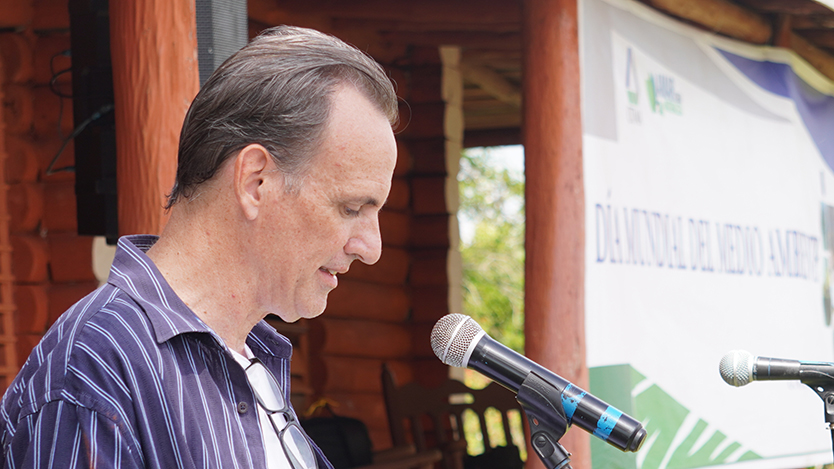
«The economic, commercial and financial blockade of the US government against Cuba sabotages environmental actions aimed at reducing pollution, conserving threatened species, tackling climate change and restoring degraded soils,» denounced Daimar Cánovas González, Deputy Minister of Science, Technology and Environment (Citma).
This cruel and illegal obstacle, intensified with more than 240 punitive measures, hinders access to clean technologies, financing, training and exchanges on key issues, among other aspects, he argued during his most recent visit to the province of Ciego de Ávila.
In this complex scenario, the Citma deputy minister asserted that political will, the people’s commitment and the scientific capacities built by the Revolution constitute tools to face challenges, promote sustainable development and meet global commitments.
«Today, when the planet sends urgent signals, multilateralism stumbles over petty interests and an empire seeks to suffocate a people by denying them the energy necessary to live, Cuba’s voice stands firm for a just international order, equitable access to technologies and financing, and the sovereign right to develop a social and economic model without siege,» he expressed.
He alluded to the struggle of the largest island of the Antilles for a world where nature is seen as a common heritage of humanity, and to the decision to continue working to confront climate change, pollution and biodiversity loss.
It is a priority, he said, to develop an economic and social model that does not compromise the well-being of future generations, based on the premises defined in the Cuban State Plan for Climate Change Confrontation (Task Life).
Cánovas González referred to the Island’s recent and active participation in international events such as the 30th Conference of the Parties on Climate Change, which the Cuban delegation attended with the satisfaction of fulfilling the main commitments of the Paris Agreement.
Despite the difficulties arising from the blockade, the National System of Protected Areas is being strengthened, covering 16.37 per cent of the land surface and nearly 30 per cent of the marine area, with 156 legally declared areas that protect mangroves, coral reefs and mountain forests.
In recent years, more than 80,000 hectares have been added to this protection mechanism, constituting a direct response to biodiversity loss and climate change.
He mentioned advances in Task Life, fundamentally related to mangrove rehabilitation, sandy beach recovery, efficient management of water resources to address drought, studies on coral reefs, reforestation efforts, and the relocation of constructions located on the first line of the coast.
Added to these efforts is the transition towards renewable energy sources, as a priority axis and with exponential growth in solar photovoltaic energy, which allows increasing electricity generation through this means and reducing greenhouse gas emissions.
The 2030 National Biodiversity Programme, which received the Reserve on the Red medal awarded by the International Union for Conservation of Nature, is being implemented successfully.
As a result of the scientific expedition «Bojeo a Cuba» and the work of recent years, the Roadmap for the Conservation, Management and Sustainable Use of Coral Reefs in Cuba was presented to the Executive Committee of the Council of Ministers, a proposal that prioritises attention to the so-called «hope sites»: the Guanahacabibes, Ciénaga de Zapata and Jardines de la Reina national parks, the Laguna de Maya and Santa Lucía Wildlife Refuge.
Cuban forest heritage exceeds 4.1 million hectares, the forest index reaches 32.1 per cent, steadily approaching the potential of 33 per cent; and seven out of every ten forests protect watersheds, soils and biological diversity, in addition to helping retain moisture and combat desertification, explained the high-level leader.
He detailed that the watershed management index is on the rise, thanks to reforestation and soil conservation, practices that also help contain erosion and preserve freshwater biodiversity.
Meanwhile, the circular economy is a productive model progressively becoming a reality, as a result of compliance with the actions foreseen in the national transition strategy.
Treatment of hazardous waste reached 77 per cent, more than 54,000 tonnes of recyclable products were recovered, and the implementation of the Integrated Alliance «Together for Less Plastic Waste» maintains as a priority awareness-raising for the efficient management of single-use plastics and encourages, through science and innovation, the search for alternatives to substitute them under Cuban conditions.
Referring to the main challenges, in a complex scenario of economic tensions aggravated by the blockade, Cánovas González mentioned the persistence of difficulties with the comprehensive management of urban solid waste and liquid waste, which hurts the hygienic-sanitary conditions of human settlements, the population’s quality of life and environmental health.
He stressed that material and energy limitations favour unsustainable and harmful practices for biodiversity, fundamentally related to increased pressures on certain natural resources; in addition to the persistence of illicit activities such as the extraction and marketing of wild flora and fauna species.
The Citma deputy minister affirmed that «safeguarding our environment is also defending the Homeland.»