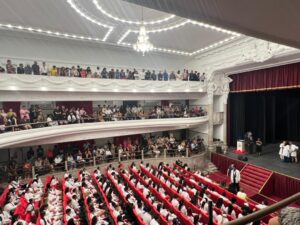
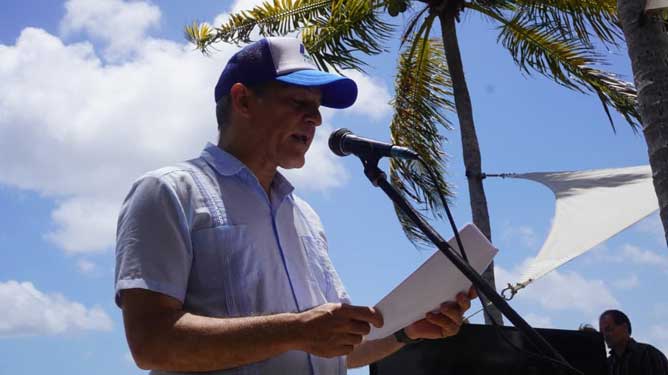
Dr Armando Rodríguez Batista, Minister of Science, Technology and Environment (Citma), expressed on Thursday the high honour and satisfaction represented by the presentation to the province of Ciego de Ávila of the accreditation as Host of the National Event for World Environment Day.
Accompanied by Julio Heriberto Gómez Casanova and Alfre Menéndez Pérez, First Secretary of the Provincial Party Committee and Governor, respectively, he extended the award to Miguel Salazar Rodríguez, acting Territorial Delegate of Citma, and to María del Carmen Olivera Isern, Deputy Delegate of Environment.
The sector head assessed that, in a complex context — marked by the tightening of the economic, commercial and financial blockade of the US government against Cuba and energy limitations — the Avilanian territory demonstrates through concrete actions that it is possible to advance towards a more sustainable development model.
This result, he argued, is the fruit of the continuous effort of institutions, the scientific community, workers, local governments, new economic actors and the population in general, who have known how to integrate environmental protection into the priorities of territorial development.
The Citma Minister noted that the Avilanian territory shows significant advances in the conservation of natural heritage, fundamentally in six protected areas, to which another three could be added in evaluation processes, which would strengthen the protection of high-value ecosystems and contribute to the implementation of the National Biodiversity Programme.
He highlighted the work of the International Project «Mi Costa», which increases climate resilience in vulnerable communities on Cuba’s southern coast by carrying out various technical tasks, including mangrove rehabilitation, and promoting training processes among residents of localities such as Júcaro.
Likewise, he praised the performance of projects focused on drought confrontation and the promotion of sustainable tourism, evidencing the territory’s capacity to articulate science, innovation and international cooperation, with the aim of promoting climate adaptation and the sustainable management of natural resources.
He pointed to the implementation of circular economy initiatives as one of the strengths, considering that state enterprises and various non-state management forms of the economy incorporate innovative practices that favour recycling, efficient use of resources and waste reduction.
Other encouraging results, he mentioned, are related to soil management and conservation, the increase in forest cover, including mangrove forests, and the implementation of territorial programmes that articulate scientific, environmental and local development projects to respond to problems identified in the province.
Added to these are advances in the energy transition, through the incorporation of solar parks and the growing use of renewable energy sources, which contributes to reducing greenhouse gas emissions and strengthens energy resilience in circumstances marked by severe external restrictions.
The results acquire greater relevance in the context of the economic transformations promoted by the country, with the implementation of the 176 measures recently approved by the National Assembly of People’s Power to improve and revitalise the Cuban economy.
These actions open new opportunities to strengthen environmental policy and management, through greater integration among all actors in society, the promotion of sustainable productive chains, investment attraction, technological innovation and the development of circular economy models.
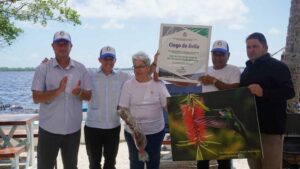
At the event, the Provincial Environment Award was presented to the Ramón Domínguez de la Peña Primary School and the Marlin Azulmar Marina, both entities located in the town of Júcaro, in the municipality of Venezuela, and linked to the «Mi Costa» International Project, in the context of which they consolidate their actions to protect nature.
Likewise, this award was received by Néstor Renato Labrada Rodríguez, a director at Avilanian Television with an extensive body of work that exalts natural values and the results of climate change adaptation projects; and Tania Delgado Pestana, with more than three decades of work in the Citma Environment Sub-Delegation and a promoter of the implementation of environmental policies in the nation.
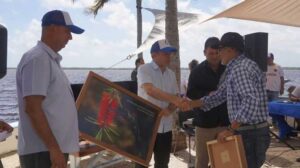
Party and Government authorities presented the Provincial Environmental Recognition to Cubasolar Ciego de Ávila, the Dolphinarium of the Marina Gaviota Cayo Coco Base Business Unit, the protected area Loma de Cunagua Wildlife Refuge and the Telecommunications Centre of the municipality of Chambas.
The Citma Territorial Delegation extended recognitions to the centres of Environmental Engineering and Biodiversity, the Provincial Meteorological Centre and the Centre for Coastal Ecosystem Research, whose scientific-technical work is focused on protecting natural resources and the environment.
Meanwhile, the provincial radio station Radio Surco was honoured for its commitment to the dissemination of environmental issues, which contributes to transforming information into collective awareness; and the medium-sized enterprise Carnes D’Tres and the Sol Cayo Coco Hotel received recognitions for implementing sustainable consumption and production practices and circular economy.
During the ceremony, tribute was paid to Commander-in-Chief Fidel Castro Ruz, historic leader of the Cuban Revolution, and to Doctor of Sciences Rosa Elena Simeón Negrín, founding minister of Citma; two personalities with advanced environmental thinking capable of transcending to guide new generations.
The National Event for World Environment Day took place at Laguna La Redonda, located in the Great Wetland of Northern Ciego de Ávila and proposed, together with Laguna de La Leche, as a protected area with the category of Wildlife Refuge.
During a tour of that site, Rodríguez Batista, accompanied by Party and Government authorities, observed the natural values and their excellent state of conservation, as well as the sustainable use of the environment for leisure activities and the potential for promoting different types of specialised tourism (ecological and scientific).
As part of his stay in the province, the Citma Minister visited the Centre for Environmental Engineering and Biodiversity of Ciego de Ávila, an institution that leads numerous scientific-technical research projects focused on climate change adaptation, biodiversity conservation, the promotion of sustainable tourism and disaster risk reduction.
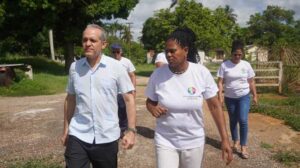
Yamilé Jiménez Peña, director of that research centre, subordinate to the Environment Agency, explained to the Citma head that they also provide numerous scientific-technical services to prioritised sectors of the economy.
In an exchange with the Ciba collective, Rodríguez Batista recalled his first visit to that centre, several years ago, together with Doctor of Sciences Rosa Elena Simeón Negrín, who had the vision to create that scientific institution, which has accumulated nearly 34 years in service of sustainable development.
The Minister referred to the urgency of promoting transformations in the functioning and performance of the Ciba, in line with the new measures adopted in the country to improve and revitalise the economy.