
That municipality was once rich. Its workplaces produced sugar, final molasses, torula yeast, molasses-urea-bagasse, protein molasses, torulin, fitomas and other sugarcane derivatives; ice, lime, animal feed, nutrients at an agrochemical plant, sausages, canned fruits and vegetables, varieties of sweets, daily bread and other lines from a state business system that has been run down not only by the enemy economic blockade.
Not enough to satisfy the ever-growing demands of the population, but local goods production and services used to cover people’s most basic needs. That’s why I’ve never underestimated such a popular saying: We were «rich» in the days of the convertible peso (CUC or chavito) and we didn’t know it.
Today, by grace of private enterprise, there is a means of survival in this era of inflation, of the sixty-year-old siege that has become an economic stranglehold imposed by the Yankee government and, why not mention it, the internal blockade intensified by hoarders and opportunists who alter prices or move the cost marker as they please and further block the dominoes for the vulnerable.
I witnessed one of those moving moves recently. The seller turned with the big piece (double nine) on the sales point table and called out «capicúa» to Liborio: «You got the last bottle of oil at 1700.00 pesos, from now on these are 2000.00, take them or leave them…»
All this happens at the municipal level, which must assume a greater role, according to the government programme to correct distortions and boost the economy. The municipality, according to forecasts, can cease to be a passive link and become the protagonist of its own development, the battleground to confront the main problems currently afflicting the people and allow them to see concrete solutions in government management.
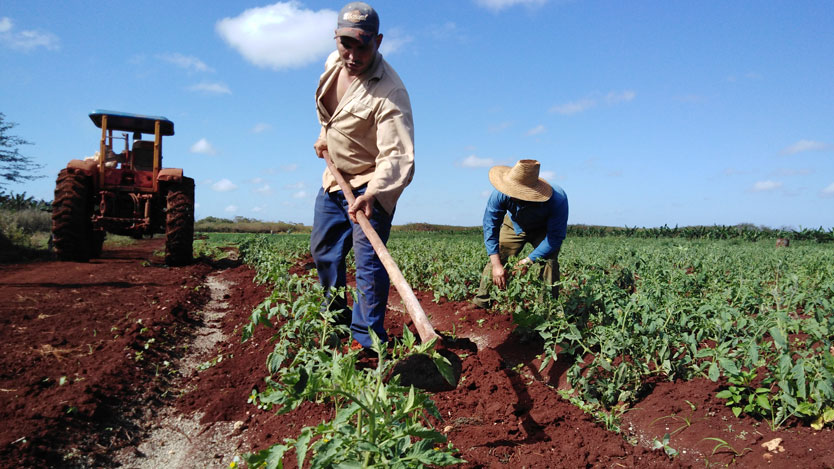
Regarding priorities, I revisit some figures and considerations published by Invasor on the strategic role of the province of Ciego de Ávila in food production. With almost 35,000 hectares dedicated to tubers, vegetables, grains and fruit trees in the agricultural sector alone, its lands are a bastion for the food security of Avilanians and inhabitants of other territories.
Its geographical position, almost in the centre of the country —the publication stresses— constitutes a key logistical advantage for food distribution. Such a convergence of location, land resource and human capital makes the territory an essential pillar, with the premise that endogenous development is the most secure basis for the country’s sustainability.
Given the importance of the matter, I return to the beginning of this commentary because that enclave of hardworking people I take as an example faces great challenges in the effort to reclaim the strengths of its industrial plant, as it is not a provincial powerhouse in the agricultural sector.
Of course, this is not the time for a sudden revival in the midst of an acute shortage of fuel, lubricants, electricity and other essential resources needed to sustain the vitality of basic activities. Although there are issues that do not depend on turbogenerators, harvesters, tractors, oxen teams and technological packages to enhance municipal autonomy.
How can this change be undertaken when there are still entities failing to comply with reporting discipline to central economic bodies? How can the future be planned if companies in the sugar sector, producers of the main local export item, are currently shielded by a Decree-Law that classifies the results of the production process?
So, with a view to providing information of public interest, one has to resort to ingenuity to report that very little power was delivered to the National Electricity System by the Ciro Redondo Bioelectric Plant (Biopower S.A.) in 2025. That, as part of this minimal energy contribution and other causes, its neighbouring sugar mill produced just over 15,300 tonnes of sugar —approximately 50 per cent of the plan for the 2024-2025 harvest— and that both industries have not started up their equipment this 2026, with more than two months of the sugar season gone and nothing has been said. Does the lack of information, in the era of a Communication Law, become part of local development strategies?
There is another among so many lost links. Last year, not a speck of charcoal could be packaged, nor foreign currency earned from exporting that line, which could have revived operations of the depressed COMCÁVILA unit. When trying to promote transformations at the municipal level, especially in the area of food, a long-standing, notorious, lengthy, ponderous and ageing chain grows fat, violating the payments system and representing a serious economic problem for the creditor (who is owed money), while the debtor (the one obliged to pay) presents a false solvency that allows them to work economically with ease.
To give you an idea, in the municipality of Ciro Redondo, a debt to six entities exceeded 22 million pesos and the average owed to just four producers reached 5,325,000.00 pesos, arrears that in some cases exceed a year’s delay, for the sale of maize, rice, beans, along with milk and beef which are also victims of non-payment.
So, when economic laws are violated, with the full knowledge of those involved in their processes, economic-financial management fails, with the risk of affecting responsibilities undertaken with the State and society. So, can everything be municipalised?