On the 115th anniversary of his death, returning to the memorable pages written by the brilliant writer would be enough to understand those endurances which, pen in hand, the greats guarantee.
«Genius is a lightning bolt whose thunder prolongs for centuries.» This is how the Norwegian author Knut Hamsun understood it, to decree what in certain sections of human history can easily be verified.
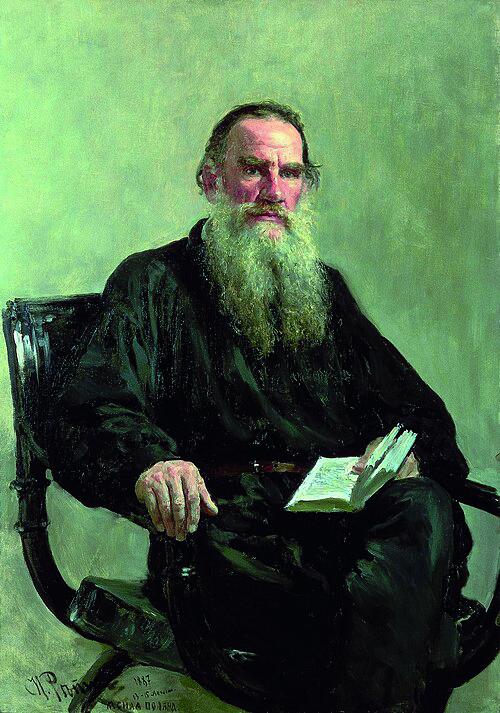
Literature is one of those areas where the aphorism finds examples. One of them is the Russian writer, philosopher, playwright, journalist and pedagogue Leo Tolstoy (9 September 1828 – 20 November 1910). His name occupies the very top seats on the list that contemplates colossal authors, endorsed by the words of other sages who grant his creation deserved superlatives.
He was born with a silver spoon, at the Yasnaya Polyana estate – today converted into a museum honouring the existence of its most celebrated inhabitant. He was a Count by birth, yet he viewed the deplorable conditions of the peasantry in feudal Russia with concern. Interested in the classics from a very young age, upon entering the University of Kazan at just 16 years old, he had his aspirations very well defined: «I. Voltaire. To learn to overcome pain, cold, privations. And religion.» He had first studied a literature degree, which he abandoned to study Law. But his fierce irreverence and strong-willed character lead him to leave these studies and continue his formation as an autodidact.
The pedagogy that so seduces him leads him to found a small school for peasant children on the estate. And writing also captivates him, which will find space in the diaries where he will pour out his precepts, which increasingly distance themselves from the aristocracy. He is consumed by uncertainty, by what to do to change the world, but the justice he yearns for does not find in his reasoning the social theory to lead him to achieve it.
Enlisting in the army was the immediate path, and there he was an artillery officer. Later he participates in the Crimean campaign against the Turks. The experience sinks deep into the spirituality of the young man who stores every image of the battles with a photographic memory. He then writes, with complete realism, his Sevastopol Sketches. He soon shows his conceptions regarding war and violence, and his patriotic feelings by referring to the defence of the homeland as the first duty of human beings.
Love came to the thirty-year-old with the face of the young Sofia Behrs, with whom he contracts a marriage from which 13 children would be born. It is the time to also conceive (he does so between 1856 and 1869) his monumental epic titled War and Peace, in which he will reflect the events of his homeland’s war against Napoleon. The tableaux of the novel reveal the maturity of a writer with his own thinking and with impressive creative mastery, who uses, among many other resources, the contrast from the very title, to reveal the Russian resistance against the invaders. Of resounding realism, and with more than 500 characters, the work gives continuity to the sequence of the historical novel and is of transcendent importance for Russian and world literature, due to the epic force of its passages.
Among many other titles – it has been said that his complete works can reach almost one hundred volumes – Anna Karenina then sees the light, of which our José Martí said: «It is not a novel, it is life» and alluding to a scene in the book he noted: «The account of the officers’ horse race is read with the saddle under one’s thighs and the whip in one’s hands.»
In the novel, Tolstoy will show, through the theme – the extramarital relationship of the protagonist with a cavalry officer, Count Vronsky – and the plot lines, his own convictions such as being as useful as possible to the homeland, as well as the search for the best in others.
Without a doubt, one of the world’s greatest literary works, Tolstoy came to say about Anna Karenina that it was his first true novel.
There were five articles that the leader of the world proletariat dedicated to his compatriot Leo Tolstoy. Without concealing the limitations and contradictions of the writer, Lenin highlighted the worth of the novelist’s creative contributions, who brought important events from his country’s history to literature with impressive realism.
On the historical importance of Tolstoy’s critique, he wrote: «(…) with a power unique to the geniuses of art, he expresses the radical changes in the mindset of the broadest popular masses of Russia (…) and precisely of rural, peasant Russia.»
When in 1978 the sesquicentennial of his birth was approaching, several articles appeared in these pages to pay homage to the distinguished writer. A few days after the 115th anniversary of his death has passed, returning to the memorable pages he wrote would be enough to understand those endurances which, pen in hand, the greats guarantee. (Author: Madeleine Sautié)