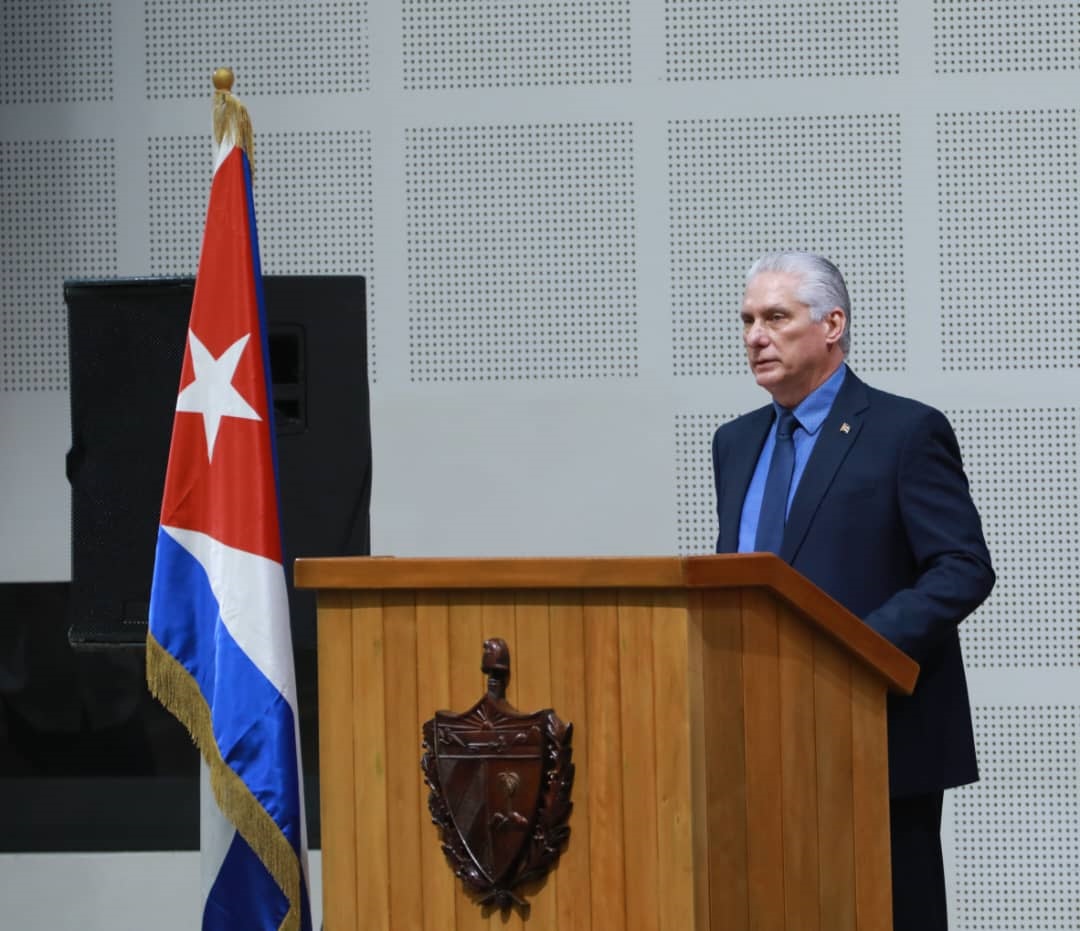
- The First Secretary of the Communist Party of Cuba Central Committee and President of the Republic, Miguel Díaz-Canel Bermúdez, delivered the inaugural lecture of the 1st International Colloquium «Fidel: Legacy and Future», in which he reviewed the life, thought and enduring relevance of the Commander-in-Chief.
Fidel continues to illuminate every inch of our struggle, and in his centenary year there is the conviction that his ideas will never die. That is the certainty that beats among the participants of the 1st International Colloquium «Fidel: Legacy and Future», which was inaugurated this Monday with the presence of the First Secretary of the Communist Party of Cuba Central Committee and President of the Republic, Miguel Díaz-Canel Bermúdez.
And it was precisely one of the Commander-in-Chief’s best disciples who, before more than 1,500 attendees from 63 countries at the Convention Palace, delivered the keynote lecture that opened the curtains of the Colloquium. The Cuban President, who knew closely the giant of the people that Fidel was, spoke in his presentation of the man who marked the 20th century and guides us today in the most difficult hours.
Díaz-Canel thanked all the men and women from around the world who have gathered in Havana, despite blockades and threats, to honour a Cuban of universal stature. There is no greater monument to Fidel, he told them, than that you are here today.
He called on them to study the Commander-in-Chief’s thought in these times, because his life as a giant merits it. Preserving the achievements of socialism and breaking all possible sieges is the first tribute we pay to the eternal Leader, he added.
The Head of State recalled the life of the man who put Cuba on the world map with a struggle that ignited on 26 July 1953. He also spoke of the suffering country that existed before the triumph of 1959, where monopolies prevailed, and there was a neocolonial status of dependence on the United States. But history changed radically until today, he said; despite the tightening of the blockade, it shows undeniable achievements from a social perspective.
All of this has had a name: Fidel Castro Ruz. Of him, he also recalled his stature as a universal statesman, because his legacy challenges us daily. «He taught us the lesson that socialism is the only way to save humanity; that unity among revolutionaries is more important than any difference,» he pointed out.
In his words, he highlighted that Fidel was a tireless student, a strategist who foresaw the future and left us a legacy of coherence for history. Díaz-Canel also evoked his internationalist and solidarity qualities, where he showed his vision as an exceptional military strategist, and, likewise, the humanity that surrounded his figure by prioritising the sending of doctors and not bombs across the planet.
Fidel was a man of the people, of that there is no doubt. And he proves it; he pointed out his permanent connection with the people, but also his vision to carry out a literacy campaign at the beginning of the Revolution, to consolidate a first-world educational system and a health system for all.
Just hours before celebrating his centenary, Díaz-Canel commented that it is necessary to have him more present than ever. «It is no coincidence that in the year of his centenary, Washington has increased its threat against Cuba,» he added. Today, the US government intends to fracture our unity and intensifies the psychological war against the largest island of the Antilles, seeking the longed-for social outburst.
The Head of State reiterated to the participants, with compelling data, the devastating impact of the energy siege and the two executive orders signed by Trump on our people. However, they have come up against a resilient country that fights hard and has even continued to send doctors to the poorest countries, he pointed out.
The blockade, he said later, constitutes an act of war against a small Island; against a people that today suffers the harshest possible shortages.
The Cuban President reviewed in figures the deep impacts of a meticulously calculated genocide against the energy sector, health, education and other vital areas of the country. However, he emphasised that pressures have not managed and will not manage to subdue the Cuban people: «Resistance is not passive, it is active.» The dignitary also stressed that collective intelligence will always be greater than any money from the empire.
Díaz-Canel emphasised that no material shortage has managed to extinguish the flame of solidarity, because the socialist structure is conceived to protect the human being, even under conditions of total siege.
On the one hand, he exposed the severe impact of the economic blockade, today translated into barely 30 per cent availability of the basic list of medicines, extreme imperial pressure on shipping companies to prevent the arrival of vital supplies, as well as the constant onslaughts of inflation, fuel shortages and blackouts.
However, in the face of that policy of deprivation, he countered the achievements that the Revolution sustains through commitment and social justice: the incorporation this year of 30,185 young university graduates ready to serve the country, among whom are 735 professionals from 62 nations — including 23 Palestinian doctors and five Americans trained in Cuban classrooms. All of this, he stressed, as a demonstration of the defence of a state model that ensures that the means of production remain in the hands of the people, rejecting any formula of extreme privatisation.
We are here because Fidel’s thought is the compass we have to move forward, he added. And as a sign that Cuba is not sitting idly by, the Head of State reflected on the economic and social transformations recently approved by the Cuban Parliament, which, as he explained, do not under any circumstances signify a step backwards on the path of socialism.
When evoking the legacy of the Commander-in-Chief, he affirmed that Fidel is not only our heritage; he belongs to the world, to everyone. It was then that Díaz-Canel formulated strategic tasks for these times for the participants:
The first calls to spread the truth by breaking the media monopoly and combating technological illiteracy to make visible both the shortages and the achievements of the Island. The second calls for articulating effective networks that transcend discourse and translate into concrete campaigns against the blockade, scientific cooperation and fair trade.
As a third premise, it urged deepening critical thinking, remembering that Fidel left open questions for new generations to provide answers in matters of digital popular power, territorial autonomy and climate change. Finally, the roadmap emphasises the need to strengthen unity, overcoming secondary divisions within progressive movements to concentrate collective effort on the fight against imperialism.
«The future is not written,» Díaz-Canel declared before the plenary. «Yes, the empire is powerful, but history is on the side of the peoples. Every act of daily survival is an anticipated victory against suffocation. It is demonstrated in every child who learns to read, in every peasant who cultivates with agroecology, in every scientist who researches without commercial patents, and in every mother who defends her children in a country of peace.»
On the close bond between the Commander-in-Chief and the new generations, he recalled the many tasks of the Revolution that Fidel entrusted to the young. The challenge ahead is immense, but there is no challenge that youth cannot face, he stated. To summarise the trust placed in new generations, he reaffirmed the enduring relevance of Fidel’s words that believing in young people is seeing in them responsibility, purity and heroism.
Fidel’s centenary, he said, must be another starting point today. From his school, what has marked me is loyalty, example and sensitivity towards the most needy, he added. That is why, he pointed out at the end of his words, «Fidel is a country, Fidel is Cuba.»