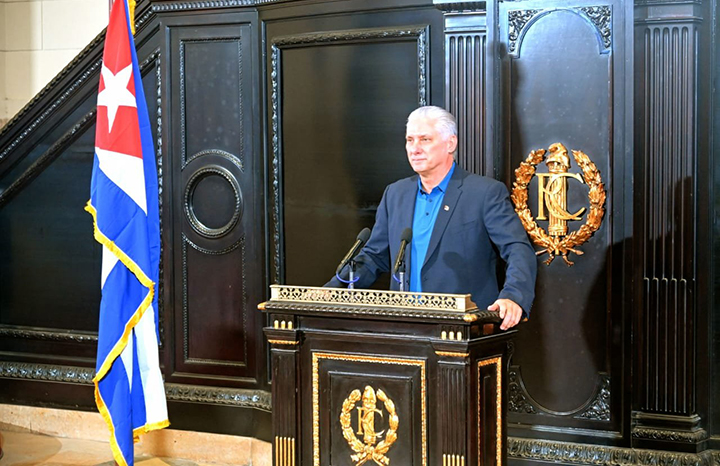
In the National Capitol, Miguel Díaz-Canel Bermúdez, First Secretary of the Central Committee of the Communist Party of Cuba and President of the Republic, led the parliamentary hearing for the 50th anniversary of the creation of the Local Organs of People’s Power, in the «Year of the Centenary of the Commander in Chief Fidel Castro Ruz».
The president highlighted that People’s Power constitutes «the most authentic expression of socialist democracy» and called for revitalising citizen participation, strengthening social justice and defending national sovereignty.
Below the Cuban News Agency reproduces the speech delivered by Miguel Mario Díaz-Canel Bermúdez, First Secretary of the Central Committee of the Communist Party of Cuba and President of the Republic, at the parliamentary hearing of the National Assembly of People’s Power, in the National Capitol, on 24th February 2026, «Year of the Centenary of the Commander in Chief Fidel Castro Ruz».
Dear comrade Esteban Lazo Hernández, President of the National Assembly of People’s Power and of the Council of State;
Comrades:
Today, 24th February, a date that transcends the calendar calls us together. In the history of Cuba, this day is charged with profound meanings that intertwine like threads of the same fabric: that of our sovereignty.
On 24th February 1895, the necessary war was resumed with the cry of independence or death, thus fulfilling Martí’s design. On that same day, but in 1899, the Generalissimo Máximo Gómez entered Havana victorious, and in 1956 José Antonio Echeverría founded the Revolutionary Directorate.
Two years later, in 1958, from the heart of the Sierra Maestra, Radio Rebelde broadcasts began; and in 1976 the first socialist Constitution of the continent was born. In 2008, Army General Raúl Castro Ruz assumed the Presidency of the Councils of State and Ministers. And in 2019 the people ratified the new Constitution of the Republic at the ballot box.
Exactly half a century ago, on this same day, the Local Organs of People’s Power were born. With them, an essential principle of the Revolution took concrete form: that power emanates from the people, is exercised in their name and is owed, before anyone, to their needs and hopes.
It was and is the most authentic expression of socialist democracy and of the will that citizens, from their communities, decide the destinies of the homeland.
This is a day to look back with a deep feeling of respect, but, above all, to look forward with the clarity demanded by these times, because in the conditions of today’s world a 50-year celebration can never be an exercise in nostalgia, it must be, above all, a call to action.
The historic decision of 1976 was not an isolated act; it was the organic continuity of a tradition of struggle and participation, which sinks its roots into the feats of independence, into resistance in the face of adversity and into the deepest conviction that the destiny of the nation is built with the voice and action of the people. It is a concrete expression of the political thought of the Commander in Chief Fidel Castro Ruz.
The Organs of People’s Power were born to be a school of citizenship, a space for debate and collective solutions. For five decades these Organs have been the direct link between the aspirations and demands of each neighbourhood and State policies.
Half a century ago we set in motion a profound idea, which consists of power, to be legitimate, must be born from the neighbourhood, from the Popular Council, from the block and the community.
Our local organs are not a simple administrative design of the chosen form of government. They are our response to the essential question of how to build a democracy where the people are the real and indisputable protagonist of their destiny.
We celebrate half a century. May so many and such strenuous years not be a weight favourable to inertia, but a motivation that impels us towards the future we deserve! We want a more agile, more participatory, more audacious, more inclusive, younger People’s Power. A People’s Power that has the capacity to listen to the slightest whisper of citizens, and sufficient sensitivity to act with agility in response to their legitimate demands.
The people do not ask us for miracles. They ask us for honesty, management and, above all, that we never lose their pace, that we march together, shoulder to shoulder in good times and bad. We live in a complex national context, marked by economic difficulties, in a convulsive world scenario.
There are accumulated pains in our neighbourhoods, legitimate dissatisfactions, impatiences burdened by the weight of the criminal tightened blockade and the inclusion on a spurious and manipulated list of countries that supposedly support terrorism; the maximum economic pressure to suffocate us, the application of unilateral coercive measures, the aggressive pressure of hatred as a fundamental component of the incessant media war that seeks to discredit and disunite us; the dictation of a genocidal Executive Order that aims to deprive the country of vital energy supplies, and, alongside this long list of attacks and threats, our own errors and insufficiencies that we are obliged to recognise and correct without excuses, because only that which is first looked at face-on and with total honesty can be transformed.
We will fight, we will battle, we will resist, we will transform, and over all adversities and imperial threats we will rise and conquer!
The anniversary we celebrate invites us to reflect on the validity of that project of love for the nation, based on unity. It reminds us that democracy is not an abstract concept, but a daily practice that is strengthened by the active participation of all and for the good of all, with transparency in management and with shared responsibility.
People’s Power is, in essence, the certainty that no problem is too big if faced with unity, solidarity and confidence in our own strengths.
Celebrating these 50 years is also renewing the commitment to the future. It is recognising that the Cuba we dream of is built from the local level, from each Popular Council, from each delegate who listens and acts, from each citizen who contributes ideas and effort.
It is reaffirming that social justice, equity and dignity are non-negotiable values and fundamental guides on the path towards the prosperity we deserve.
In line with that will, this Solemn Session is called to transcend the deserved act of remembrance and tribute. It cannot be a succession of slogans. It should and must be, above all, an exercise of conscience and commitment.
Today we must pay tribute to the founders, to the delegates of these five decades, to those who almost always without resources and tirelessly have knocked on doors, listened to complaints, faced the music in difficult assemblies and defended, from the modesty of their constituency, the grand idea that no one can be left to their fate in a revolutionary and socialist State.
And the best tribute we can offer them is not a diploma or applause, it is the will to do better what it falls to us to do now.
What do 50 years of People’s Power mean at this minute of our history? First: it means appreciating the essence of closeness.
In these 50 years the delegate has not only been a representative, they have been the voice of a small environment in the great statistics. In today’s Cuba this function is more vital than ever.
In the delegate the citizen must find not a processor of paperwork, but the neighbour leader of the community who leads with determination and audacity the confrontation of common problems, from the anxieties over what does not arrive at the bodega, the pothole in the street, the breakdown of the transformer or the worries about the young person who neither studies nor works and the elderly without close family support.
Our strength is not in grand proclamations, but in the capacity to resolve the small, yet enormous and always challenging daily life.
Second: it means understanding that participation is not just another name on the list of attendees at an event. It is the engine of collective progress.
For too long we have sometimes confused People’s Power with a transmission belt for decisions already made. The 50th Anniversary demands we take a qualitative leap in this narrow interpretation of a genuine work, profoundly Cuban and greater than ourselves.
We need the municipalities, the true guarantors of the rights that our Constitution enshrines, to exercise their autonomy. The country is saved from the local level, from the capacity of each territory to find its own solutions, to foster its enterprises, to manage its culture and economy with creativity and without unnecessary ties.
Third: it means honesty for analysis and courage for criticism. We cannot look at the path travelled without questioning our shadows. We suffer greatly the consequences of formalism and improvisation that frequently distort and spoil strategic planning.
And we are still too held back by centralism, that is, the excess of centralisation that curbs the creative initiative of individuals, collectives and municipalities. Recognising this is not to weaken us; it is to strengthen us. The true revolution is one that lives by criticising itself so as not to grow old.
Fourth: it means to shield hope. Amidst external hostility, the blockade that tries to suffocate us, the noise and manipulation that seeks to weaken us, the work of People’s Power is the most effective antidote.
Because when a delegate manages, when neighbours participate, when a community organises itself to clean a vacant lot or restore a daycare centre we are demonstrating that here there is a project of social justice capable of constantly renewing itself with its own strengths.
We are not a democracy for shop windows; we are a democracy of trenches, built with enormous sacrifices, it is true, but also with impressive creativity and unsurpassable dignity in the heat of the most difficult battle: that of day by day and hour by hour. In this context the call is clear.
To the delegates: It is not enough to be elected, one must be chosen every day in the respect and trust of the compatriots who are our neighbours.
One must be more in the street than behind the desk, more in the queue than in the meeting, more listening than speaking. One must turn every complaint into concrete management, every criticism into a proposal, every problem into an opportunity to add wills and advance, advance without tiring.
We will not always have resources, but we can always have sensitivity and will to change what must be changed. And the truth, even when it hurts, always builds more than silence or automatic justification.
To the local administrations: People’s Power is not a procedure nor a signature at the end of a resolution. Government management must articulate with the priorities that emanate from the Local Organs, from the municipal assemblies, from the popular councils, from direct analysis with the community.
We cannot allow bureaucracy, routine or lack of control to turn agreements born of popular will into dead letters. To serve the people is to govern facing the people, to account with data and results, to explain when one cannot and to rectify when one has done wrong.
To our people: Today we must also look within ourselves. Participatory democracy is not exhausted by going to vote when the ballot boxes are set up. It is exercised in the accountability assembly, in voluntary work, in the meeting of neighbours who organise to care for the tranquillity of the neighbourhood and who mobilise to support the most vulnerable.
Criticism is necessary, but it is more powerful when it comes accompanied by a willingness to get involved, to propose and to collaborate. The power of the people is not an abstract concept, it is built with names and surnames, with concrete faces, with hands that get down to work, more valuable the more adverse the scenario.
Fifty years later we can say with pride that the system of People’s Power has been a genuinely our own creation, fruit of the experience and political thought that sustains the Revolution, of the Martí legacy, of the ideas of the Commander in Chief and the Army General.
But we must also admit, with humility, that it is an unfinished work, that needs to be perfected and adapted to the challenges of this time: population ageing, migration, new technologies, new ways of participating, new ways in which human groups form their opinions and expectations.
The Local Organs of People’s Power must be capable of dialoguing with a country that is not the same as in 1976, and of doing so without renouncing their founding principles.
May this 50th Anniversary be then a turning point, not the finish line. A moment to reaffirm that we will not renounce the idea that the people decide, control, demand and participate.
A moment to say, with serenity and firmness, that we are willing to change everything that must be changed in the way institutions function, provided it is to strengthen social justice, equity and conscious participation.
In the name of all who have dedicated their lives to public service from a constituency, of all who have carried on their shoulders the concerns of their neighbourhoods, of those who have opened their doors at dawn to attend to an emergency of others, let us reaffirm today a simple and profound commitment:
Never lose the bond with the people.
Assume the pain of others as one’s own.
Not to settle for explanations that do not solve. Insist on solving.
Not to renounce the ideal that, despite difficulties, in Cuba power continues to have the surname of people.
Honour to those who began this path fifty years ago!
Responsibility for those who continue it today.
May history, in another 50 years, be able to look towards this moment and recognise that we rose to the challenge.
May this anniversary be, then, a call to revitalise participation, to defend sovereignty and to keep hope alive for a better tomorrow.
People’s Power is not just a structure. It is the expression of a people that, with its history and its will, continues to be the protagonist of its destiny.
For these 50 years of shared history; for the delegate who daily walks the neighbourhood transforming spaces and mentalities, without tiring however much the sun beats on their back; for the people who are the sole Sovereign:
Long live People’s Power! (Exclamations of: «Long live!»)
Long live Fidel and Raúl! (Exclamations of: «Long live!»)
And so that it may always be thus, let us reaffirm our unwaverable conviction of:
Socialism or Death!
Homeland or Death!
We will win! (Applause.)