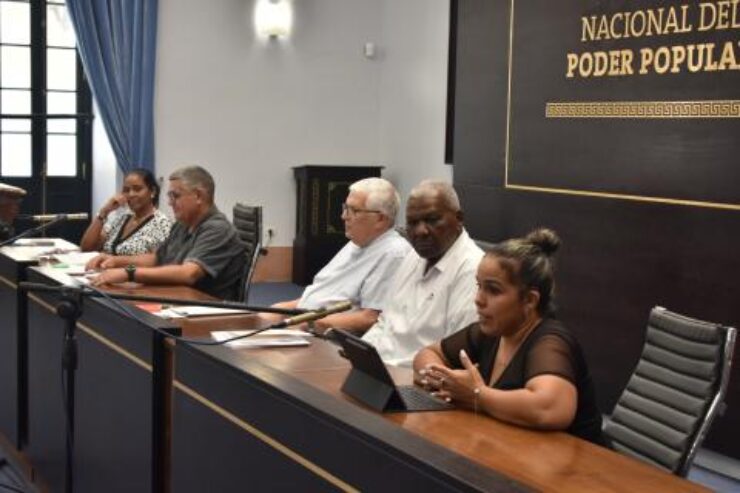
Five draft laws will be debated in the 7th Ordinary Period of Sessions of the National Assembly of People’s Power (ANPP), in its X Legislature, convened from this Wednesday at the Convention Palace in Havana and via videoconference from the provinces.
This meeting format, also used for the Third Extraordinary Session of that supreme body of State power, is being repeated due to the serious economic and fuel limitations the country is going through.
Doctor of Juridical Sciences and Secretary of the ANPP and the Council of State, José Luis Toledo Santander, informed national media on Tuesday that the packed agenda of the plenary session includes information and analysis on the implementation of economic and social transformations, an update on the progress of the execution of the State Budget in 2026 and the validation of the Budget for the preceding year, as well as the swearing-in of deputies elected in recent days.
Regarding the draft laws that will once again be debated and approved, he stressed that this is one of the final actions in that regard, since legislative activity is permanent, and several of these proposed legal norms — responding to the changes arising from the Government Programme and the economic and social transformations — have been in development for some time, as part of the deputies’ responsibility to contribute to the legal framework in Cuba.
Mid-July Analysis
The above is exemplified by the meetings of deputies from across the country held via videoconference in mid-month, available on the Cuban Parliament website, https://www.parlamentocubano.gob.cu.
According to this source, in recent days the following draft laws were studied: Agricultural and Forestry Land Law, Housing Law, System of Personal Identity and Domicile Law, Labour Code and Organisation of the Central State Administration Law.
The first integrates and modifies scattered legal provisions, with the aim of promoting a coherent and modern legal body; thus, it updates the regime of property, possession, succession by reason of death and use of land and agricultural assets, as well as their systemic unification, for the proper regulation, management and administration of land as a fundamental means of production.
With this, it is put in service of agrarian development, as the basis of food sovereignty, the revaluation of rurality and the social justice of the Cuban socialist economic and social development model.
At that time, the president of the ANPP Agri-Food Commission, Ramón Aguilar Betancourt, highlighted that the proposal responds to the need to strengthen institutionalisation in the agricultural sector and guarantee a rational and sustainable use of resources.
For its part, the Housing Law draft aims to establish and regulate the ways in which the State makes effective the right of people to adequate housing and to a safe and healthy habitat with criteria of climate resilience and energy efficiency.
The president of the parliamentary commission for Industry, Construction and Energy, Magda Ileana Pérez Matos, ratified that in the case of the Ministry of Construction, its role as the governing entity is established, in charge of directing state housing policy, integrating socio-cultural, economic and environmental dimensions.
The legislative debate included the draft law on the System of Personal Identity and Domicile, aimed at «establishing and regulating the System of Personal Identity and Domicile, guaranteeing the recognition and protection of the identity of Cuban and resident foreign citizens, as well as the determination, registration and updating of domicile as a legal-administrative attribute», in coherence with the Migration, Citizenship and Foreigners laws.
The importance of having a single and reliable registry that supports legal security and facilitates administrative procedures was underlined. Hence, the proposal will allow for the unification and modernisation of official registries, which will contribute to more efficient public management and the organisation of services linked to social life.
Likewise, the Labour Code draft law was evaluated, which updates and improves the regulations guaranteeing the protection of rights and the fulfilment of duties arising from the individual legal-labour relationship established between workers and employers, whether in the state or non-state sector.
Deputies and authorities from the Ministry of Labour and Social Security recognised that, since its first version, the role of trade union organisations was fundamental for its strengthening, based on proposals derived from a broad consultation process.
Last but not least is the draft law on the Organisation of the Central State Administration, whose articles are in line with the economic and social transformations recently approved in the country, and which determine the number, denomination, mission and functions of the ministries and other bodies that compose it.