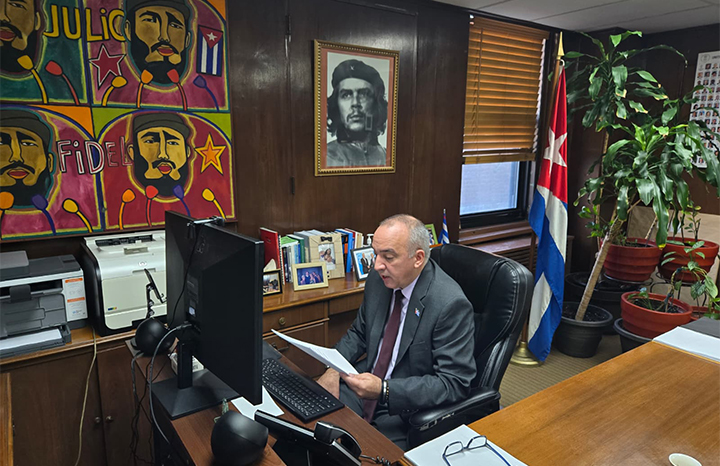
The humanitarian and genocidal impact of the US blockade on the Cuban people was exposed by Ernesto Soberón Guzmán, Cuba’s Permanent Representative to the United Nations, in an intervention during a virtual briefing organised by the Office for the Coordination of Humanitarian Affairs (OCHA) on the updated UN Action Plan in Cuba and the so-called «humanitarian reset», held from Geneva.
According to details from Cuba’s Permanent Mission to the United Nations on its Facebook profile, during his intervention the diplomat denounced that the US policy against Cuba, maintained for more than six decades, seeks to cause shortages and affect the living conditions of the people through an economic, commercial and financial blockade rejected by the international community.
Soberón specified that since 2019, with the imposition of more than 250 new coercive measures, the siege has intensified, particularly in the energy sphere.
He noted as particularly serious the decision adopted on 29 January 2026 to threaten tariff reprisals against countries that export fuel to Cuba, which constitutes — he stated — a total energy blockade with severe social and humanitarian consequences.
The Ambassador stressed that these actions directly impact essential sectors such as transport, medical services and the daily lives of millions of Cubans, especially affecting vulnerable groups.
He also denounced the extraterritorial nature of recent measures directed against financial entities in third countries, as they contravene the United Nations Charter and International Law.
Despite these challenges, he reaffirmed the determination of the Cuban people to move forward and avoid a humanitarian crisis, supported by their universal health, education and science systems, as well as the capacity and preparedness of their human resources.
The Permanent Representative thanked the sustained support of the United Nations, OCHA and the Office of the Resident Coordinator in Cuba, as well as the contributions of Member States and international partners to the updated Action Plan.
He also reiterated that such cooperation is essential to address the country’s complex current circumstances and contribute to the well-being of the people, while reaffirming the firm defence of national sovereignty and independence.