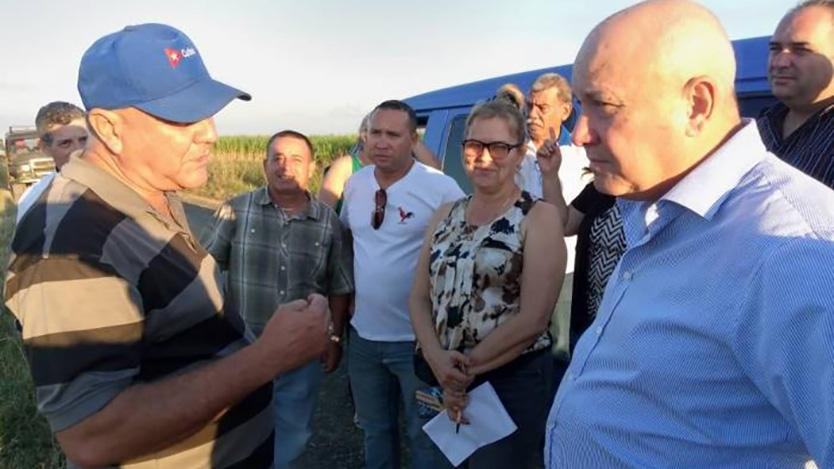
Jorge Luis Tapia Fonseca, Deputy Prime Minister of Cuba, toured areas of the municipalities of Morón and Ciego de Ávila, and analysed before representatives of the Administration Councils, producers and directors of enterprises and organisations of both territories, strategic topics of the Government Programme to Correct Distortions and Reinvigorate the Economy.
During the meeting, Tapia demanded greater effectiveness and a clear orientation towards solving problems, with direct exchange with the population.
He placed special emphasis on increasing food production, accelerating land distribution and efficiently using that already distributed, in order to convert each territory into the engine of its own transformation.
«We cannot look to the ship that arrives at the port with the rice. We have to produce it in the municipality, in the enterprises and even in the People’s Councils if necessary, and in Ciego de Ávila there is land and experience for the advancement of that programme.»
Analysing the topic of commerce and gastronomy, the Deputy Prime Minister made a call to action with fixative. With that metaphor he underlined the necessity for achievements to be sustainable and not passing efforts.
He gave as an example that the Avilanian province had a restaurant network among the best in the country and today it is not so, while many of them remain closed and do not offer services to the population.
Other facets of the analysis led to non-payments by Acopio to producers, discrepancies with the banks, both the Credit and Service Bank and the People’s Savings Bank, the strengthening of productive linkages with industry, the availability of labour force in areas assigned to enterprises and the payment of workers.
He emphasised that the presidents of the People’s Councils must position themselves at the very centre of the problems, not as distant observers, but as committed actors. Their fundamental work is to know in depth the realities of their community, diagnose its needs and, based on that knowledge, drive and articulate joint action.
He insisted that the effective solution to everyday challenges is not decreed in isolation; it requires the coordinated mobilisation of the very neighbours, the enterprises located in the territory and the different organisations and institutions. Only through this integration of wills, resources and perspectives, with the council president as dynamiser and link, can viable, sustainable and truly adjusted solutions to the population’s interests be generated. It is the essence of an effective and truly popular local government.