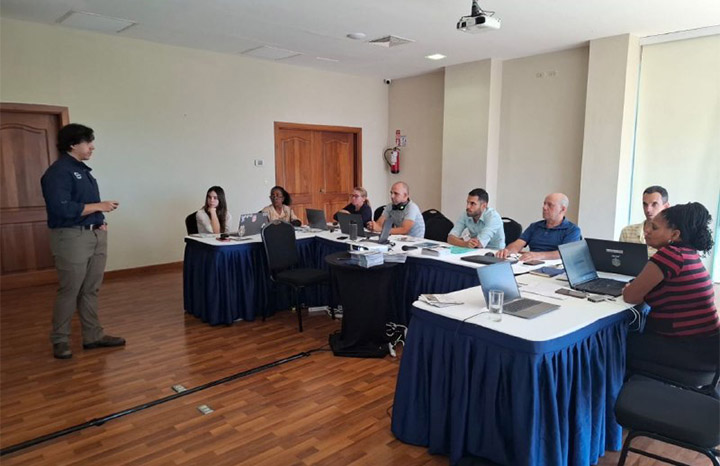
Cuban professionals are acquiring new skills for the management and conservation of internationally significant environments by participating in the Workshop on the Design and Implementation of Wetland Monitoring for the Efficient Management of Caribbean Ramsar Sites, taking place from 13 to 16 April in the Dominican Republic.
The delegation from the largest island in the Antilles is made up of eight directors and specialists from the National Centre for Protected Areas, the Centre for Environmental Studies and Services of Sancti Spíritus, and the Centre for Environmental Engineering and Biodiversity of Ciego de Ávila (CIBA-CA), all part of the Ministry of Science, Technology and Environment (CITMA).
According to the participants’ report, representatives from the Flora and Fauna Business Group, the CITMA General Directorate of Environment, and the territorial delegations of that institution in the provinces of Granma and Ciego de Ávila are also attending.
In statements to the Cuban News Agency, Yamilé Jiménez Peña, director of CIBA-CA, spoke about the professional opportunity that attending this event represents, convened by the Regional Office for Mexico, Central America and the Caribbean of the International Union for Conservation of Nature (IUCN-ORMACC).
She argued that this is an event sponsored by the Convention on Wetlands, within the framework of the implementation of the project «Rational use of Caribbean wetlands for climate change mitigation and conservation of their ecosystem services».
This event is also financed by the International Climate Initiative of Germany, and implemented by the IUCN.
Daylon Fundora Caballero, principal specialist of the CITMA Environment sub-delegation in Ciego de Ávila, detailed that the Cuban delegation is made up of actors involved in decision-making processes and the management of globally significant wetlands, classified as Ramsar sites.
He valued the opportunity to incorporate knowledge for their work in environmental control and methodological advisory activities, as well as his role as an assistant researcher at CIBA-CA, linked to four research projects being implemented in the Great Wetland of Northern Ciego de Ávila (GHNCA).
Fundora Caballero specified that the knowledge will be shared and useful for executing future projects in the GHNCA, where numerous human settlements belonging to five Avilanian municipalities are located, and where several agencies converge to carry out economic and social activities.
Jiménez Peña highlighted that the centre she directs has an extensive history of studies in the GHNCA, mostly linked to food production using sustainable agriculture techniques, the management and control of water resources, and the rehabilitation of mangroves and coastal dunes.
She also noted that the centre is venturing into research on reptile communities as bioindicators of the health status of plant formations.
To this are added hazard, vulnerability and risk studies, and the experience accumulated by participating in international projects such as Coastal Resilience, Euroclima Plus and Sustainable Tourism, financed by the Global Alliance for Climate Change, the French Development Agency and the Global Environment Facility, respectively.