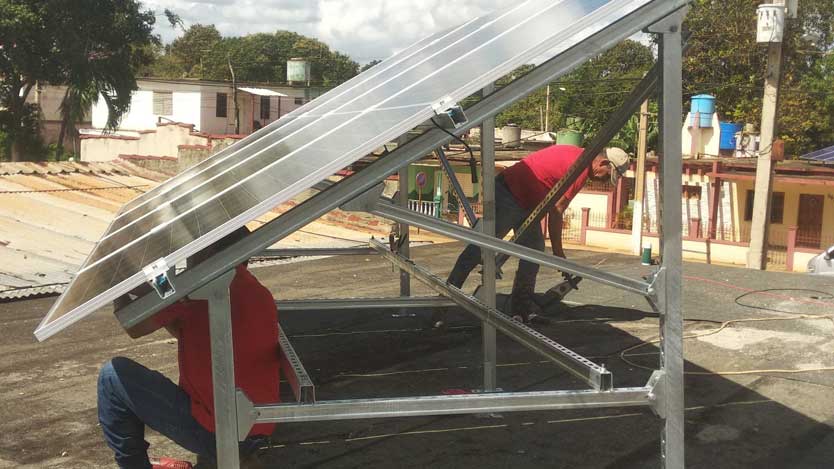
According to Dr Dianelys González Gallego, head of Primary Health Care at the Provincial Health Directorate, confirmed to Invasor, all 19 polyclinics in the province now have photovoltaic kits installed and operational.
«Not only those located in the municipal capitals, but also those providing services in some towns have their photovoltaic systems active,» the specialist specified.
Each of these centres has 2 KW panels, a capacity that, while not addressing all healthcare needs, has brought about a qualitative change in daily service.
«It has allowed us to attend to the population without darkness. We no longer depend on torches or mobile phone lights. We have fixed electric lighting to attend to patients in our consultations,» explained González Gallego.
However, the official clarified that the 2 KW equipment cannot power services such as ultrasounds, X-rays or clinical laboratory equipment simultaneously or continuously.
Faced with this reality, each polyclinic has designed alternative strategies: patients are attended to, samples are taken and processed when conventional electricity returns, or higher-energy-consumption studies are rescheduled.
Among the 19 centres, there is one notable exception: the Norte Polyclinic, located in the municipal capital of Ciego de Ávila. This centre has a 10 KW photovoltaic system, which allows it to offer a wider range of services.
«That polyclinic does have enough capacity to provide vital services such as X-rays, ultrasounds and laboratory analyses. That is why it has become a natural concentration point for a large part of the population of the capital,» said the doctor.
Nevertheless, she recalled that these services require air conditioning and sometimes cannot be used simultaneously. But, in relative terms, the Norte Polyclinic today represents the reference facility for care with solar backup in the province.
Dr González Gallego called for patients’ understanding: «We continue working to improve. The panels have given us stability for essentials, and at the Norte Polyclinic, we can concentrate on more complex services. The entire system is reorganising to ensure no one is left without care.»
With this initiative, Ciego de Ávila continues to integrate renewable energy into the health system, although the challenge remains to expand installed capacity to achieve full service coverage.