
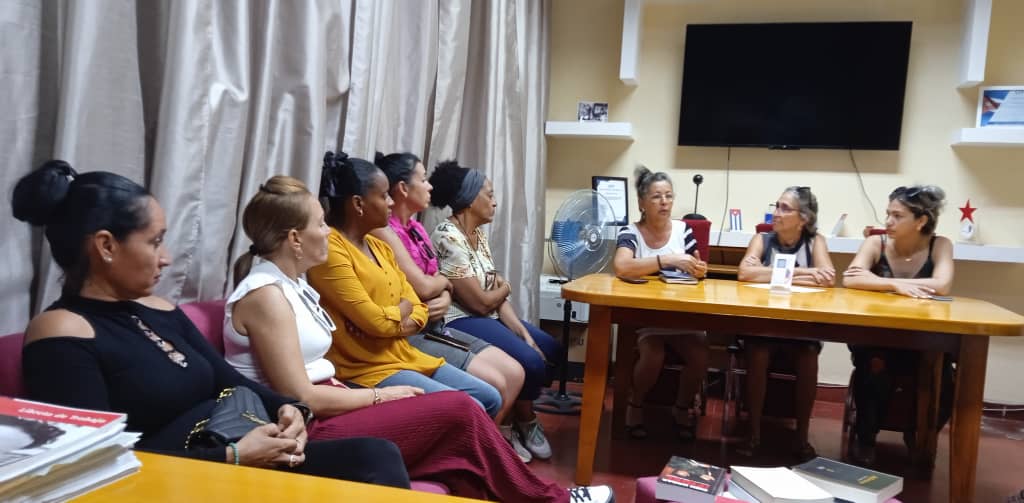
- During the meeting, examples were presented where the country’s legislative changes have expanded the ombudsman’s scope of action towards the most vulnerable people in society.
Electoral authorities of Ciego de Ávila exchanged views on attention to vulnerable members of society with officials and directors of the Ombudsman Department of the Ministry of Justice and the Special Education Directorate of the Provincial Education Directorate.
With the presence of Hilda Lidia Díaz Reyes and Heidy Santana Pacheco, head and specialist, respectively, of the aforementioned department, the electoral authorities received an update on the role of that structure, which emerged as a result of the latest legislative changes in the country, including the Family Code.
«This is a relatively new activity within the Ministry of Justice of the Republic of Cuba and the Provincial Justice Directorate in the territory, so it needs dissemination and coordination with other institutions and bodies,» noted Hilda Lidia Díaz.
The director explained that the electoral system, through its capacity to reach the grassroots of society via community communication, could be a channel to publicise the rights and protection mechanisms for people who are socially vulnerable, because they have limitations of various kinds in defending their rights, especially the elderly and minors.
«It is necessary,» she said, «that the ombudsman mechanisms be known at the level of constituencies and neighbourhoods; these can be diverse, for example, advising, activating administrative or legal processes on behalf of people who have been left alone or whose rights are being violated.»
Among the examples presented, in which the department has acted, are mediation and supervision in divorce proceedings, where the litigation has been on the verge of affecting the rights and assets of minors or vulnerable elderly people in need of being incorporated into the Family Care System.
Sometimes, explained Heidy Santana Pacheco, officials of the aforementioned department encounter situations that do not reach the Ombudsman’s Office; hence the need for other institutions to know about that function and help increase awareness and participation in citizen protection.
In the case of the education sector, María Esther Pol Luis, head of Special Education departments at provincial level, and Clara Reyes González, director of the Home for girls, boys and adolescents without parental care, referred to the need to deepen the link.
To this end, they gave examples of situations, including cases in which young people in the care of the Home have been granted housing prescribed by the State, and the parents, who at the time denied parental care, have attempted to make use of those assets, which has led to the activation of citizen defence mechanisms.
The officials from both sectors specified that the legislative changes have expanded the margins of citizen defence, since today, for example, it is possible to proceed with the revocation of a will granted by an elderly person in exchange for receiving care, where the beneficiaries of the deed did not comply in real life.
Marlenys Baez Valdivia, vice-president of the Provincial Electoral Council, noted the importance and sensitivity of the Ombudsman Department’s mission, so it was agreed to extend the exchange to the Municipal Electoral Councils as a way of achieving greater integration.
Produced by Luis Raúl Vázquez Muñoz, institutional communicator of the Provincial Electoral Council of Ciego de Ávila.