There was no need to cross the Atlantic or set foot in the glass headquarters in New York to feel the weight of diplomacy. For two days, Ciego de Ávila became a hive of ideas, rebuttals and agreements.
In the midst of a global scenario fractured by tensions and conflicts, and strictly complying with the reduced capacity demanded by current circumstances, the MUNDÁVILA event demonstrated that university diplomacy remains an irreplaceable bastion.
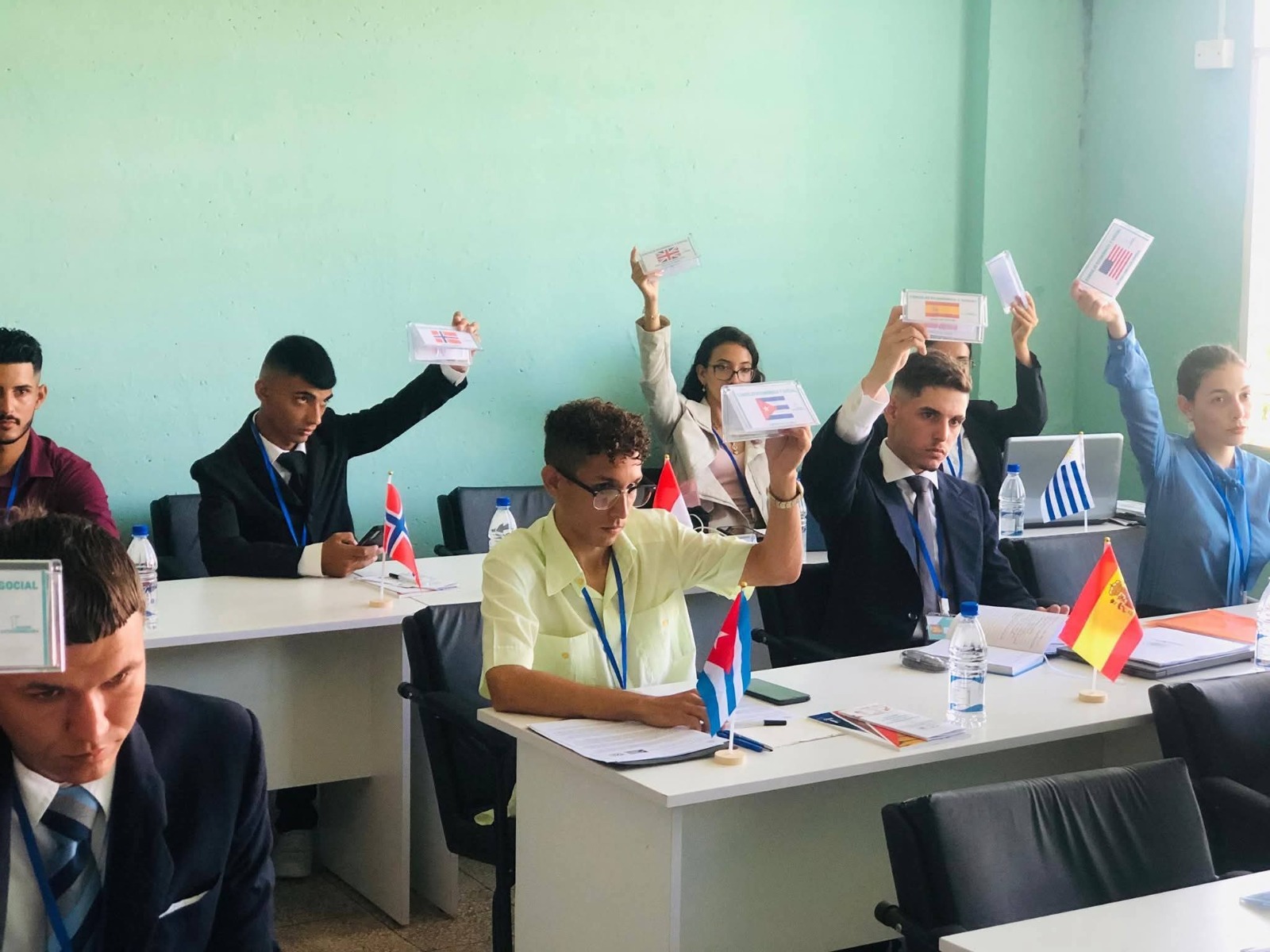
The summit moment of the event arrived when the Human Rights Council, composed of students with the seriousness of true ambassadors, approved a historic resolution. With 15 votes in favour and only 3 against, a document was endorsed that reinforces international cooperation in the protection of fundamental rights.
Behind those figures, there was no frivolity: delegates from 20 countries debated with passion and stature on technical assistance, exchange of good practices and strengthening of human rights mechanisms. Each intervention was guided by the spirit of Vienna and the UN Charter, as if the world truly depended on their words.
But MUNDÁVILA is not just a simulation exercise: it is a school of life. Aware that human rights are not defended only in speeches, the academic programme was enriched with collateral activities of profound human meaning.
The visit to the Camilo Cienfuegos Gerontological Centre, promoted by the Querubín Project of the Faculty of Social and Humanistic Sciences together with the UJC Community Youth Network, took the theoretical debate into practical solidarity. That afternoon, the future communicators and leaders did not debate old age; they shared smiles and listened to stories, reaffirming that human dignity has a face and a name.
The closing of the event held the greatest emotion. Technology erased distances and connected the Avilanian youth with the rector of their Higher Education institution, Yurisbel Gallardo Ballat, who was following the debates from Peru.
His intervention, charged with an almost paternal pride, stated: «What I see is not a simple student gathering; I see the future of my Cuba in each one of you.» And he added, in a phrase that resonated among the attendees: «In complex times, where everything seems to push backwards, you choose to stay, to build, to debate and to grow. You are not young people who wait; you are young people who act.»
Gallardo Ballat recognised the value of resilience and a positive attitude, and dedicated a special recognition to the young Kevin Marcos Delgado Álvarez, Secretary General of the United Nations Model, for his dedication and example.
The icing on the cake came with a symbolic act of great institutional weight: the signing of the MUNDÁVILA Statutes, a document that consolidates the principles and norms of the Model. With that ink on paper, MUNDÁVILA ceased to be an isolated event to become a perpetual legacy, a formal commitment to international law and respectful dialogue.
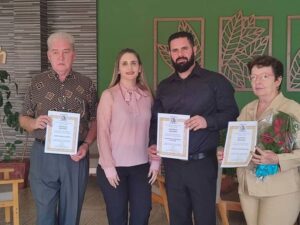
The meeting also served to honour Lilian María Ramos Conde, sub-secretary and executive coordinator of the event, who closes this student cycle to enter working life. With diplomas in hand, delivered by Kevin Marcos Delgado Álvarez, and the bright gaze of her peers, Ramos Conde received recognition for a dedication that transcends the classroom. Her departure is not a goodbye, but living proof that MUNDÁVILA trains professionals ready for the world.
In his closing remarks, Law graduate Delgado Álvarez highlighted: «We have demonstrated that when political will meets young talent, the results are extraordinary. We have seen how science and technology ceased to be abstract concepts to become concrete tools for social transformation. And we have seen, above all, that multilateralism is not only possible, but indispensable. This session has been a testing ground, a laboratory where we have rehearsed solutions that we will later elevate to the General Assembly in the next ordinary session. We take away the certainty that youth has the capacity, the energy and the intelligence to build a better world.»
At the end of the day, amid hugs and promises to meet again at the next edition, it was reaffirmed that these United Nations models are an invaluable pedagogical tool. They train professionals with political sensitivity, ethics and an internationalist vision that Cuba needs.
The Avilanian university students do not wait for change to come; they are generating it, debate by debate, hug by hug, with their gaze fixed on a world where human dignity is, finally, the centre of everything.