
The Orion spacecraft of the Artemis II mission entered the Moon’s sphere of influence this Sunday, the point at which the natural satellite’s gravity begins to become stronger than Earth’s, while the four astronauts prepare for the key day of the journey, this Monday, when they will see the more hidden side of the Moon.
This Monday, in addition to having a close-up view of the far side of the Moon, commander Reid Wiseman and astronauts Victor Glover, Christina Koch and Jeremy Hansen will surpass the record distance of more than 400,000 kilometres from Earth in deep space, which will interrupt their communication with NASA for about 40 minutes.
On the sixth day of the mission following launch last Wednesday from Cape Canaveral, Orion is to reach its farthest point from Earth as it travels 4,000 miles (6,400 kilometres) beyond the Moon, meaning Artemis II will surpass the distance record of the Apollo 13 mission and make its astronauts the furthest travellers to date.
Apollo 13 set the record in 1970 — almost 250,000 miles (400,000 kilometres) from Earth — days after an explosion in its oxygen tank, which endangered the crew’s lives and changed the mission plan, which focused on returning home and ruled out landing on the Moon.
This Sunday, NASA released a photograph of the far side of the Moon captured by the Artemis II crew, which is close to reaching its goal of becoming the first crewed mission to reach the natural satellite’s orbit in more than half a century, after the crew of the Apollo 17 mission did so in 1972, marking the end of that programme.
In the image, taken on Saturday, the Moon is seen upside down, with its South Pole pointing upwards and a complete view of the Moon’s Oriental Basin, which has never before been seen in its entirety by human eyes, according to the space agency.
The Oriental Basin will be an ongoing object of study for the crew, who hope to reach a strategic observation point of the far side of the Moon this Monday, after travelling the greatest distance ever from Earth: 406,773 kilometres.
«Last night we had our first view of the far side of the Moon and it was absolutely spectacular, and there’s something in your senses that tells you it’s not the Moon I’m used to seeing,» astronaut Christina Koch told the US channel NBC in an interview with the crew this Sunday.
«We pulled out our lunar navigation information and compared it, and said: that’s the dark side,» she added.
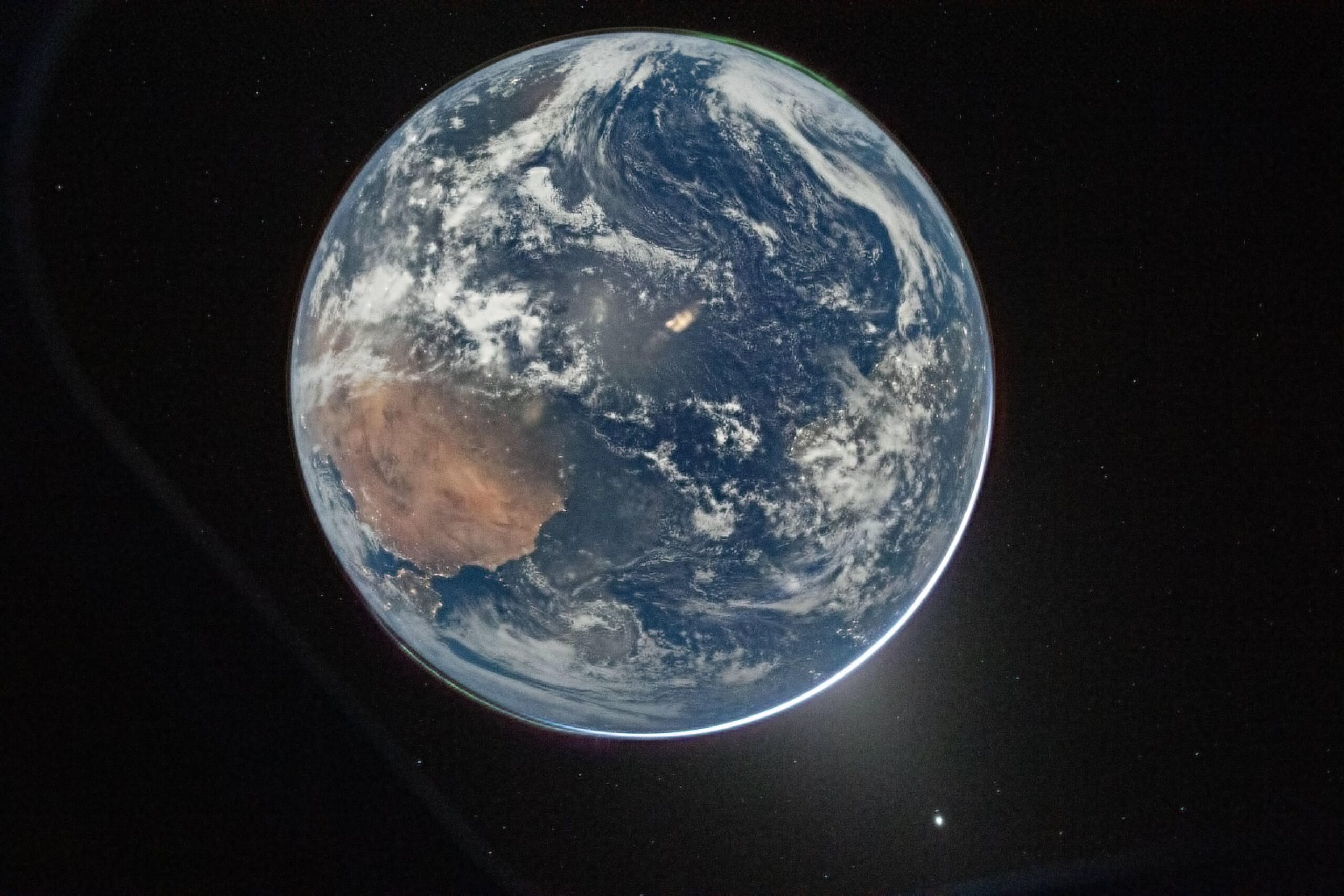
As they approach the Moon, the crew continue to look at Earth. This Sunday, the fifth day of the journey, the mission took a photo of the planet from inside the Orion spacecraft.
Orion has more than 32 cameras and devices — a figure that includes any instrument with a lens capable of capturing photos or video — located both inside and outside the spacecraft.
Fifteen cameras are mounted directly on the spacecraft, while 17 are handheld cameras operated by the crew, who have already shared several images of Earth, the Moon, and several selfies of the Orion capsule.
In one of the first photographs taken by Wiseman, which has gone viral, the complete planet is seen with the predominant blue of the ocean, swirls of white clouds and a large brown land mass corresponding to Africa, an image reminiscent of one captured by the Apollo 17 mission more than half a century ago.
The crew will not land on the Moon and after the lunar journey will begin their return to Earth. It is planned that on the tenth day of the mission the Orion capsule will arrive at sea, off the coast of San Diego.