
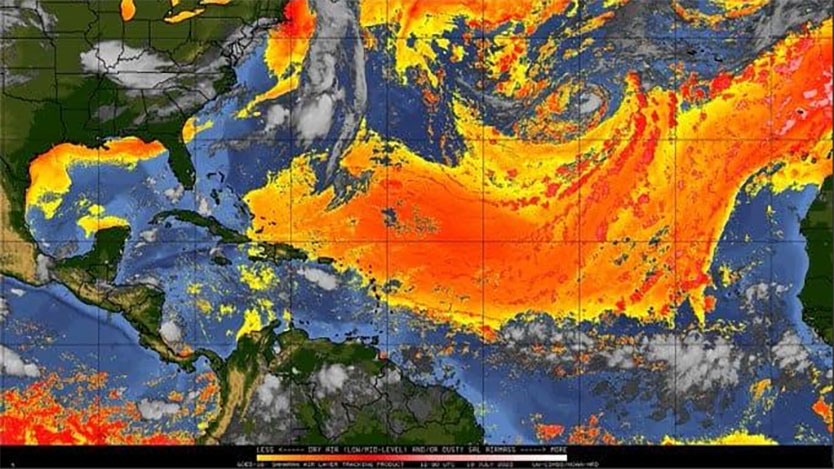
In recent days, we have had, over Cuba, the presence of dust clouds from sandstorms originating in the Sahara Desert in Africa.
Every year, in the summer and autumn months, the Caribbean becomes the recipient of this most massive atmospheric transport phenomenon of mineral dust on the planet.
This phenomenon arouses great interest and much controversy among the population, so on this occasion we will be addressing the particularities of the dust clouds that are part of the atmosphere these days.
The so-called Saharan Dust is mobilised from the vast areas of the central and western Sahara. Dry convective storms and squall fronts associated with the African easterly jet lift fine particles to the mid-troposphere (850–500 hPa).
Once suspended, the dust is encapsulated in the Saharan Air Layer (SAL), an extremely dry and warm air mass that moves westwards embedded in the trade winds.
The thermal gradient generated by this dust layer is key: the absorption of solar radiation by the dust heats the layer, creating a temperature inversion at its base that acts as a «cap» inhibiting deep convection.
This dust jet can cross the Atlantic in five to seven days, first impacting the Lesser Antilles and then the entire Antillean arc, Central America, the Yucatán Peninsula and the Gulf of Mexico, with episodes of high concentration usually extending from June to August.
Modulation of Hurricane Activity
The most publicised and studied effect of the Saharan Dust layer is the suppression of the genesis and intensification of tropical cyclones. The mechanism is not single, but a combination of factors operating synergistically.
On the one hand, the intrusion of dry air at mid-levels means relative humidity can fall below 30 per cent, eroding the cyclone’s warm core by favouring the evaporation of convective towers and the formation of cold downdrafts.
In addition, an increase in vertical wind shear occurs in this layer. The difference in heating in this layer accelerates the African easterly jet, increasing shear over the tropical Atlantic, which disorganises the vertical structure of pre-existing disturbances.
The temperature inversion at the base of the Saharan Dust layer inhibits the development of the deep convection necessary for cyclogenesis. By absorbing solar radiation, this dust warms the mid-troposphere and cools the ocean surface, reducing the latent heat flux that feeds the cyclone.
Saharan Dust and Precipitation
The combination of atmospheric stabilisation and surface cooling disrupts rainfall patterns on different scales. The eastern Caribbean islands experience a marked reduction in daytime rainfall during the presence of dense dust, affecting rain-fed agriculture and aquifer recharge.
There is evidence that years with a large Saharan dust load shift the Intertropical Convergence Zone southwards or weaken it, modulating precipitation in north-eastern Brazil and the Amazon region.
Part of the phosphorus and iron deposited in the Amazon comes from the Sahara, fertilising the forest, but the reduction in radiation and induced stability can depress Amazonian rainfall during the dry season.
Despite its negative impacts, Saharan dust also has its benefits. Saharan dust is a vital source of iron, phosphorus and reactive nitrogen for the waters of the Caribbean Sea and the western Atlantic.
Iron, in particular, is a limiting micronutrient for phytoplankton primary productivity in vast oceanic areas. Dust waves trigger phytoplankton blooms that increase atmospheric CO₂ uptake through photosynthesis, coupling the biogeochemical cycle of dust to the global climate through a negative feedback (carbon sequestration in the deep ocean).
Saharan dust can have significant implications for air quality and human health, particularly in regions downwind of dust source areas.
Dust storms can raise levels of particulate matter (PM) in the atmosphere, including coarse and fine particles capable of penetrating deep into the respiratory system.
This can aggravate respiratory conditions, trigger allergic reactions and contribute to cardiovascular morbidity, posing risks to vulnerable populations, such as children, the elderly and individuals with pre-existing respiratory diseases.
In summary, the presence of dust clouds from the Sahara not only determines whether it will rain or not in the coming days, but constitutes a complex atmospheric phenomenon that is interrelated with other atmospheric processes.
Although they originate thousands of kilometres from our country, their impacts define the weather for many days during the rainy season in our country, being more than a simple air pollution phenomenon.
*Meteorologist of the Provincial Meteorological Centre