The main modifications incorporated in the Draft Law of the new Labour Code were presented this Friday during the sessions of the 22nd Congress of the Cuban Workers’ Federation (CTC), as part of the process of updating the legal framework that accompanies the economic and social transformations approved for the country.
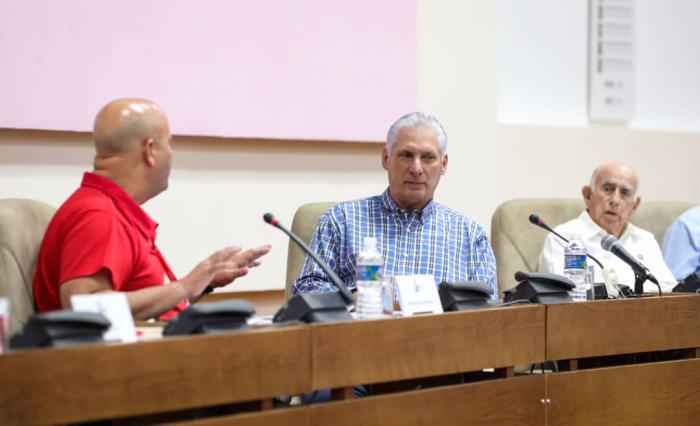
The session was presided over by the First Secretary of the Party Central Committee and President of the Republic, Miguel Díaz-Canel Bermúdez, and by Politburo member and Central Committee Organisation Secretary, Roberto Morales Ojeda, together with other Party, Government and trade union organisation leaders.
When presenting the topic, the Minister of Labour and Social Security, Jesús Otamendiz Campos, explained that the legislative proposal is based on the 2019 Constitution of the Republic, the Programme for the updating of the economic and social model, the National Economic and Social Development Plan up to 2030 and other legal norms approved in recent years, in addition to the international labour conventions ratified by Cuba.
He highlighted that the text was enriched through a broad consultation process conducted between 8 September and 12 December 2025, during which 40,591 meetings were held in state work collectives, self-employed workers, MSMEs, mixed entities and Cuban missions abroad.
In this process, 2,014,338 workers participated, equivalent to 87% of those expected, who formulated 96,250 proposals; of these, 41,403 were accepted, 9,641 partially accepted, 8,703 led to clarifications, while 33,687 were not incorporated and 2,816 corresponded to matters outside the scope of the regulation.
Among the topics that generated the most debate were the maintenance of 17 years as the age for acquiring legal capacity to establish employment relationships; the exceptional incorporation into employment of adolescents between 15 and 18 years; multiple employment; unpaid leave; compliance with social service; protection of workers’ income; and the conceptualisation of new hiring modalities.
Otamendiz Campos explained that the new Code extends its scope to all employers and workers, regardless of the sector in which they perform their duties, and incorporates provisions to regulate combined work, strengthen the protection of working people, and specify rights and duties in line with the transformations experienced by the Cuban labour landscape.
The proposal also improves the regulation of worker transfers between territories, strengthens the protection of women and people in vulnerable situations, prohibits the use of fixed-term contracts to cover permanent activities, and incorporates the principle of demonstrated ability for access, permanence and promotion in employment.
Among the novelties pointed out by the head of the Ministry of Labour and Social Security is the possibility of establishing working days of less than eight hours with proportional remuneration, according to the characteristics of the post and the worker’s competencies, as well as the strengthening of mechanisms for resolving labour disputes, including mediation and collective bargaining.
The Minister also explained that the preliminary draft incorporates the adaptations derived from the economic and social transformations, the policies linked to foreign investment, migration provisions and other recently approved norms, to harmonise the labour legal framework with the country’s economic reality.
At the conclusion of his intervention, he affirmed that the Ministry of Labour and Social Security is working together with the CTC so that, once the Code is approved, the modifications can be implemented as swiftly as possible, in line with the transformations promoted by the country and to strengthen the protection of labour rights in all forms of economic management.