An entire nation paused today to honour those fallen on Venezuelan soil, while the words of an improvising Avilanian poet give voice to the collective pain.
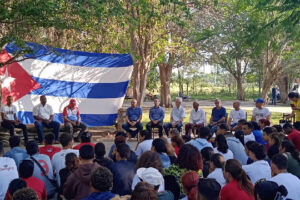
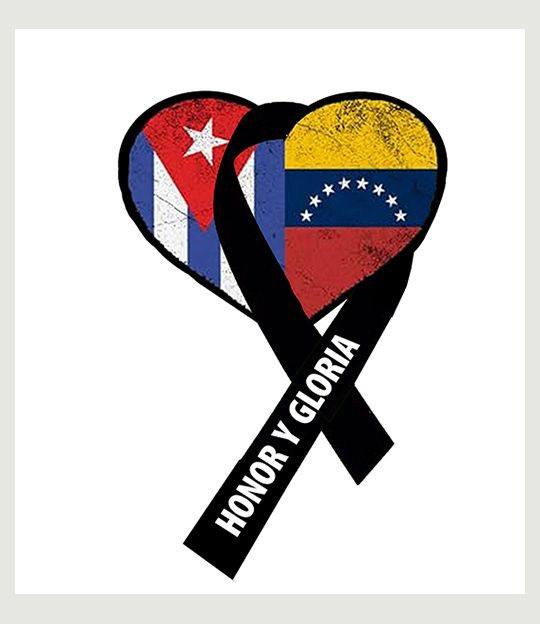
For the first time in many years, Cuba dawned dressed in a mourning that did not need official proclamations to settle in every heart. From Pinar del Río to Guantánamo, the entire country paused this Friday to pay homage to those who departed for Venezuela and returned transformed into absence, into a flag at half-mast, into contained tears.
In Ciego de Ávila, Miguel Salazar Rodríguez — a man of science accustomed to the precise language of laboratories and the hermeneutics of the Social Sciences — found that only poetry could contain what overflowed from his chest. His improvised verses circulate today from hand to hand, from telephone to telephone, as if millions of Cubans had been searching for exactly those words to name the unnameable.
«Who says they have died / they who have touched the glory / of duty fulfilled,» wrote Salazar, and in that poetic denial beats something profoundly Cuban: the incapacity to accept that death could defeat the sense of duty, the conviction that took those men and women to Venezuelan soil.
They were not soldiers who fell in open battle. There was no time for textbook heroics or for memorable last words. The violence that reached them was sudden, treacherous, as all aggression that takes shelter in the shadows usually is. But the Avilanian poet names it without euphemisms: «Treacherous imperial claw / in the unredeemed land / of Chávez and of Maduro.»
Latin America, that America which has so often seen its land stained with the blood of foreign children who made it their own, «trembles with shared rage and pain.» Because these Cuban dead in Venezuela are not only Cuba’s: they belong to that greater geography of internationalism that has taken Cuban doctors, teachers and technicians to fifty countries of the world.
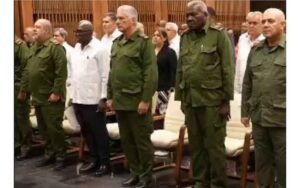
The country’s squares filled today with grave faces, with impeccable uniforms, with flowers that seemed insufficient before the magnitude of the loss. In each act, in each minute of silence, Salazar’s verses resonated as an invisible mantra: «They have not died brothers / they have risen to the eternal / altar of the grateful Homeland.»
«Cuban blood bathes / the painful night / that does not end,» wrote the poet. And it is true: this Friday of national mourning seems to extend beyond the hours, to settle as a persistent mist in the collective mood. Because each fallen one carries with them not only a name, but a family that awaits them, a community that misses them, an unfinished project that others will now have to complete.
In workplaces, in schools, in the polyclinics where many of them served before leaving, their comrades organised spontaneous honour guards. No one ordered these intimate tributes; they sprang up as tears spring: inevitable, necessary, purifying.
Miguel Salazar, deputy delegate of Science, Technology and Innovation of CITMA in Ciego de Ávila, probably did not imagine that his improvised verses — written surely in the sleepless early morning of pain — would become the unofficial epitaph of this tragedy. But that is how true poetry works: it finds the exact words when ordinary language fails.
«Vibrant flashes of light / that do not go out / before the vile aggressor of dark shadow,» says the poem. And perhaps therein lies the consolation that a nation seeks amidst mourning: the certainty that what those men and women represented — commitment, solidarity, the vocation for service — cannot be murdered by any bullet.
The coffins covered with the lone star flag have already arrived on the Island. But those who return, as the poet well points out, are not the same who departed. They return «transformed into heroes,» elevated to that dimension where they are no longer only individuals but symbols, where their particular biographies merge with collective history.
Would that this Friday, in every corner of Cuba, the final verse of Salazar’s tribute be repeated as if it were a prayer: they have touched «the sublime aureole of honour and courage defended.» And in that verse resonates the echo of all Cubans who ever departed to fulfil missions in distant lands: those who fell in Angola, those who resisted epidemics in West Africa, those who took literacy to remote mountains.
Tomorrow, when the pantheons close and the flags wave again at full mast, that «astonishment at that undefeated death» of which the poem speaks will remain. Also remaining will be the tacit commitment that they did not fall in vain, that their last act of service will not be forgotten.
For today, all of Cuba observes a minute of silence that extends for hours. And in that silence resonate, like bells, the improvised verses of a man of science turned poet out of the soul’s necessity.
The fallen, at last, have returned home. And the Homeland, grateful and grieving, opens its eternal arms to them.