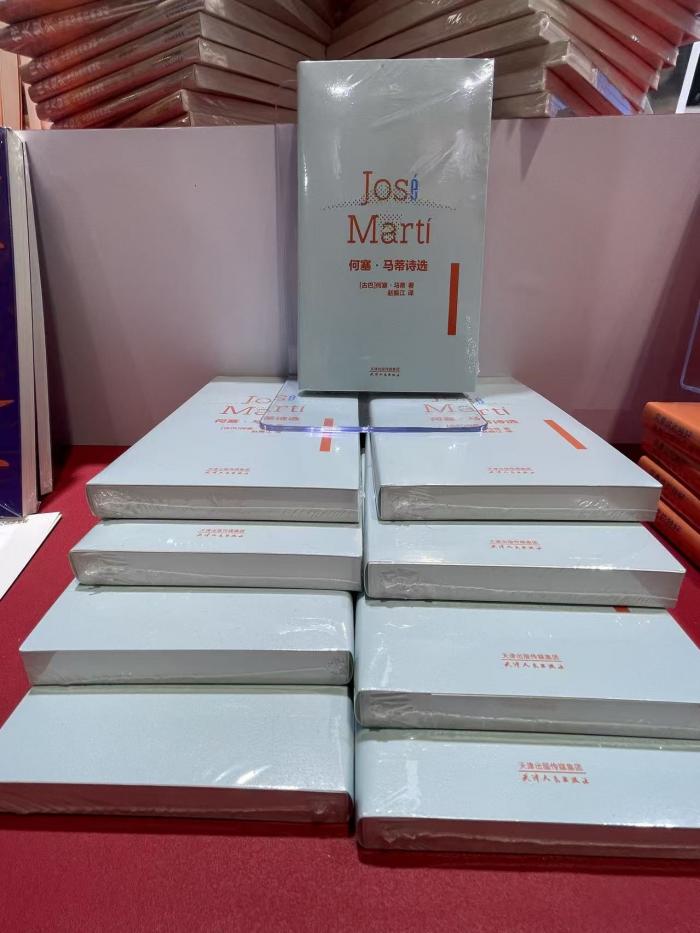
During the first day of the Beijing International Book Fair (BIBF), the annual most important event of the Chinese book industry, the Tianjin People’s Publishing House presented two new translations into Mandarin by the recognised Hispanist Zhao Zhenjiang: «Selection of Poems by José Martí» and «The Landscape Here is of a Unique Beauty», an exquisite gathering of Latin American bards with texts about China.
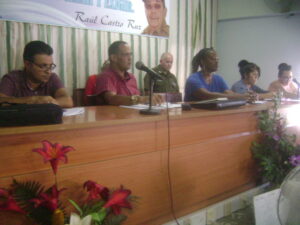
During the presentation of the new books at the thirty-eighth edition of BIBF, the numerous group of readers gathered at the China National Exhibition Centre confirmed the growing interest in Ibero-American literature, intercultural dialogue and the poetic work that fosters mutual understanding.
During his speech, Zhang Yunfeng, Vice General Manager of the Tianjin Publishing and Media Group, highlighted that «on the commemoration of the 130th anniversary of José Martí’s fall in combat, the publication of a selection of his poems is the sincere testimony of our profound recollection and respect for his brilliant ideas and immense literary legacy.»
«This selection of poems allows us to appreciate the literary world and monumental spirit of Cuba’s national hero, great poet and exceptional thinker,» affirmed Zhang.
«José Martí was not only a symbol of Cuban independence, but also a literary giant who expressed profound emotions and noble ideals through poetry,» he added.
José Martí (1853-1895) is considered one of the fundamental precursors and initiators of Spanish-American Modernism, a literary movement that renewed poetry and prose in the Spanish language at the end of the 19th century and beginning of the 20th.
Regarding the new publication of José Martí’s poetry in the Asian giant, Alpidio Alonso Grau, Minister of Culture of Cuba, sent a fraternal message from Havana.
«Martí, besides being our national hero is our principal poet, the greatest poet that our country has given, that our land has given, a land of poets because Cuba, despite being a small country, and of a relatively recent culture, nevertheless has a great literary tradition,» affirmed Alonso Grau, in a video projected during the presentation in Beijing.
«It is very important for us, for the Cuban people, to make Martí’s poetry known in the world,» asserted the culture minister of «the largest of the Antilles.»
In the new selection in the Chinese language of José Martí’s poetic work appear about a hundred poems from his books Ismaelillo (1882), Versos Sencillos (1891), Versos Libres (published posthumously in 1913), Flowers of Exile (published posthumously in 1933) and a section dedicated to his love verses.
During the panel, Zhang recalled that Master Zhao, professor in the Department of Spanish Language and Literature at Beijing University, recently decorated with the Order of National Culture of Cuba, has been for decades «the faithful boatman who has brought Chinese readers closer to those works and authors that originally did not belong to our waters.»
«I believe the publication of this poetry collection not only expresses our recollection and respect for José Martí, but also inspires contemporary Chinese poets,» emphasised Zhao.
For her part, the young Chinese translator Yuan Jing, Doctor in Spanish Language and Literature from Beijing University and editor of the World Literature journal at the Institute of Foreign Literature of the Chinese Academy of Social Sciences, stressed that living in an era of massive quantities of online information, and constantly overwhelmed by it, that information is not only content; but also a type of language that conceals the language we already have.
«This makes us easily lose our own language, and that means losing the style and rhythm that accompany it. But reading, especially classic works like Martí’s poetry, is like precious wood adrift in this sea of information, allowing us from time to time to peer out, grasp something and reinforce our humanity,» considers Yuan.
«Rather than trying to replace with tools like AI to increase our cultural content, poetry, with its more subtle and concise language, can serve us as the most powerful lifebuoy,» expressed the young Chinese translator.
Founded in 2009, the Tianjin Publishing and Media Group has stood out as one of the principal state publishing groups in China, with a strong focus on the production of high-quality books, national awards, export of copyrights and international promotion. Besides the distinguished People’s Publishing House, the Group features Baihua (Hundred Flowers) Literature and Art Publishing House; the Xinlei (new buds) Publishing House, specialising in children’s and young adult literature, and the publishing house dedicated to ancient classics, local history and historical documents, among others.
The Chinese publishing industry is one of the most dynamic and strategic sectors in the country. With an average of 190,000 to 200,000 new titles annually, China is the largest publishing market in the world in terms of publication volume, with a significant impact on the economy and culture. In the case of poetry, although it is a minority segment, it maintains a notable activity through sustained publication which is assisted by national funds and a greater number of young readers.
«I believe there is no better ambassador than culture, and within culture, there is no other manifestation that better expresses the soul of peoples than poetry,» assured Minister Alonso Grau. «Cuba has a great poetic tradition. Poetry is the mother genre of Cuban literature and, therefore, it gives us great satisfaction to know that Martí is published in the Chinese language.»
«We believe that literature is the language of the world, poetry is the bond of emotions and literature possesses the power to penetrate hearts and connect the world. The publication of these two poetry collections is not only a collection of words, but also a handshake,» agreed Zhang, Vice General Manager of the Tianjin Publishing and Media Group.
«It is a very noble and valuable labour that we thank. It is equally important to be able to continue making Chinese authors, Chinese poets known in Cuba… so that an exchange of knowledge of our literatures occurs,» concluded Alonso Grau, Minister of Culture of Cuba.
By Yasef Calderón