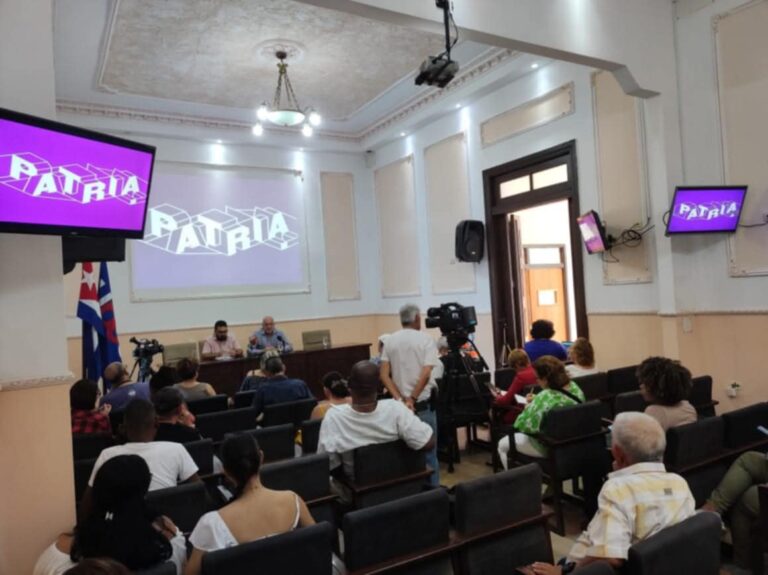
This was emphasised on Wednesday at a press conference by the president of the Union of Journalists of Cuba (UPEC), Ricardo Ronquillo Bello, when explaining the political decision to maintain the Colloquium, despite the tightening of the blockade and logistical difficulties.
The response to the call has shown that Cuba is not alone and that there is a significant international solidarity response, Ronquillo assessed, reporting that nearly 150 foreign participants have already been confirmed.
This demonstrates the global interest in an event that — he said — is essential for confronting the communications offensive against the Cuban Revolution.
The union leader explained that since 29 January, the country has had to readjust its entire functioning to the new survival conditions imposed by the tightening of US measures, but the political will to hold the «Patria» Colloquium was maintained in order to counter attempts to isolate and suffocate the nation.
He also stressed that the call, launched in record time, has already received a very significant response, including academics, communicators, journalists and leaders of communications teams, mainly from Russia, Mexico, Europe and the United States.
He highlighted that many of these participants already have their plane tickets, despite problems with flights to Cuba and other obstacles arising from the US government’s decisions, which — he insisted — demonstrates that the country has the backing of solidarity movements, governments and institutions from around the world.
Ronquillo Bello recalled that Patria has become an event of great international expectation, especially among communication specialists and relevant political actors, and that Cuba’s convening power reflects its moral authority to debate the dilemmas of the contemporary world.
One of the new features of this edition, according to the president of UPEC, is the emphasis on preparing the communication teams of all public institutions to face the communications offensive against the Revolution, for which workshops will be held parallel to the main event and within the gathering itself.
He announced that this year, special emphasis will be placed on the training of political activists, organisations and media, taking advantage of the presence of high-level international specialists.
He also stressed that the modernisation of the Cuban public press system — which includes editorial, economic and technological transformations — cannot be seen in isolation, but rather associated with Patria, because it is essential to articulate the national system with the most advanced communication criteria in the world.
As part of this articulation, he announced the holding of a virtual Patria, with daily video conferences so that journalists, editors and communicators from provinces and municipalities can also participate in the debates.
In addition to the central conferences and panels, seven parallel workshops open to media and institutions will operate, focused on social media management, digital analytics and communication strategies.
Subsequently, Daniel González, a member of the Colloquium’s organising committee, reported that many of the more than 100 international experts ready to travel to Havana have participated in previous editions and are part of Patria’s «founding essence».
The young specialist explained that the event will take place to coincide with the 65th anniversary of the proclamation of the socialist character of the Revolution, at the Line and 18 Station in Vedado, Havana, with a large avenue of stands for national media and around seven international projects.
He specified that artificial intelligence will be one of the central and novel themes of this edition, with workshops on how to build products for the internet with the help of AI, which is beneficial for small teams with fewer resources than their adversaries in the communications battle.
The programme will include daily panels — such as the inaugural «Cultural Hegemony and Digital Power» — and seven in-person and virtual training workshops, the latter to guarantee the interactive participation of professionals from all provinces given the complexities of travel.
Finally, González mentioned that, in parallel, in the same venue, cultural activities for children will be held during the school break week, including performances by La Colmenita, to link the event to the community and the Cuban context.
It is not an event only for theorists; it is for popular education in the field of communication, Ronquillo Bello pointed out, highlighting his organisers’ expectations of reaching all citizens, like a communications Bay of Pigs victory.