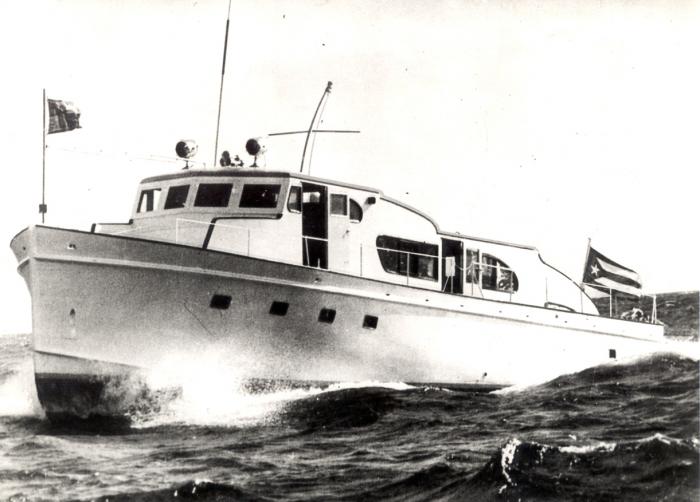
Only faith in victory proved capable of allowing 82 men to overcome the difficulties they encountered navigating in the yacht Granma from Mexico until its arrival at Las Coloradas, on the south-eastern Cuban coast on 2 December 1956.
That date acquired a special connotation, because the Rebel Army was thus born, the central nucleus of the later Revolutionary Armed Forces.
The expeditionaries departed from Tuxpan, Mexico, under a fine drizzle on 25 November 1956 with a voyage plan of five days, delayed by two due to bad weather.
A stormy sea, engine breakdowns, an overload of four times its capacity and a man falling overboard made the journey longer and prevented the aim of arriving on 30 November.
For this reason, one of the objectives set by the head of the 26th of July Revolutionary Movement, Fidel Castro Ruz, was frustrated: that of coinciding the landing with an armed uprising in Santiago de Cuba.
The Santiago rebellion had prepared a reception group at the Cabo Cruz lighthouse with trucks and 100 men to, subsequently, attack the garrisons of the Batista tyranny in the towns of Niquero and Manzanillo, then move into the mountains of the Sierra Maestra and carry out a guerrilla war.
Due to the late arrival, the supporting uprising was isolated and destroyed and the expeditionaries lost the element of surprise, while it gave the military the opportunity to deploy on maximum alert throughout the region.
The expeditionaries suffered the siege of the enemy Army and aviation and, with great difficulty and heavy losses, they moved into the Sierra Maestra.
After being surprised and dispersed by Batista’s troops, the young men regrouped and formed the nucleus of the Rebel Army that defeated the forces of the dictator Fulgencio Batista and triumphed on the first of January 1959.
With the landing of the Granma, Fidel Castro fulfilled his promise of being free or martyrs after spending months imprisoned on the then Isle of Pines as a result of the trial for the assaults on the Moncada barracks in Santiago de Cuba, and the Carlos Manuel de Céspedes barracks in Bayamo, on 26 July 1953.
The 82 men of the Granma were mostly very young, except for the expedition’s second-in-command, Juan Manuel Márquez, a little over 40 years old, whom the soldiers of the tyranny captured, tortured and murdered days after 2 December 1956.
The landing was also another feat, as it occurred at an unplanned and intricate point on the eastern Cuban coast, further complicated by a strong barrier of mangroves and a muddy bottom.
Carrying the weapons they could, exhausted and disoriented, because they did not know where they were and under fire from Batista’s aviation flying overhead, they reached the coast.
The peasant Ángel Pérez Rosabal confirmed to them that they were on national territory. Within a few days, a hard blow awaited them at the Alegría de Pío enclave, but the fate of the Cuban Revolution was cast, and its destiny was victory.
The survivors of so many vicissitudes advanced towards the heart of the Sierra Maestra and with the faith in victory that never abandoned them, they linked a chain of successes against a more numerous and well-armed Army until they definitively defeated it on the first of January 1959, and «if at the last minute, it had not been possible to come in the Granma, we would have come anyway,» said Fidel. (Mando Arreola, ACN)