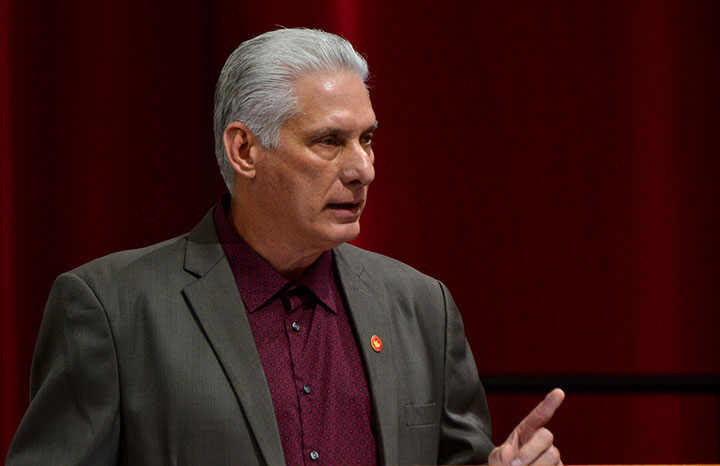
To imprint the example and teachings of the Commander in Chief Fidel Castro Ruz upon the challenges of the year 2026 was the call today, in this capital, from Miguel Díaz-Canel Bermúdez, First Secretary of the Central Committee of the Communist Party of Cuba and President of the Republic.
In the presence of Army General Raúl Castro Ruz, leader of the Cuban Revolution, at the closing of the Sixth Ordinary Session of the National Assembly of People’s Power (ANPP), in its Tenth Legislature, the leader called on those present to work tirelessly in this stage to contribute to defending the sovereign and prosperous country project that the people deserve.
At the proposal of the head of state, the Cuban Parliament proclaimed 2026 the Year of the Centenary of the Commander in Chief Fidel Castro Ruz, a charge which, according to Díaz-Canel, commits the political leadership of the country, the State, the Government and society as a whole to direct all efforts towards the recovery of the national economy and the correction of distortions identified in recent times.
The First Secretary of the PCC recalled that under that principle it was agreed to postpone the Ninth Congress of the Communist Party of Cuba, which, he assessed, does not constitute a setback, but an opportunity to devote all forces and energies to improving the current situation, so as to arrive at the party gathering in a more strengthened context.
To the members of the supreme organ of state power, whom he described as a true People’s Assembly, he conveyed the precise mandate and immense responsibility of continuing the path, aware that it will not be easy, but it is our own, chosen with sovereignty and dignity, and where the project of social justice and humanism of the Cuban Revolution beats.
While discussing the growing dangers of imperialist aggression threats from the United States administration against brotherly peoples, such as the Bolivarian Republic of Venezuela, Díaz-Canel pointed out that in that context it is «decisive that Parliament transmits a clear signal: The magnitude of the crisis is recognised, reality is not whitewashed and at the same time the political will to change what must be changed to defend social justice and national sovereignty is ratified.»
For this, he emphasised, transformations are essential; they are not only structural, but of mindset, to eliminate obstacles and schemes that do not function under siege circumstances, sure that the only limit to what can be done is that it does not contravene the principles of independence, socialism and national sovereignty.
He noted that in that direction the Government Programme must become the roadmap for all organisations, enriched in the political consultation process with the contributions and participation of all to correct distortions from the conviction that it is not used only as a slogan, but as a guide in the concrete battle, which demands economic rigour, but also social justice, warning of the impossibility of conceiving one thing detached from the other.
He assured that a country whose finances and commercial relations are persecuted daily is obliged to manage its foreign currency income with maximum efficiency, indispensable for confronting productive problems, investments in social programmes, medicines, public transport, among other non-deferrable spheres for society.
All analyses must put a face to those who do not comply, because, in his view, in their non-compliance lie millions of dollars that were in the Economic Plan and that were counted on to undertake necessary tasks; a review of accounts is essential, a self-critical analysis of what is failing, with concrete solutions for each case; while that is not done and it remains in the analysis of descriptive reports and diagnoses, we will not resolve anything nor will the current situation change.
«Let us hope that with the examples from our history of continuing the struggle when it seemed impossible and under the guidance and inspiration of Fidel, 2026 finds us fighting and more united than ever,» he concluded.
At the close of the plenary, the update of the legislative schedule with the proposal of laws and decree-laws to be presented next year and the ratification of the decree-laws and agreements approved by the Council of State were also approved.