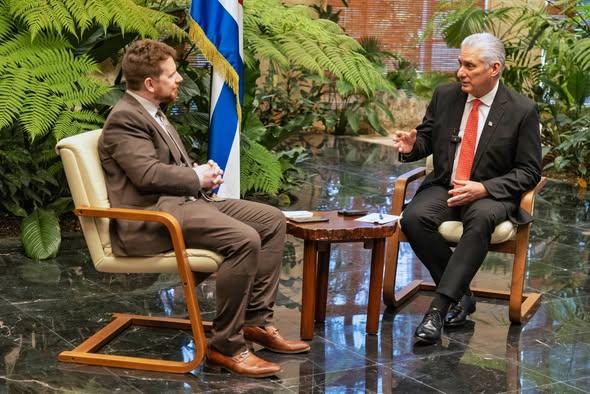
Interview with the First Secretary of the Party Central Committee and President of the Republic, Miguel Díaz-Canel Bermúdez, with Tom O’Connor, Senior Writer for Foreign Policy and Deputy Editor for National Security and Foreign Policy at Newsweek.
Newsweek: You have confirmed that the United States and Cuba are in talks and have proposed areas of cooperation such as science, migration and the fight against drug trafficking. President Trump appears to be seeking regime change. Do you believe an agreement is possible and that diplomacy could prevail?
Díaz-Canel: I believe dialogue is possible, and I believe we can reach some agreements, but it is difficult. Why can we say both these things?
We can have dialogue because, throughout all the years of the Revolution, Cuba has always had the will to maintain a civilised, neighbourly relationship with the United States, regardless of our ideological differences.
There are many common areas where we can work, and not only could we do so, but we could reach agreements beneficial to both our peoples and both nations.
Now, we have always maintained that it must be a respectful dialogue, on equal terms, with respect for our sovereignty, our political system, our self-determination and on the basis of reciprocity and observance of international law.
I also say dialogue is possible because, at different times with other US administrations, we have been able to talk and address issues of common interest. In some cases, we have been more successful than in others. But these two reasons explain why that possibility exists.
On the other hand, what factors make this dialogue difficult? Firstly, in the United States, in American society, there are sectors that strongly oppose any kind of dialogue with Cuba.
Furthermore, it is an asymmetric relationship between Cuba and the United States, where the superpower that is the United States has always played the role of aggressor, and the small island of Cuba has always been the nation and country under attack.
We have often held talks and reached agreements, and Cuba has always honoured its commitments. However, on several occasions, the United States government has not honoured its own.
But, on the other hand, for 67 years there has been, from the United States, a policy of hostility, aggression and threats, a policy of blockade, of intensified blockade, and now, even more tightened, with the cruel energy blockade.
It is evident that our country is suffering a multidimensional aggression from the United States, with a devastating effect on people’s lives.
On the other hand, there are the current actions of the US government: proposing supposed talks with other nations only to later attack them. All this undoubtedly breeds distrust among our people.
But I do believe we can engage in dialogue and negotiations and reach agreements. We can reach agreements on issues such as migration, security, environment, science and innovation, trade, education, culture and sports. We can also receive investment from US companies in Cuba and develop trade between both countries.
We can also implement mutually beneficial project programmes in various spheres of our economy. If dialogue is consolidated and agreements are reached in this area, I am sure they will be mutually beneficial agreements for both nations and both peoples.
This would allow us to take firm steps towards creating spaces for understanding that move us away from confrontation. Because what I believe is that the Cuban and American peoples deserve to be able to work in a climate of peace, friendship and cooperation, rather than be caught up in a war.
Newsweek: You mentioned that this US administration has a precedent of taking military action amid negotiations. We have seen it in the cases of Iran and Venezuela, and President Trump has said in some of his statements that Cuba could be next. If diplomacy fails or does not achieve the desired results, are you concerned about a possible US military operation against Cuba? Is there a strategy to defend against it?
Díaz-Canel: Cuba is not a country of war. It is a country of peace that promotes solidarity and cooperation. But Cuba is not afraid of war. We have a defence doctrine called «the war of the whole people», which is not an aggressive doctrine, but a defensive one, involving the participation of the entire people.
Cuba does not represent a threat to the United States, much less an «extraordinary and unusual» threat, as has been said to justify the executive order. And I do not state this simply in response to your question, but because Cuba has demonstrated it throughout its history in the context of the United States and the world.
Therefore, there is no pretext or excuse for the United States to resort to military aggression as a solution to our differences.
However, constantly, and especially in recent months and weeks, there has been a whole rhetoric from an official representative of the United States government announcing military aggression against Cuba, setting deadlines for how long the Cuban Revolution will last, and fixing dates for how long we will resist before they take control.
And there is a phrase that is very, very exemplary, extremely illustrative, of that ultra-conservative mindset. It is when they say: «We have exerted all possible pressure against Cuba» — thus acknowledging that there was a brutal blockade, which they now deny — and immediately afterwards add: «Therefore, the only option left for us is to take control and wipe it out.»
This is a totally belligerent and aggressive stance, far removed from what we proposed in our conversations with the United States. Therefore, we have a responsibility to prepare for the defence of the country.
This is not the first time in our history; for 67 years, the possibility of aggression, of a military threat, has always been present.
And that is why we prepare for defence — not to attack, but to defend — and so that this preparation for defence, this firmness, this willingness of the people to defend the Revolution, to defend our sovereignty and to defend our independence, also serves to avoid confrontation.
For us leaders, for those of us with leadership responsibilities within the Revolution, our commitment is to the people and to the Cuban Revolution, to its work, to the sovereignty and to the independence of the country.
Consequently, this implies the conviction that we are ready to give our lives for the Revolution: for its existence, for its sovereignty and for its independence. We are not concerned about our personal safety.
We will always strive to avoid war. We will always work for peace. But if military aggression occurs, we will respond, we will fight, we will defend ourselves, and if we fall in combat, to die for the homeland is to live.
What we must do, then, is prepare the country to avoid aggression and prepare it for military defence, because what concerns us is the fate of our people and the future of the Cuban nation.
Likewise, I can state with absolute certainty and honesty that a military action against Cuba, besides being an extremely embarrassing situation, would leave immense losses for both nations and their peoples. The loss of life and material damage would be incalculable. Such an act of aggression would be extremely costly in every sense, and it is not what our peoples deserve.
I repeat to you: our peoples deserve peace, the possibility of living in an environment of friendship, of cooperating, and of enjoying full freedom to forge a true neighbourly relationship.
I believe this is what is truly constructive, and that this is what truly offers an emancipatory vision regarding the possibility of resolving bilateral differences through dialogue.
Newsweek: Given the methods this administration has used against foreign countries, are you concerned about your own personal safety and freedom, or about efforts to find collaborators within the Cuban government at this time?
Díaz-Canel: As I said at the beginning, I am not concerned about my personal safety. The leadership of the Cuban State, Party and Revolution is collegiate. And decisions are made collectively.
We function on the basis of monolithic unity, ideological cohesion and revolutionary discipline. Furthermore, there is a close relationship with the people, as well as popular participation in decision-making on fundamental processes being carried out.
Therefore, the country’s security is also a collective construction in which there is a fundamental protagonist: the people, who act and watch over it. And when this happens, betrayal becomes extremely difficult. It becomes extremely difficult for anyone to successfully forge a parallel agreement that undermines our constitutional order or threatens the sovereignty and independence of the country. Consequently, I believe there is no room for it.
And above all, considering our people’s capacity to resist and fight, I do not believe comparisons with what has happened in other countries are appropriate. It would be to ignore the history of the Cuban Revolution and the history of our people, it would be to ignore the strength of our institutions, and it would be to ignore our own unity.
Newsweek: Sixty-seven years after the Revolution, many things have changed in Cuba, as we have already discussed, but the Communist Party remains in power. Given the country’s current situation, how do you assess the enduring success of this ideology and whether it remains the best guarantee for the future well-being of the Cuban people?
Díaz-Canel: That is a very interesting question, and it is very difficult to answer in a very short time.
I feel satisfaction and admiration for the role the Communist Party of Cuba has played for 67 years. And this does not mean we have been completely complacent, but rather that for 67 years, under permanent aggression, subjected to sanctions, coercive measures, a policy of maximum pressure, a blockade, an intensified blockade and now an energy blockade, that Party has been able to lead as the guiding force of our society and, together with the State, the Government and the people, has been able to direct the socialist construction process of our Revolution.
And from any perspective, the Cuban Revolution, under those conditions and under the leadership of that Party, has achieved extremely significant advances that cannot be denied if evaluated honestly, even by those who oppose the Revolution and its ideology.
A country in such conditions and under the leadership of that Party managed to fight a battle and eradicate illiteracy. Decades later, thanks to a Cuban pedagogical method called «Yo sí puedo» (Yes, I Can), four other Latin American countries managed to eradicate illiteracy. Today, that method is applied in numerous communities and regions of various countries of the Global South.
That Revolution has managed, under blockade conditions, which is extremely difficult, to implement and maintain a universal and free health system that reaches everyone, which has allowed the Cuban population to be treated, to eliminate diseases that existed before the Revolution, to improve all health indicators, and to place us on a par with the world’s major powers.
And not only that, but we have trained a large number of human resources in the field of healthcare that has allowed us to provide assistance on the basis of solidarity to other countries around the world.
Likewise, we have an educational system that guarantees free and inclusive education for all, from primary school to university, including postgraduate studies and doctorates.
We have managed to develop significant human resources; we have been able to promote science and innovation. Cuba’s advances in the biotechnology and pharmaceutical industries are well known. During COVID, we were one of the few countries that could manufacture their own effective vaccines.
Sport is a right for the entire population. Our sporting achievements, both Olympic and world, are well known. Despite its small size, Cuba is one of the countries with the best ratio of Olympic medals per inhabitant.
Culture is considered a heritage of humanity; it is part of our identity and cultural activity is accessible to all.
Productive infrastructure in all sectors of the economy has undergone a transformation. A digital transformation based on the use of artificial intelligence is being promoted. An energy transition towards renewable sources is being promoted.
More than 32 social programmes are being implemented to address situations of vulnerability in individuals, families and communities. People with disabilities receive specialised attention.
Social justice, equity and participation have been achieved. We have been able to offer solidarity. We have a system of international relations that allows us to maintain broad exchange with the international community.
For these reasons, and many others, a feeling of admiration for Cuba has been generated in many sectors of the world population, as well as recognition of the work of that Party, of the achievements of the Revolution and of the heroism of the Cuban people, who have been its main protagonist, because Party members and Party leadership are part of the Cuban people and the work of the Revolution has been recognised by that people.
Having said that, we feel no complacency regarding what has been achieved; in fact, the satisfaction I express about the Party’s work over these years, carried out in difficult conditions, is based not only on the achievements of the Revolution, but above all on having been able to keep the Revolution alive amidst these circumstances.
However, it is natural that we cannot feel completely satisfied, because we have not yet been able to achieve everything we dream of and imagine as a nation. We have things to conquer, perfect and advance in, areas where the blockade plays a fundamental role in what affects us and holds us back.
There is recognition that we cannot feel complacent about the current situation, marked by so many deprivations and difficulties in life. And therein lies the relationship between satisfaction and complacency.
On the one hand, I recognise that we managed to implement a universal, free and high-quality health system. However, despite now having these healthcare capacities and services, there are more than 90,000 Cubans on a waiting list for surgical operations, among whom there are more than 11,000 children.
And that hurts, because we have the capacity to do it, but the blockade prevents us from obtaining the supplies and having the necessary energy to carry out an operation of that magnitude.
Nor are we complacent about the mistakes made or the self-critical analyses carried out. And we are not complacent because revolutionaries always have a vocation for perfection, for moving forward, for consolidation and for improvement.
But I can summarise by saying: yes, I feel pride and satisfaction, because that Party has withstood the test of time, thanks to the achievements of the Cuban Revolution.
And I insist that this is a source of immense pride and deep respect for those heroic people who face adversity every day, and who not only face it but rise to the occasion.
Newsweek: In these adverse conditions, how long do you think Cuba can realistically hold on, and what is your message to your opponents, including many Cuban-Americans, who see this as an opportunity for regime change in your country?
Díaz-Canel: There is a lot of media manipulation and a lot of pressure. We face an ideological, cultural and media war. There is enormous media intoxication. Much hatred has been sown, especially on digital networks.
However, we continue fighting, dreaming and maintaining our commitment to the continuous improvement of our socialist construction process, always driven by the search for social justice and going through incessant moments of transformation rooted in the critical and self-critical analysis undertaken by our people and our institutions, and led by the Party.
And frequently, these transformations are not known in the United States, or they are denied, or not reported.
But, for example, at this moment we are carrying out transformations in the economic management system to achieve the right balance between centralisation and decentralisation, and the right balance between planning and market.
We are proposing a comprehensive restructuring of the administrative, business and institutional apparatus of the State. We propose greater autonomy for the state business system. We have approved measures allowing the creation of economic partnerships between the state and private sectors.
The participation and growth of the private sector in our economy have expanded significantly in recent years.
We are also reinforcing the autonomy of municipalities and the creation of local productive systems capable of driving their prosperity, based on the use of their capacities.
We have updated and relaxed regulations for direct foreign investment in Cuba. We are promoting closed foreign currency financing mechanisms. We have opened new avenues for the participation of Cubans residing abroad in our socio-economic development programme.
We are perfecting the relationships that should exist between the state and non-state sectors of the economy.
We are driving a deep energy transition towards renewable energies. We are increasing food production in the country to achieve food sovereignty, we are improving our banking and financial system, always with an eye on how to address vulnerabilities and how to reduce and mitigate existing social inequalities, without renouncing, moreover, solidarity assistance, collaboration and cooperation with other countries.
We are involved in all this; we dream of all this; and in all this, we strive to implement improvement measures. And we trust that we can achieve it.
What we need is to be left in peace. I always ask myself: if the United States believes the Cuban economy is so fragile and that we are so incapable, if they believe our model is so bad, why, for 67 years, has the United States persisted in spending millions of taxpayer dollars to blockade us, subvert us and attack us? If we are so incapable, why don’t they just let us fail on our own?
Or is it that they are so afraid of the example of what we could do and achieve if we were not under a blockade, taking as a starting point everything we have achieved even while under blockade?
That is the feeling in a country where more than 80% of the population was born after the Revolution. My generation was born under the blockade, our children were born under the blockade, our grandchildren have been born under the blockade, and we all continue to live under that blockade.
What would Cuba be like if it harnessed all its potential and how much could it contribute to the rest of the world if not for that blockade?
A brief anecdote, and forgive the length. Throughout the week, I have been participating in an exchange with Cuban scientists to address specific science and innovation issues, with the aim of solving our problems.
Recently, a group of scientists presented the results of a Cuban drug in development to combat Alzheimer’s. Part of the clinical trial was conducted with US patients from a clinic in Colorado. You can see the video, which is circulating on social media, and what the clinic’s director says about the results of his patients with that drug.
The results are superior to all traditional drugs. He recognises the potential of this innovation developed by Cuba, as well as the importance of advancing this work in a more cooperative and broader way, rather than doing so under the restrictions imposed by the blockade. In fact, he condemns the blockade.
That is the future we are betting on, the future we want, and the future I am sure we can achieve.