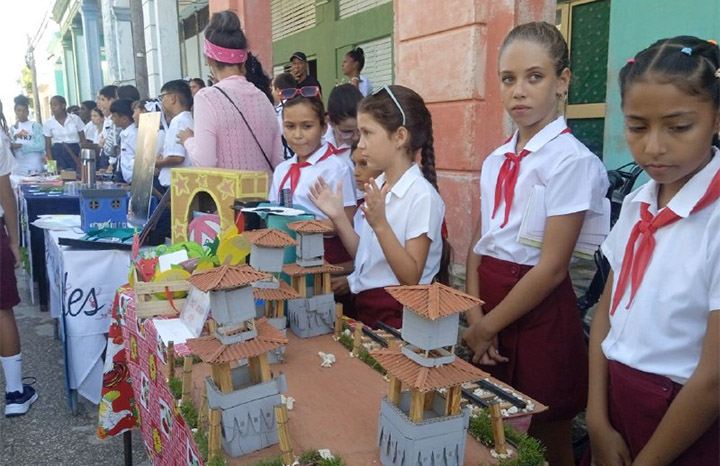
Students and teachers from educational institutions in the municipality of Morón, in the province of Ciego de Ávila, are creating teaching aids from recycled materials, an initiative that addresses shortages in classrooms and aligns with environmental policies.
This project responds to the principles of the Transition Strategy towards a Circular Economy and the Integrated Alliance Together for Less Plastic Waste.
Specialists from the Territorial Delegation of the Ministry of Science, Technology and Environment (DT-Citma) emphasised, in statements to the Cuban News Agency, the commitment of that sector to align with national policies that promote sustainable consumption and production, the circular economy and the progressive reduction of single-use plastics.
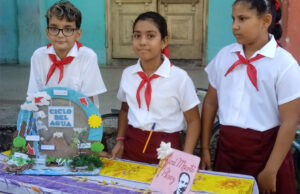
This experience is a concrete example of how creativity and commitment can transform an environmental problem (inadequate solid waste management) into an educational opportunity, expressed Tania Delgado Pestana, head of the Environmental Policy Instruments Department at the DT-Citma’s Environment Sub-Delegation.
By recovering containers, lids, paper, cardboard, metal fragments and other materials, students and teachers not only prevent these materials from being indiscriminately dumped into the environment, but also extend the useful life of resources by using them to create teaching aids.
Citma recognises this as a practice that aligns with actions contemplated in the Alliance, particularly those related to information and communication for efficient waste collection management, as well as the creation of pilot experiences for sorting waste at source.
By becoming active collection and recovery points for discarded resources, educational centres of various levels in Morón demonstrate that this sector can be a key player in implementing policies aimed at fostering the circular economy and reducing plastic pollution.
Pupils, teachers and families become involved in a process that transcends waste management, as pedagogical practice becomes a mechanism for environmental education, promoting principles such as reduction, reuse and recycling from the earliest ages.
The manufacture of teaching aids from recovered materials represents significant savings, as it reduces expenses associated with the acquisition of traditional goods, which are sometimes imported or of high cost on the national market, thereby allowing school budgets to be optimised and foreign currency to be freed up for other needs.
Furthermore, this initiative reduces the costs associated with the transport and final disposal of waste originating in communities.
The school environment, families and communities strengthen ties through a common cause: caring for the environment and improving educational conditions; meanwhile, students, by actively participating in the creation of their own didactic resources, develop practical skills, creativity and a strong sense of belonging.
By reducing the release of waste into the environment, soil, aquifer and ecosystem pollution is also mitigated.