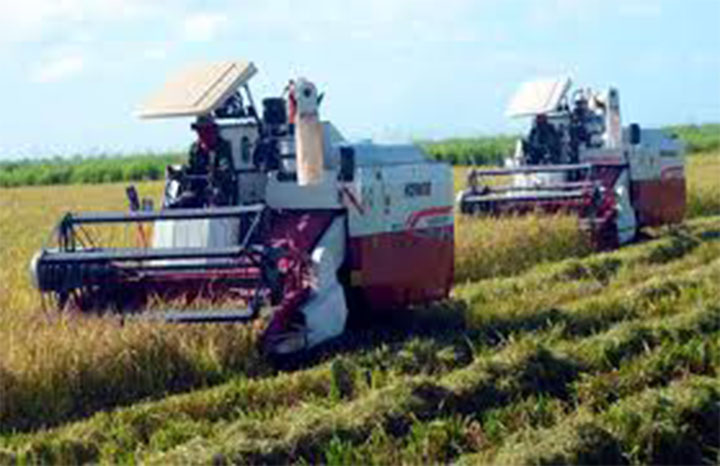
The Ministry of Agriculture (Minag) plans for this year 2026 the sowing of 200 thousand hectares of rice, of which 61 thousand 035 will be in the cold season campaign and 138 thousand 965 in the spring campaign, reported Israel Lugo Hernández, principal specialist of the Minag Agricultural Business Group.
The official specified on the Minag institutional website that in 2025, 122 thousand 990 hectares were sown, with a production of 111 thousand 528 tonnes destined for the Ministry of Domestic Trade, agricultural markets, tourism and other sectors.
Laudelina Lugo Pérez, specialist from the same group, noted that national needs are still not being met, although new strategies are being applied, and recalled that between 2012 and 2018, 304 thousand tonnes of rice for consumption were achieved, but since 2019 the blockade and the pandemic have limited access to inputs.
More than 23 thousand producers are participating in the rice programme, with priority given to specialised and popular sowing, to guarantee self-consumption and delivery to the industry linked to the basic food basket, indicated Lugo Hernández.
The specialist mentioned that Pinar del Río, Sancti Spíritus and Granma, together with 22 municipalities, achieved production levels that allow self-sufficiency, in compliance with the Law on Food Sovereignty and Food and Nutritional Security.
Among the limitations, he highlighted the scarcity of fuel, which affects soil preparation and irrigation systems. Some producers have purchased oil in foreign currency to sustain production.
Alternatives such as bioproducts and biopesticides are being applied, with more than 140 thousand hectares treated, mainly with biofertilisers, to make up for input deficits.
Since 2024, productive linkages have been developed with 10 MSMEs in Sancti Spíritus, Pinar del Río and Camagüey. In 2025, they sowed three thousand 020 hectares, with a production of nine thousand 304 tonnes of wet paddy rice and a yield of 3.08 tonnes per hectare.
Cooperative projects are also being executed with the Vietnamese Company V Mariel in Pinar del Río, Thai Binh in Granma and a Russian consortium in Sancti Spíritus. In Los Palacios, Pinar del Río, collaboration with Vietnam allowed yields of 5.4 tonnes per hectare.
Lugo highlighted that in these experiences, drones are used for sowing and crop care, and the acquisition of this equipment by producers with support from the company GeoCuba is being evaluated.
Cuba sustains a high annual consumption of rice, which is why the self-sufficiency strategy is a priority to guarantee food sovereignty.
The strengthening of the rice programme constitutes an essential axis to substitute imports and ensure the stability of the basic food basket.