
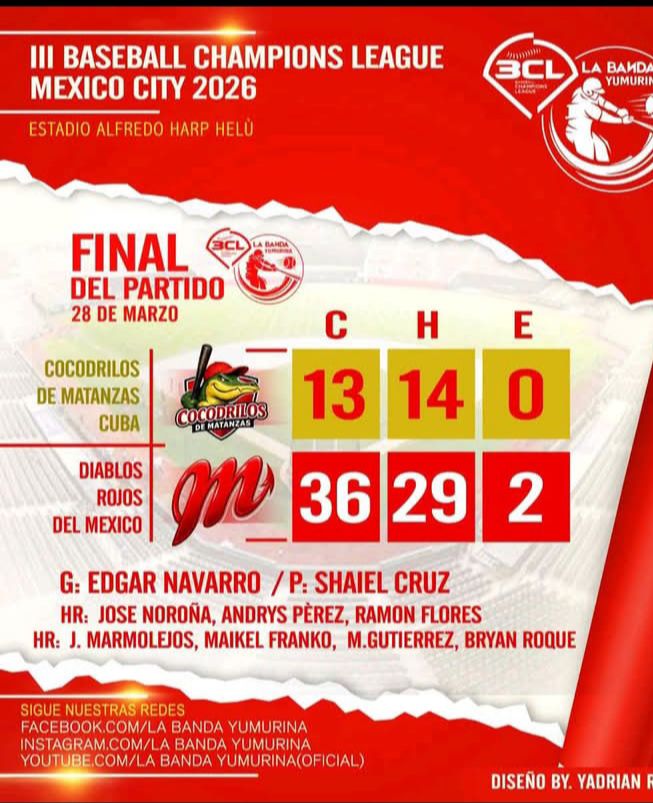
What happened this Saturday in the Champions League of Baseball in Mexico is not simply a defeat; it is an earthquake. The Diablos Rojos del México scoring 36 runs against the Cocodrilos de Matanzas is not just any scoreline: it is a statistic for the record books, but above all, a brutal symbol of the distance that today separates Cuban baseball from that played in other professional leagues.
It would seem that Cuban baseball has hit the ground, and not exactly to slide into a base. It has collided with a reality that many on the island sensed but few wanted to confront so harshly.
Matanzas is no minor team; they are the current champions of the Cuban National Series, the representatives of a tradition that for decades was synonymous with quality and pride. For such a team to concede 36 runs in a sport where a 10-run game is already considered a thrashing is an alarm signal that transcends the sporting realm.
What explains this historic drubbing?
Inevitably, this result is a reflection on the Cuban National Series and confirms the low current level and the changes the league needs.
Facing teams that play 90 or 120-game seasons with a daily professional rhythm, Cuban teams arrive at a disadvantage in terms of physical conditioning, roster depth and competitive quality.
A 36-run game exposes not just isolated failures, but a fundamental collapse: the pitching gave up 19 bases on balls and simply could not contain an offence accustomed to facing higher-calibre pitchers day in and day out. Suffice it to say that Cuban pitching allowed 69 runs in four games, an average of 17 runs per game.
The Champions League, this new continental league, is revealing that Latin American baseball no longer has a single centre of power. Mexico, with its Mexican Baseball League — Triple-A in essence but with Major League resources in some cases — and countries like Colombia, Panama or Nicaragua, have grown rapidly. Cuba, on the other hand, arrives with its hands tied by its economic context, and that has an impact on the sporting side.
When a scoreline like this occurs on an international stage, the blow is not just on the scoreboard, but on the prestige of a school that produced legends such as Omar Linares, Antonio Muñoz, Luis Giraldo Casanova, Braulio Viñet, Rogelio García and José Antonio Huelga, among others.
More than a humiliation, it is a wake-up call
Far from seeking to diminish Matanzas — who surely gave their best on the field — this result should invite structural reflection. Cuban baseball urgently needs to rethink its integration into the international professional circuit. It is not just about allowing the return of players who are abroad, but about modernising our league, making structural changes, and understanding that, if these are not made now, competitive isolation will eventually take its toll in results as scandalous as this one.
For Cuban fans, seeing a scoreboard with (36-13) hurts like few things do. Because that scoreline speaks not only of runs, but of the erosion of a hegemony that for years was a source of national pride. And for Mexican baseball, it is a confirmation that their teams are no longer just participants, but protagonists with more than enough power to give lessons in offensive might.
In short: what the Diablos Rojos did was not a simple victory. It is a demonstration of power in current Mexican baseball.
It remains to be seen whether Cuba will take it as an accident or as the start of a necessary change. Because if a (36-13) makes anything clear, it is that in today’s baseball, history matters, but the present is won with resources, preparation, openness, and changes to the very foundations of our ballgame.