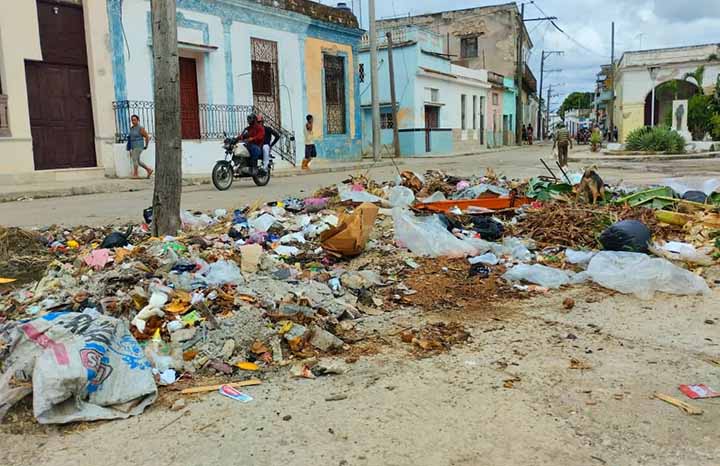
The accumulation of solid waste in the streets, avenues, empty lots and community spaces of Cuban cities has ceased to be an exclusively urban planning problem and has become a direct threat to public health.
When makeshift dumps become part of the everyday landscape, bad smells, pests and the smoke of burning rubbish cease to be occasional annoyances and reveal a deficiency that compromises the quality of life of thousands of people.
The situation is particularly worrying in densely populated communities, where the proximity between homes, schools, health institutions and commercial areas multiplies the possibilities of exposure; even in Havana, with its infrastructure and communal service limitations, it constitutes one of the most visible scenarios of this problem, though not the only one.
It is true that fuel shortages severely constrain mechanised collection and the transfer of waste to landfills. The halting or reduction of collection truck routes, together with difficulties in repairing equipment and securing other supplies, explains part of the magnitude of the problem.
However, recognising those limitations cannot mean accepting that rubbish remains for weeks next to homes or that its elimination by fire ends up becoming a tolerated or normalised alternative.
Precisely, during the first months of 2026, some less indulgent and triumphalist press outlets documented the accumulation of waste and the burning of rubbish in various Havana municipalities; likewise reporting the decision to enable points for so-called controlled incineration, justified by the capital’s authorities as a temporary emergency measure.
But it is worth asking: to what extent can a practice that shifts contamination from the ground into the air the neighbours breathe be considered a health solution?
The open-air burning of household waste is not harmless. In a mixture in which plastics, organic matter, rubber, textiles, chemical products and other materials may coexist, combustion releases fine particles and irritant gases, as well as potentially toxic compounds.
No one should play down the seriousness of the issue with phrases taken from the book «How to Talk a Lot and Say Nothing.» It is not enough for fire to visually reduce the volume of the waste: emissions can remain in the environment and reach homes, schools and workplaces.
From the clinical point of view — an assessment that deserves some airing on those television programmes designed to talk about «reality» — acute exposure to smoke can cause eye and respiratory tract irritation, coughing, a feeling of chest tightness, difficulty breathing and exacerbations of pre-existing diseases such as asthma and chronic obstructive pulmonary disease (COPD); with older people, children, pregnant women and those suffering from cardiovascular or respiratory conditions being especially vulnerable groups.
On that programme yet to be made, it should mean that the risk does not end when the flames go out, since repeated or prolonged exposure to fine particles and pollutants derived from combustion can contribute to the deterioration of lung function, aggravate chronic respiratory diseases and increase the risk of cardiovascular ailments and cancer, depending on the nature of the pollutants and the intensity and duration of exposure.
It is not a matter of claiming that every exposed person will necessarily develop a disease, but of warning that an avoidable damage factor is being incorporated into communities that already endure other environmental and health adversities.
To this scenario is added another danger: the proliferation of vectors. Organic waste attracts rodents, flies and cockroaches, while containers, tyres, packaging and other abandoned objects can accumulate water and become mosquito breeding sites.
In a country facing insect-borne diseases such as dengue and chikungunya, such conditions favour propagation and hinder prevention and control efforts.
Rodents, for their part, are not simple visitors to dumps. They can contaminate food and surfaces and contribute to the transmission of diseases such as leptospirosis, particularly when the urine of infected animals comes into contact with water or soil and with skin lesions or mucous membranes. Rain, blocked drains and the proximity of waste to homes aggravate these risks.
Nor are initiatives lacking that demonstrate that alternatives and capacities exist which deserve greater support. The El Batazo local development project, in the Los Sitios popular council of Centro Habana, has put into practice door-to-door collection, the sorting of waste in homes and the use of recyclable materials and organic waste.
Its experience, documented by IPS Cuba in June 2026, shows that community participation and differentiated management can help keep certain urban spaces clean.
Likewise, during 2026, experiences of private ventures dedicated to household waste collection came to light, among them Belmary, in Nueva Gerona, and services promoted in areas of Havana.
These initiatives, some with monthly fees for households, show a possibility of complementing public management, but they also raise questions about the population’s ability to pay and the State’s responsibility to guarantee an essential service.
Now then. Private participation should not become an automatic transfer of the cost of inefficiency onto families whose incomes hardly allow them to assume new obligations.
On the other hand, extraordinary clean-up operations, such as the so-called Operation Clean-Up, and announcements of government measures to tackle the accumulation of waste can offer immediate relief. However, removing large quantities of rubbish in concentrated days is not the same as solving the problem.
If, after each operation, the waste returns to occupy the same corners, what is missing is not an exceptional mobilisation, but a stable, measurable and sustainable system of collection, transport, sorting, recycling and final disposal.
The question the authorities must answer is not only how many cubic metres of waste are removed, but how many remain uncollected, how often each community is attended to, what resources are allocated to communal services and what concrete results the announced measures offer.
Those indicators would make it possible to evaluate responsibilities and correct deficiencies, instead of accustoming the population to living with insalubrity.
The fuel shortage is a reality, just as we need creative solutions to be generated and demanded: reorganisation of routes, prioritisation of vulnerable areas, alternative means of transport, recovery of equipment, separation of waste at source, recycling and participation of community and private projects under health and environmental regulations.
How is it achieved: proactive and dynamic coordination between local governments, Public Health, Education, community organisations and the entities responsible for environmental management; and not whole days of meetings where all that is qualified is apathy and the handy use of scapegoats blamed for all the misfortunes hanging over the people.
No alternative will be sufficient if it is limited to responding to the emergency without modifying the structural causes that reproduce it. Rubbish does not disappear because it is moved to another corner, buried without control or turned into smoke. It only changes place and, frequently, route of exposure.
The much-vaunted resilience, so often invoked in the face of the country’s economic and material difficulties, cannot be confused with resignation, nor used as an argument to normalise conditions that endanger life.
Let us accept once and for all that a community’s capacity to overcome a crisis does not mean it must renounce demanding indispensable services, nor that the will to survive implies accepting as inevitable what can be prevented.
Living in difficult circumstances should not force one to choose between enduring the stench of a dump or breathing the smoke of its burning. Nor can citizens be required to keep their communities clean while the responsible institutions do not guarantee regular and effective mechanisms for removing waste.
Those who consider that the topic serves only for the monthly, quarterly, half-yearly or annual report, I have bad news for them. That is not the way. Because cleaning our cities is not an ornamental matter nor a secondary demand in the face of other national urgencies. It is an elementary condition of health, dignity and coexistence, an obligation of government management whatever its scenario of action, a commitment ever since democracy was first spoken of in Rome.
A society that grows accustomed to seeing rubbish piled up outside its doors runs the risk of also growing accustomed to the damage that reality causes. And no crisis, however deep, should turn the right to breathe clean air and live in a healthy environment into a privilege.