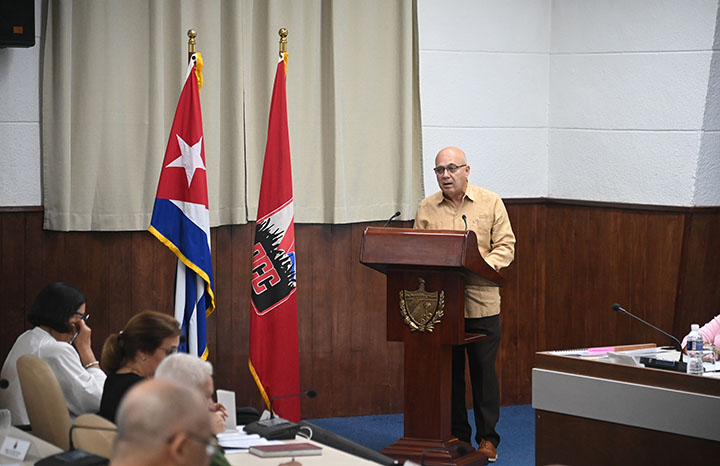
Despite being subjected to a fierce blockade, Cuba not only resists but also seeks alternatives, focused on preserving the Revolution and the main achievements of socialism. This was stated at the start of the Extraordinary Plenum of the Communist Party of Cuba Central Committee, held on Wednesday afternoon, by Roberto Morales Ojeda, Organisation Secretary of that body.
After recalling the 121st anniversary of the death of General Máximo Gómez, reaffirming commitment to him and the heroes and martyrs of the Homeland, and referring to other motivations such as Fidel’s centenary and the 73rd anniversary of the assaults on the Moncada and Carlos Manuel de Céspedes barracks, Morales Ojeda emphasised the Party’s reforming spirit and adherence to principles, its willingness to debate and make necessary changes.
He also returned to the ideas recently expressed to the press by the First Secretary of the Central Committee and President of the Republic, Miguel Díaz-Canel Bermúdez, who presided over this session, regarding the proposals for economic and social transformations: unity and broad discussion are essential, from which a better idea can always emerge.
CONSENSUS AND POPULAR PARTICIPATION
Divisional General José Amado Ricardo Guerra, member of the Politburo, conveyed a message from Raúl, who attended the session via videoconference. The Army General stated that he had been consulted and was in full agreement with the proposed transformations.
«I am convinced that from collective analysis and even from disagreements, the best ideas always emerge,» the message conveyed, and he called for opinions to enrich the content, build the necessary consensus at a transcendental moment, and undertake the transformations: «it is what best suits the Revolution today.»
The Leader warned that as important as or more important than the approval of the document will be its proper and timely implementation, with well-defined priorities and the conscious participation of the people. This demands acting with feet and ears on the ground, taking very much into account the opinions and concerns of the population.
TRANSFORMING OURSELVES WITH OUR OWN EFFORTS AND RESOURCES
A detailed explanation of the current moment was presented to the Central Committee members and guests, among whom was Rebel Army Commander José Ramón Machado Ventura, when Cuba is experiencing the most serious multidimensional crisis since the Special Period, due to the tightening of the blockade from 2019 onwards, aggravated by the Executive Orders of the current US administration.
This is the most aggressive sanctions escalation in recent history. It has prevented oil tankers from reaching Cuba, has threatened companies with business in Cuba, forcing their withdrawal, and has caused the country’s disconnection from international credit and financing systems.
As a result, the Island has experienced a sharp contraction of its economy in the first half of 2026, with a daily average of 20 hours of electricity disruption and a 1,955 MW deficit.
In this regard, Politburo member and Prime Minister Manuel Marrero Cruz explained that, faced with the harsh reality of the current historical moment, profound transformations must be carried out with our own efforts and resources. It is a matter not only of resisting, but also of advancing and developing, he said.
Regarding the proposals, which will be presented tomorrow, Thursday, to the deputies of the National Assembly, and made known to the entire population, he illustrated that they have been nourished by the instructions of Army General Raúl Castro Ruz and First Secretary Díaz-Canel, analysis of programme documents and consultation with experts. There are 176 proposals, divided into 23 fundamental axes of the country’s economic and social life.
These axes correspond to transformations concerning the management model of economic actors; property relations; the economic planning system; the budgeted sector and its downsizing; municipal autonomy; agricultural recovery; moving from product subsidies to subsidies for people; labour and wage issues; and energy and social matters.
They are also related to the modernisation of the banking and financial system; the tax system; price policy; foreign investment; foreign trade; the scope of the partial dollarisation of the economy; the tourism sector; transport; commerce, gastronomy and services; insurance policy; digital transformation, artificial intelligence and the knowledge economy; the national statistical system; and control and inspection mechanisms.
It transpired that the legal framework for these proposals will be essential; it was explained that they do not contradict the Constitution of the Republic, but require the repeal and modification of regulations, and the creation of others.
These measures, Marrero noted, conceive profound changes in line with the 2026 Government Economic and Social Programme: both documents are complementary. They also imply the transformation of the business fabric, greater openness to private capital and the recognition of market mechanisms as instruments for efficient resource allocation.
It was also stated that this does not imply renouncing the State’s social responsibility. As stated in the document under discussion, «They do not constitute a deviation from the socialist project; on the contrary, they respond to its own logic of development. Cuba is in the historical period of building socialism.» Likewise, the ideas of Fidel and Raúl were insisted upon as the source for this process.