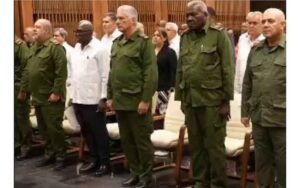
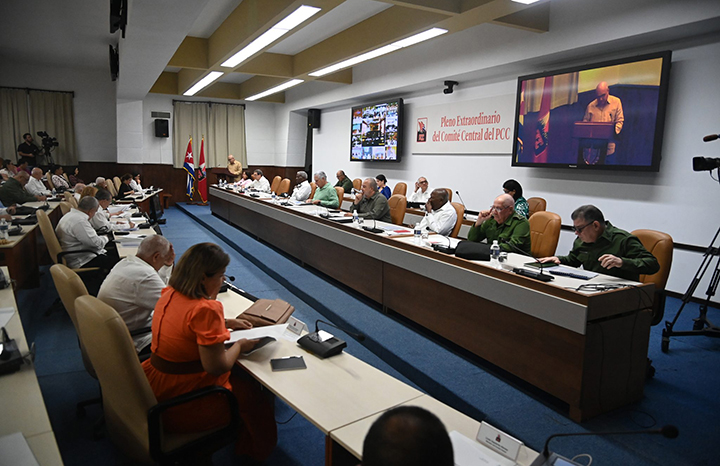
According to the Communist Party of Cuba’s website, the objective of the Extraordinary Plenum, which has been meeting since Wednesday, is to evaluate proposals for economic and social transformations, as set out by the First Secretary of the Party Central Committee and President of the Republic, Miguel Díaz-Canel, in recent statements to the national press.
These involve more than twenty measures aimed at updating the economic model, boosting production and strengthening state and territorial management amid the challenges facing the Cuban economy.
Among the main proposals is the elimination of the obligation to carry out import and export operations through state-owned enterprises, which would allow more direct participation by economic actors.
Likewise, tariff incentives are planned for the import of raw materials intended for national production, along with a reorganisation of logistics chains to favour exports and foreign currency earnings.
The plan also contemplates greater autonomy for state enterprises, which could define their own wage systems and expand their commercial powers. In terms of decentralisation, the initiatives would grant municipalities greater powers to manage foreign currency, authorise businesses and participate directly in foreign trade activities.
An institutional reform is also being promoted that would reduce the number of ministries from 27 to 21.
The proposals include the expansion of micro, small and medium-sized enterprises (MSMEs), the relaxation of activities permitted for self-employment, and the opening of mechanisms to facilitate investment by Cubans residing abroad.
In the agricultural sector, new regulations are envisaged to expedite the granting of productive land and significantly reduce idle agricultural areas.
On the social front, the programme proposes moving from universal subsidies for products towards a system focused on vulnerable individuals and families, to optimise the use of public resources and strengthen social protection policies.
The transformations also cover the energy sector, where plans include promoting electric mobility, incorporating new actors into energy generation, and accelerating investments in photovoltaic projects.
Díaz-Canel recently stated that the reforms already have political consensus and are in their final phase of conceptual adjustments.
After evaluation by the PCC Central Committee, the proposals must be submitted to the National Assembly of People’s Power for final approval.
The extraordinary plenum takes place at a key moment for the Cuban economy, marked by production constraints and resource scarcity due to the impact of the blockade policy applied by the United States Government against the Island for more than six decades.