In the history of the Omar Valdés Award — the highest distinction that the UNEAC Association of Performing Artists has awarded to Cuban performing arts since 1994 — there is a silent logic: recognition rarely arrives before time makes it indisputable.
The award bears the name of one of the island’s greatest theatre, film and television actors, and is presented to figures for their notable contributions to this artistic manifestation.
This year, on 23 April 2026, in a ceremony where the National Folkloric Ensemble provided the music to the solemn silence of the hall, UNEAC presented the distinction to eight Cuban cultural personalities, among them a man from Morón who has spent four decades turning clay, streets and Cuba’s forgotten communities into a stage.
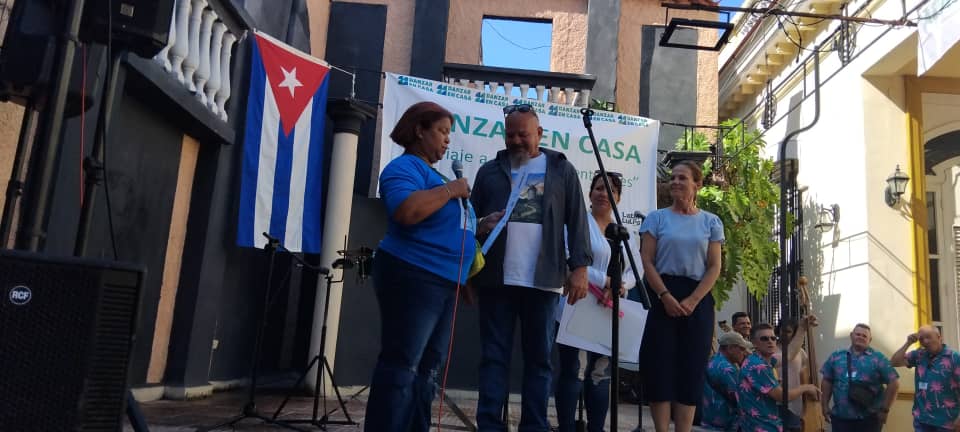
His name is Orlando Concepción González. And his is one of those cases where the award does not discover an artist: it confirms him. In this edition of the 4th International «Danzar en casa» Day, this award was presented to him by Marilyn Galbey.
Concepción was born in Morón, Ciego de Ávila, in 1966. A graduate as an Art Instructor, he receives the award after four decades of uninterrupted work at the head of his theatre company, which is precisely celebrating its 40th anniversary of foundation.
The simultaneity is not coincidental: the Omar Valdés 2026 Award arrives in the same year that D’Morón Teatro celebrates four decades, as if the cultural institution had waited for the exact moment when the round number made any omission impossible.
The company was founded on 28 May 1986 under the direction of Orlando Concepción, with the purpose of revitalising theatrical tradition in the Avilanian region.
That founding purpose — to revitalise, not simply to do — says much about what the project has been from the beginning: not a group that fills calendars, but a deliberate commitment to the cultural fabric of a province that the national map tends to point out more for its lagoon and its bronze rooster than for its stage creators.
Invasor newspaper, a historic voice of Avilanian culture, has spent years documenting that commitment with a consistency that speaks as much of the project as of the medium.
In 2020, the newspaper itself described what Concepción had built in these terms: «The Orlando Concepción of 2020, who already has three decades of artistic life and several awards, who ‘makes stones speak’ according to his actors, no longer finds the shoes of that twenty-something recent graduate he once was, tender with the dream of founding a theatre group, too small.»
The phrase, taken from an extensive profile published by the same newspaper, condenses with journalistic precision what is difficult to describe with specialised criticism: the rarity of someone who grows at the same pace as their work, without either falling behind.
That Invasor article is also a document of what provincial theatre can mean when its director understands that the stage does not end at the curtain.
The trajectory of D’Morón Teatro has a backbone that goes from the stage to the clay, and from the clay to the community. In 2009, the company premiered «Clay Medea» in Morón’s Agramonte Park, an adaptation of Euripides’ tragedy by Concepción, with designs by Luis Ricardo Faura, Liuba Rojas Alpízar and the Ríos Fariñas brothers.
The work was presented in several provinces of the country and at festivals in Havana, Camagüey and the Matanzas Street Theatre Day.
For its novelty, originality and social impact, it deserved the 2010 Rubén Vigón National Design Award in the street spectacle category.
The choice of the most violent and most matriarchal Greek tragedy as a vehicle for Cuban street theatre was not an avant-garde whim: it was a demonstration that Concepción understands dramaturgy as he himself has defined it, in his own words recorded by Invasor: «the science that studies the characteristics of drama» and «the basis of any scenic process», without which any staging has sand for a floor. «Medea» would go on to be performed 112 times on the Island.
For a provincial company, in a country with the logistical problems that Cuba is going through, that figure is something more than a number: it is an image of resistance.
But if there is one project that definitively separates Concepción from directors who make good theatre and stop there, that project is «Grown by Culture».
This initiative, born from the community’s core, took art to the most vulnerable areas of the province. The actors of D’Morón Teatro settled in rural communities, shared bread and words, and offered performances that spoke of identity and dreams.
The project has been presented on an ongoing basis at the Reguero Community Cultural Complex — its permanent base in Morón — and in the towns of Miraflores Nuevo, Ciudad de la Juventud and Las 20, among other Avilanian territories.
Concepción takes the project to remote communities in Primero de Enero, a municipality that elected him as a candidate for deputy to the National Assembly, where they performed mainly at night, feeding off people’s daily lives.
What «Grown by Culture» proposes is a radical subversion of the usual logic between art and institution: instead of waiting for the public to come to the theatre, the theatre goes where the people who have never set foot in a venue live. And it does so without condescension, without the paternalism that often stalks community art projects when the artist feels like a missionary. In Morón, theatre arrives as a neighbour.
Concepción’s career is distinguished by a consistency that has earned him recognition as a National Vanguard for ten consecutive years, a rarity in the Cuban artistic landscape.
His social commitment earned him appointment as president of the UNEAC Provincial Commission for Community Work, and his work was recognised with the National Community Culture Award and the Raúl Gómez García Medal.
The Omar Valdés 2026 Award thus falls not as a surprise, but as the visible culmination of work that the official Cuban media — from Granma to Radio Rebelde, from the Cuban News Agency to Invasor newspaper — have been documenting for decades with unusual coherence.
The ceremony on 23 April, according to Granma, was attended by Yuris Nórido, vice-president of UNEAC; visual artist Lesbia Vent Dumois, National Visual Arts Prize winner; director Lizt Alfonso; and National Dance Prize winner Santiago Alfonso.
That the theatre of a city in central Cuba — where the bronze rooster guards a lagoon and culture is made with whatever is available — has found its place in that hall alongside the highest names on the Cuban national scene is not only Orlando Concepción’s merit.
It is also proof that provincial theatre, when it has enough honesty and tenacity not to imitate anyone, can end up being the most necessary of all.