It is common for her to be cited, on most internet sites, only as Amelia Peláez; but a small oversight is committed by omitting her full name. For Amelia Peláez del Casal had links to the modernist poet Julián del Casal, a profoundly Cuban writer, and who was her uncle.
But also her mother, Carmela del Casal y de la Lastra, was a cultured woman, a lover of music, painting and literature. Possibly, such ancestry constituted the first nationalist influence in the life of this distinguished figure of Cuban visual arts, born on a day like today in 1896, in the municipality of Yaguajay, in the present province of Sancti Spíritus.
Regarding her work, diverse readings exist. Some maintain that Amelia did not paint autochthonous elements of the Island to settle on the reconstruction of an idea of nationality, as perhaps she only sought to develop her multifaceted visual language –a product of contact with the Parisian avant-gardes– based on her personal ideals.
Whatever her reason –inscribed in pictorial movements or perhaps more intimist–, the important thing is that she bequeathed us a novel vision of the Cuban, as Loló de la Torriente wrote in Bohemia: «Amelia fanned away the shadows to bring forth, clear and vibrant, the poetic image of an island that oscillates between passion and melancholy.»
It has been mentioned that she was very introverted, with a hard character, with few friends and, as art critic Jorge Rigol noted, who lived immersed, literally, in the world of forms that populated her painting.
But in that indulgence in her inner and intimate space, the artist discovered numerous expressive possibilities that she materialised in Cuban fruits, still lifes, stained-glass windows and lunettes –which contributed significantly to her way of structuring composition–, with exquisite finesse of colours that filtered a mysterious touch into her canvases.
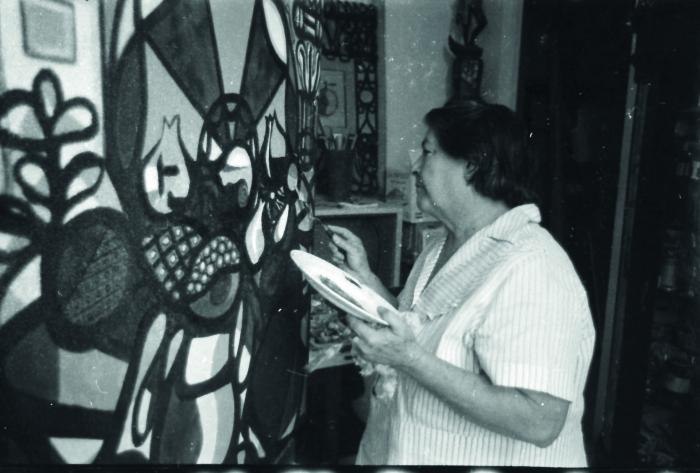
Villa Carmela, named thus in honour of her mother, was her residence on Luis Estévez Street, in Santo Suárez (Havana). There she had her studio, full of decorative objects, flowers and grilles that guarded her home space. Those who visited her said she greatly enjoyed spending afternoons in her patio: a botanical world, with begonias, carnations, ferns and plumerias.
Such an environment was the one recorded by a Granma team, from whose visit a batch of images of her and her relatives is treasured. On that occasion, she was glimpsed in the full exercise of painting, to which she always dedicated herself with a loving discipline.
It is meritorious to mention that in her trajectory –an indelible mark of a marked creoleness– she united, in the same artistic will, canvas, muralism and ceramics. To this latter vocation she dedicated herself in the 1950s, with the creation of vases, plates and fountains.
She remained painting actively until her passing on the 8th of April 1968. Behind her, she left the wake of her aesthetic ideology, which was an extraordinary contribution to the cultural heritage of the nation and –why not– of all America.
Finding her traces, 130 years from her birth and 58 from her death, will not be difficult. It suffices to visit the third floor of the National Museum of Fine Arts in Havana, where her classic still lifes and her still lifes shine. Or easier still, to raise one’s gaze right opposite the Habana Libre hotel. There is Frutas Cubanas, the enormous mural that perhaps was her masterpiece, a monumental testimony to her genius.