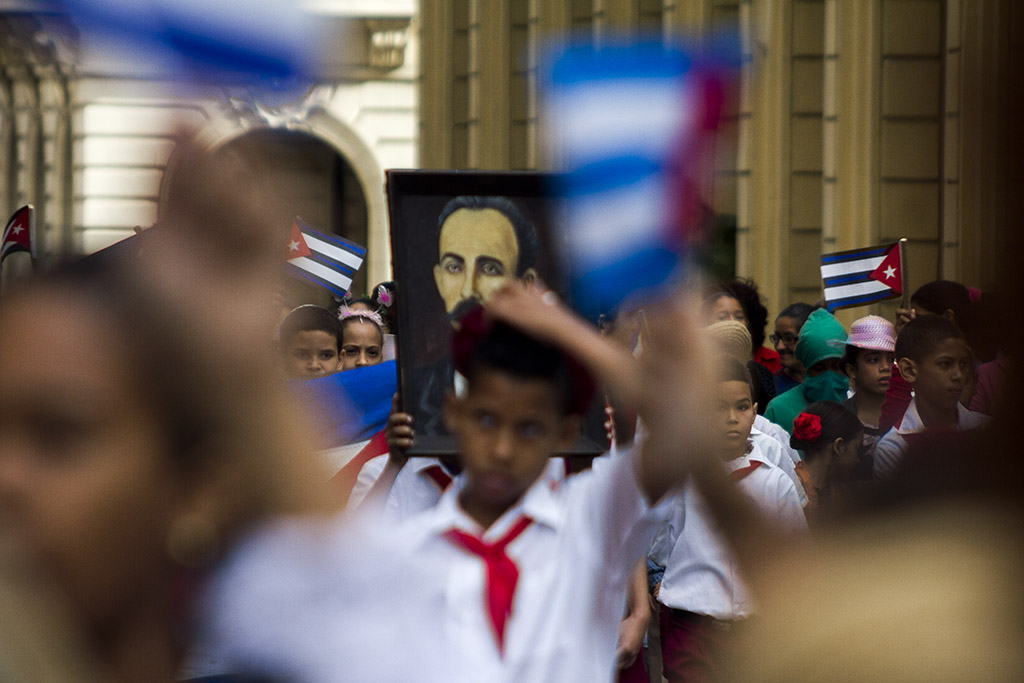
Contemporary young people increasingly need their ethical, political and ideological conceptions to be reinforced with paradigms that can guide their conduct in their struggle for a better world. The comprehensive education of youth is not possible without an ideal to serve as a guide for action from a socialising perspective, and this model we find in José Martí, the pinnacle of ethical and political thought in 19th century Cuba, bearer of a humanist and comprehensive ideal of Society.
The Master was a living example of the unity of thought and action, characterised essentially by the rejection of individualism. In the very process of political and intellectual maturity, he came to assume the entire human species as the Homeland, from the root concept of decorum and dignity, «Homeland is Humanity.» His intellectual gifts, his command of the Cuban problem, his ethics and his example of constant sacrifice led him to become a mass leader, a politician born of unity and trust. When we delve into the vast Martian work, we reaffirm that he was a man of his time, who understood the historical reality he lived in, an era of domination by colonial empires, the lack of national sovereignty of the peoples of America, Asia and Africa, the enslavement of men. He feels and practices that to serve is to act, that this service must be done with intelligence and love.
Martí’s life was like a loving embrace full of unconditional dedication, as the perfect expression of a life of full existence, and this can only be conceived as the support and pious search for great collective aspirations. José Martí took into account how feelings are expressed in educational work. From his writings, it can be inferred how instruction enhances the development of thought, while education participates in the formation of feelings and values; feelings such as love, patriotism, optimism are fixed in the consciousness of men not only in a rational form, but also emotionally, for this reason it is related to the conception of the world and its perception.
The Martiano legacy germinated in the men of the first decade of the 20th century in Cuba, who were first Martians and revolutionaries before being Marxists; it was the generation of Mella, Guiteras, symbolically connected to Martí by Baliño, who sought references and found in the Martiano ideology the reality of their endeavours for justice in their struggles; this youth brought about an awakening of anti-imperialist consciousness and the struggle for Cuba’s true independence, making the Martiano ideology a reality.
During the second half of the 20th century, with the existence of a Republic full of national disgrace and political, economic and cultural subordination to the United States, it awakened feelings of nationality and identity in a group of young people who responded to a Martiano impulse and decided to change the prevailing state of injustice. The Centenary Generation resurrected Martí after one hundred years; the challenge was set for Cuban youth. This struggle was led by Fidel Castro, a faithful follower of José Martí’s thought, defending the Master’s dream of creating an independent, democratic Republic with all and for the good of all.
The formation of young Cubans must be underpinned by a solid political, ideological, aesthetic, cultural, scientific education and a morality corresponding to our Socialist Revolution, where humanism, respect, human dignity, and the good of others are present. Swimming in the ideas of the Apostle allows us to develop a creative, profound and reflective thought. Likewise, the legacy of José Martí is for Cubans a necessity to try to interpret the realities of the world and our own; it is to assume a liberating thought, his ideology of greatness and freedom inspires norms of conduct for peoples and for men, man seen in the creative conjunction within him of the clearest human values. He conceived freedom as the realisation of man’s external and internal possibilities, his integral and sacred use as such, his first and last idea for which he fought and died, is man; to educate man for the exercise of full spiritual dignity.
The thought of Martí is an essential component of the ideology of the Cuban Revolution; it can be seen from any ethical, political, ideological, pedagogical, aesthetic field, essentially human; that his ideas marked the path for honest fighters of different generations in the struggle for national liberation and the Social Revolution. Therefore, it is a necessity to study, research and promote the life and work of the most universal of all Cubans, putting it into practice from the study of History in the first levels of Education to form men of good, who will be the continuators of this revolutionary work, sustained by Martiano, Marxist and Fidelista principles for the preservation and updating of our Socialist Social Economic Model.