- Puzzle, is an impressionist poem that explores the fragmentation of identity through grief, memory and absence.
It does not need to be brilliant to captivate its audience. It does not have to be published in a book, anthology or magazine to be memorable. It is enough that it comes from the hands and soul of a woman who knows how to astonish and achieves it through her literature, with all the innocence and all the talent.
Puzzle emerges as an emotional kaleidoscope in which fragmentation is not only a stylistic resource, but the axis of the lyrical discourse. From its first line—»Lately I am composed of scraps»—the author deploys a voice that recognises itself as an incomplete entity, composed of the affective rubble of what has been loved, lost or entrusted. The repetition of «Lately» acts as a rhythmic pulse marking the progressive deterioration of an identity that no longer sustains itself in its integrity, but in the accumulation of absences. This reiterative structure, far from falling into monotony, functions as an interior echo that resonates with increasing intensity, mimicking the way memory insists on returning to unhealed wounds.
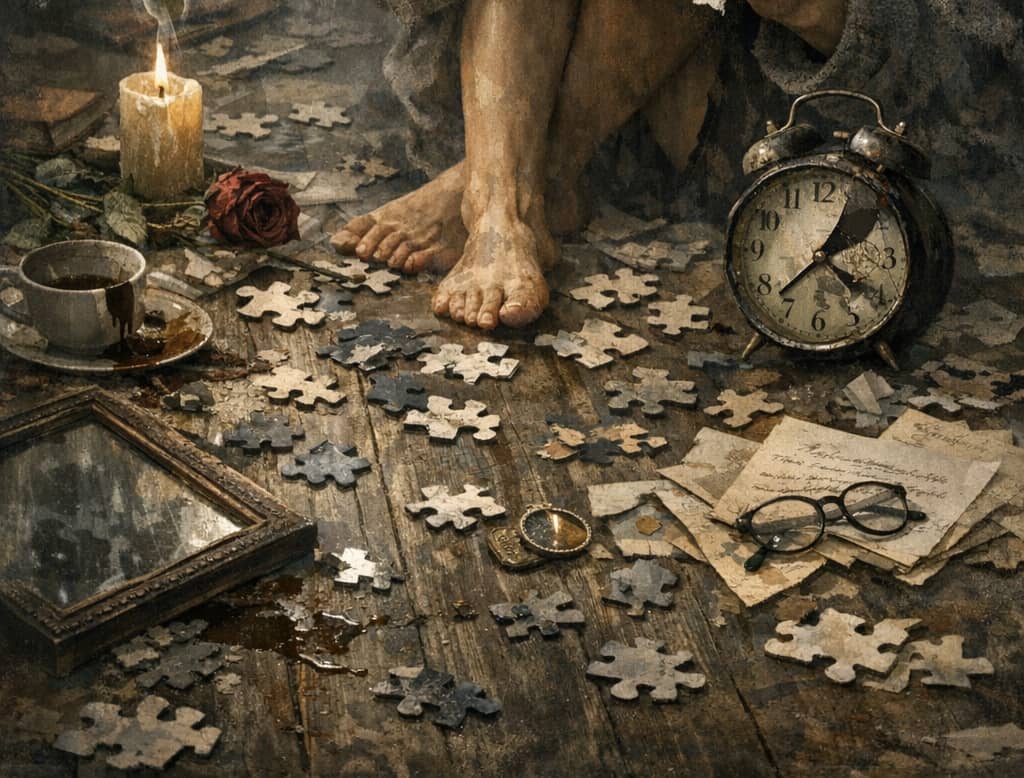
The form of the poem, free and fluid, stands as a direct reflection of its content: there is no fixed metre nor obligatory rhyme, because the soul that speaks does not obey rules, but the urgency to name the unnameable. Each line resembles a loose piece of that puzzle, with irregular edges and unpredictable shapes. And it is precisely in that irregularity where its beauty lies: the author does not seek to order the chaos, but to give it voice. The use of sensory images—»dead mothers between the fractures of a muscle that does not oxygenate,» «darned toys,» «tear ducts of other children»—evokes an almost pictorial sensibility, as if each metaphor were a stroke of colour on an expressionist canvas where pain is painted in muted tones yet vibrant with meaning.
One of the greatest poetic achievements of Puzzle resides in its capacity to transform the everyday into transcendent symbol. The objects mentioned—photos on worn walls, used shoes, earrings—cease to be mere utensils to become relics of a shared existence. These details, seemingly trivial, acquire immense symbolic weight: they are the tangible vestiges of broken bonds, the only witnesses of a story that no longer has a narrator. The author employs the object conjoined with memory as a mnemonic strategy of grief, showing how the body stores what time tries to erase. In this sense, the poem becomes an act of resistance against forgetting.
Furthermore, the dichotomy between composition and decomposition runs through the entire text like a dual heartbeat. «I decompose with more haste than I manage to compose myself,» confesses the lyrical voice, revealing an acute awareness of its own fragility. This contrast not only underlines the tension between construction and destruction, but also suggests a distorted temporality: time no longer advances linearly, but folds back upon itself, disassembled «from its main axis.» Here, the author plays with the notion of chronos and kairos, showing how trauma suspends the experience of historical time and substitutes it with an eternity of broken moments.
The language of Brizaída de la Nuez Hernández possesses an intimate, almost whispered musicality, which contrasts with the rawness of its images. There are no shouts, but a restraint that multiplies the emotional impact. The brief enunciations, the implicit silences between lines, and the absence of logical connectors reinforce the sensation of disconnection that the poem denounces. Yet, amidst so much fracture, a thread of hope persists: «the hope that someday, all the pieces will fit together again.» This ending is not naïve, but profoundly human; it does not promise restoration, but possibility. And in that possibility resides the poem’s true strength: not to resign oneself to disorder, but to keep searching for forms, even if they are never the same.
Thus, I am among those who believe that Puzzle has the capacity to condense the complexity of collective and individual grief into a voice that, even broken, keeps speaking. Brizaída de la Nuez Hernández not only masters poetic resources—anaphora, metaphor, synaesthesia, ellipsis—but puts them at the service of an intimate and universal exploration of loss, memory and identity. The poem does not merely describe a state of mind; it embodies it, makes it palpable, turns it into shared experience. And puzzle is not just a title, but an invitation: to look at our own loose pieces and recognise in them the beauty of the imperfect, the unfinished, the profoundly human.